Home
Class 12
CHEMISTRY
(S)-sec Buty1 chloride is subjected to f...

`(S)`-sec Buty`1` chloride is subjected to free-radical chlorination followed by fractional distillation to isolate the various isomeric products. How many frecations are isolated?

A

Four

B

Five

C

Six

D

Three

Text Solution

Verified by Experts

The correct Answer is:
B

In analyzing the sterochemistry of such reactions follow the guidelines:
(1) Unless a bond to an original chiral center is broken, the configuration is retained center and (2) if a new, chiral center is generated, both possible configuration about the new center results.
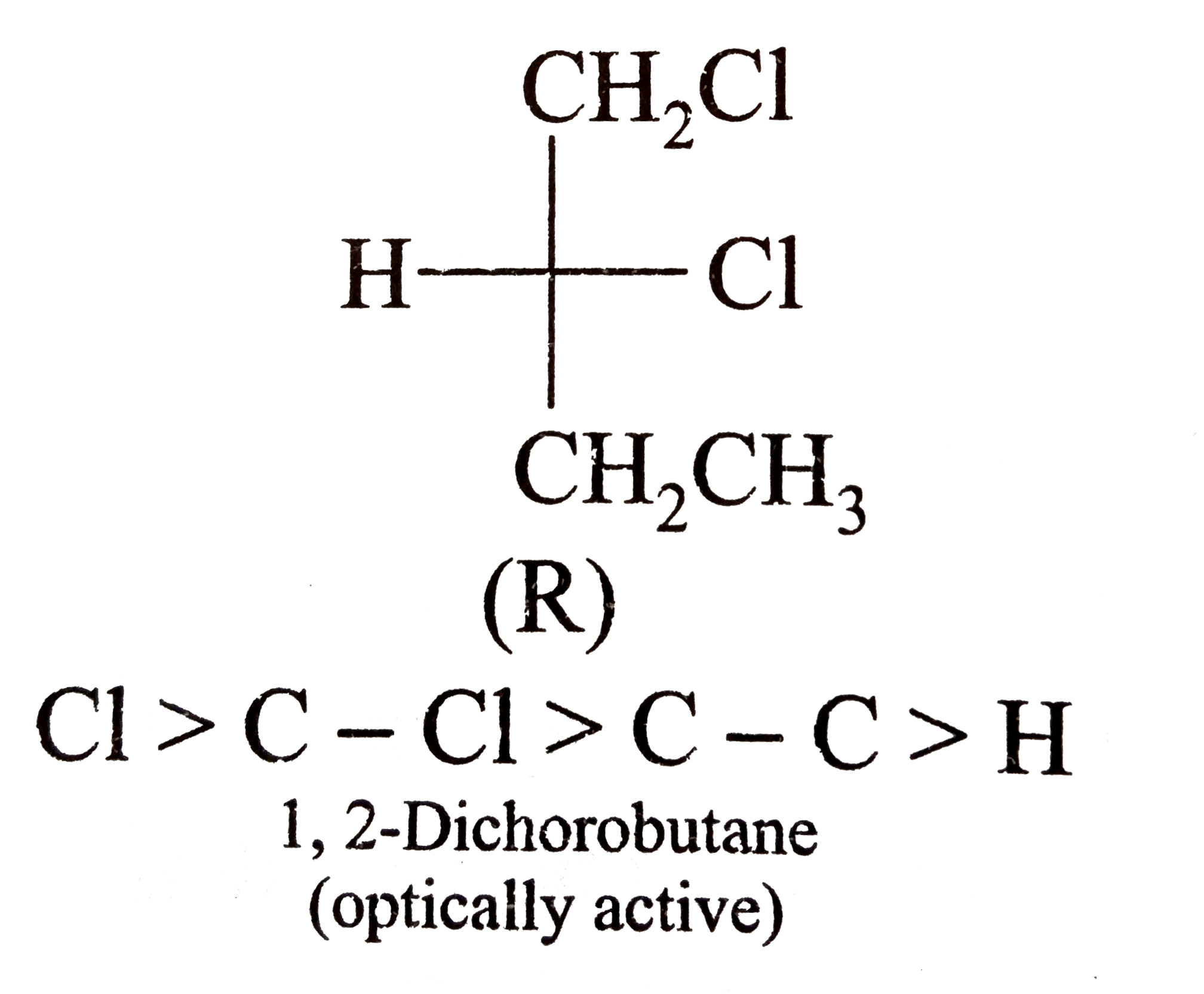
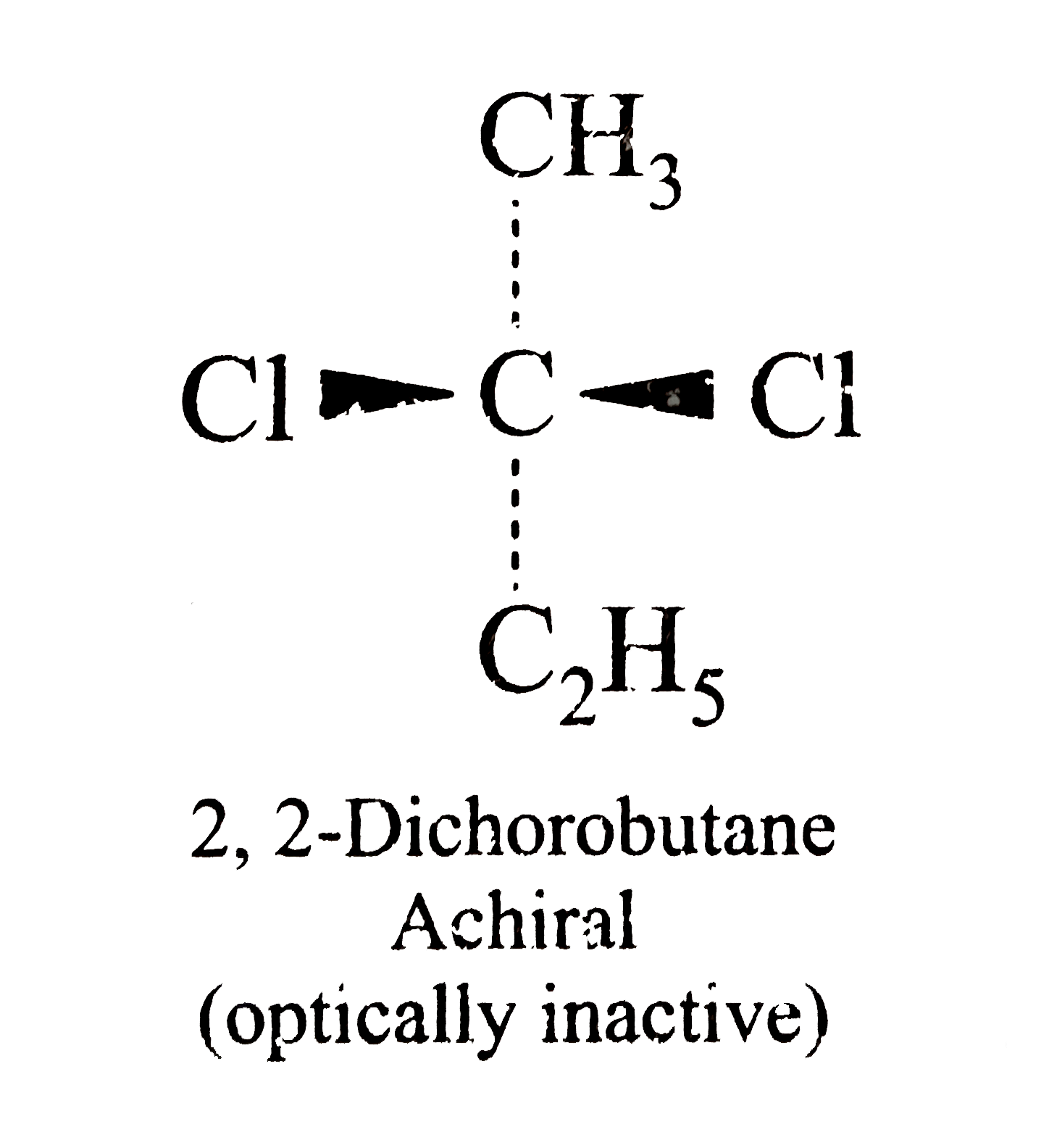
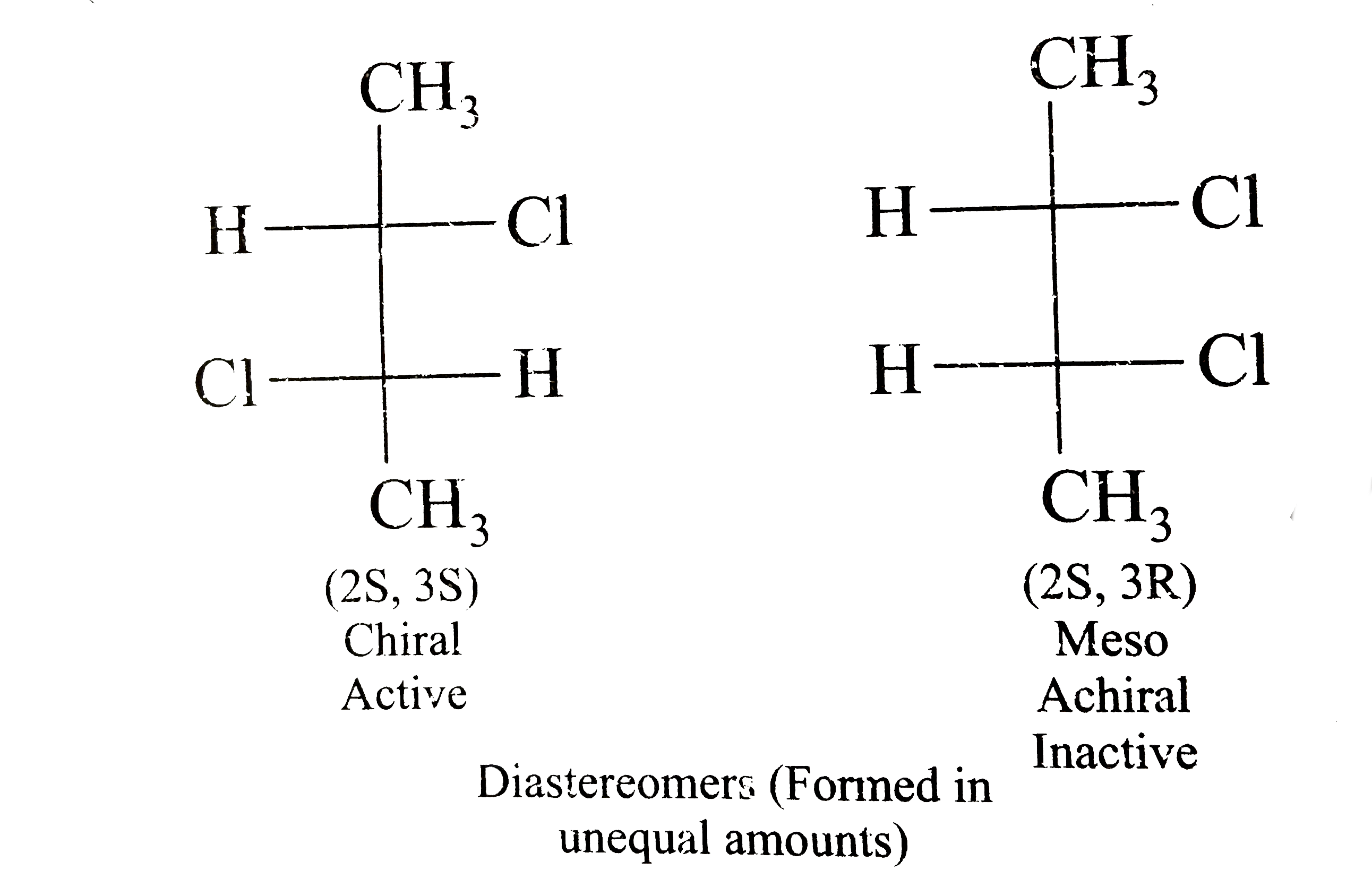
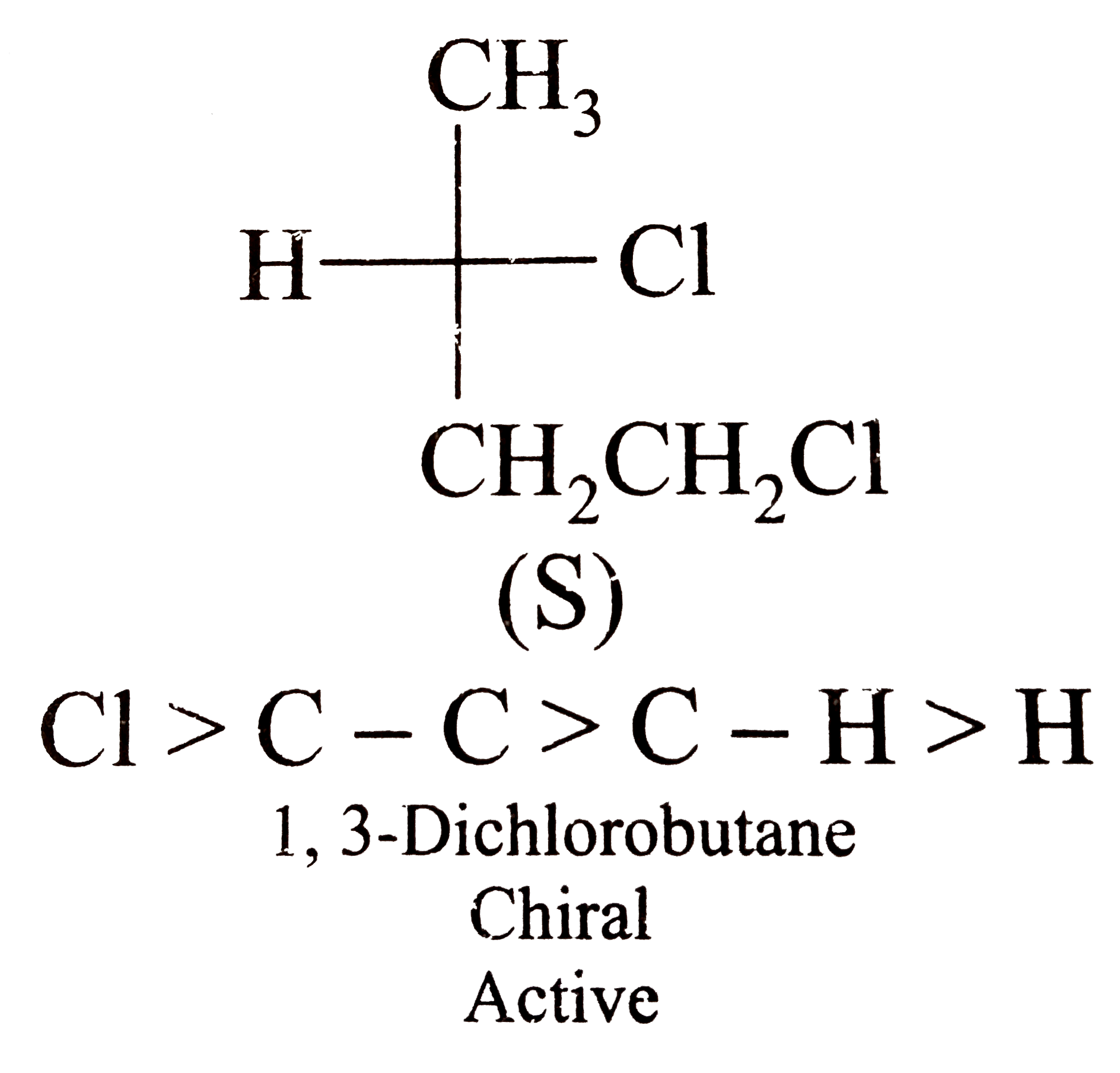
`(S)-CH_(3)overset(CI)overset(|)CHCH_(2)CH_(3)overset(CI_(2))underset(hv)rarrunderset(1,2-"Dichlorobutane")underset((A))(CICH_(2)overset(**)CHCICH_(2)CH_(3))+underset(2,2-"Dichlorobutane")underset((B))underset(CI)underset(|)overset(CI)overset(|)(CH_(3)C CH_(2)CH_(3))+underset(2,3-"Dichlorobutane")underset((C ))(CH_(3)underset(**)overset(CI)overset(|)CHoverset(CI)overset(|)underset(**)CHCH_(2)) +underset(1,3-"Dichlo robutan e")underset((D))(CH_(3)overset(CI)overset(|)underset(**)CHCH_(2)CH_(2)CI`
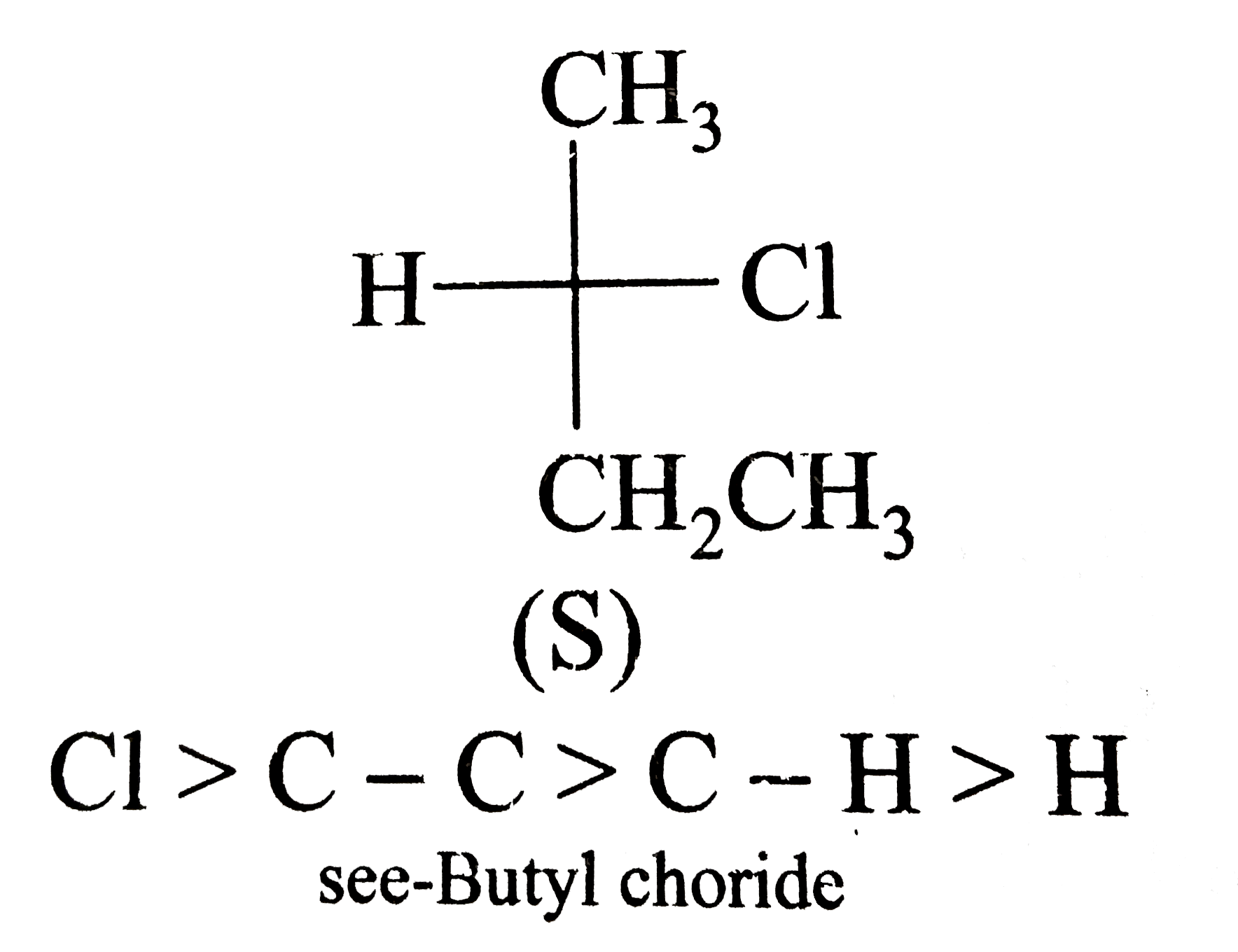
Monochlorination of sec-buty`1` chloride can occur at any one of four carbons. The staring meterical is the optically active compound `(S)`-sec buty`1` chloride.

`underset("see-Buty1 chloride")(CI gt C gt C gt C-H gt H)`
`(A)` is still chiral but the `C-2` configuration is unchanged because no bonds to the chiral carbon `(C-2)` have beem broken. However because of the change in priorities `(CH_(2)CI gt CH_(2)CH_(3))`, it is `R`.

`underset(("optically active"))underset(1,2-"Dichlorobutane")(CI gt C-CI gt C-C gt H)`
`(B)` is achiral because during its formation the chiral center `(C-2)` is destroyed as `C-2` with two identical ligands (two `CI's`) has a plane of symmetry.

Two diastereomers corresponding to `(C )` are formed. `C-2` is steill `(S)` as none of its bond is broken but `C-3` can be `R` or `S` as the flat radical has enantiotopic faces. These diastereomers are `(2S,3S)` which is optically active and meso `(2S,3R)`.

Attack at `C-4` does not effect the configuration at `C-2` because no bond to the chiral center is broken. `(D)` is also chiral and `(S)` because the priority order does not changes (ot is just accidental that `-CH_(2)CH_(2)Ci` happens to be of the same relative priority as the `-CH_(2)CH_(3))`.

Note that both `(A)` and `(B)` and `(D)` are formed with retention of configuration but `(A)` has the opposite sepecification while `(D)` has the same specification.
Thus a total of five diastereomeric fractions are obtained of which two are optically inactive and three optically active. Monomchlorination of `(R)`-sec-buty`1`chloride will yield similar result i.e. five diastereomeric fractions (two inactive and three active). Monochlorination of racemic sec-buty`1`chloride also gives five diastereomeric fractions but all optically inactive. They will be the same as discussed above except that each chiral structure is now accompanied by an equal amount of its enantiomer.
Promotional Banner

Topper's Solved these Questions

Similar Questions

Explore conceptually related problems

How many Monochloro derivatives are possible when 2-methyl butane is subjected to free radical chlorination.(including stereo isomers)

Isopentane is allowed to undergo free-radical chlorination and the reaction mixture is separated. How many optically active fractions of formula C_(5)H_(11)CI would you expect to collect?

How many monochloro derivatives are possible when 3-methylheptane is subjected to free radical chlorination ?

(i) Out of (CH_(3))_(3) , C-Br and (CH_(3))_(3) C-I, which one is more reactive towards S_(N)1 and why? (ii) Write the product formed when P-nitrochlorobenzene is heated with aqueous NaOH at 443K followed by acidification. (iii) Why dextro and laevo-rotatory isomers of Butan-2-ol are difficult to separate by fractional distillation?

R SHARMA-STEREOCHEMISTRY-Level III
  1. Consider the following configurations (A),(B),(C ) and (D) (A) ...

    Text Solution

    |

  2. Consider the following configuration (A),(B) and (C ). (A) Whic...

    Text Solution

    |

  3. The chemical properties of enantiomer are the same towards achiral (...

    Text Solution

    |

  4. Which fo the following stereosimers represent meso compounds?

    Text Solution

    |

  5. (S)-sec Buty1 chloride is subjected to free-radical chlorination follo...

    Text Solution

    |

  6. Cyclohexene on reaction with Br(2)in C CI(4) yields

    Text Solution

    |

  7. Consider the following reaction sequence The final product (III)...

    Text Solution

    |

  8. trans-But-2-ene reacts with cold dilute KMnO(4) solution to yield

    Text Solution

    |

  9. trans-But-2-ene reacts with D(2) in the presence of Ni as catayst. The...

    Text Solution

    |

  10. Geometrical isomerism is exihibited by

    Text Solution

    |

  11. The smallest ketone and its next homologue are reacted with H(2)NOH to...

    Text Solution

    |

  12. Which of the following Fischer's projection formula is identical to D-...

    Text Solution

    |

  13. Among the following four structures I to IV C(2)H(5)-overset(CH(3))o...

    Text Solution

    |

  14. The number of isomers for the compound with moelecular formula C(2)BrC...

    Text Solution

    |

  15. Give the IUPAC name of the alkene

    Text Solution

    |

  16. When NH(2)OH reacts with an usymmetrical ketone then numver of product...

    Text Solution

    |

  17. The name of the formed is

    Text Solution

    |

  18. The absolute configuartion of the configuration compound is

    Text Solution

    |

  19. The prefixes syn and anti are used to denote

    Text Solution

    |

  20. The number of optical isomers of the compound CH(3)CHBrCHBrCOOH is

    Text Solution

    |