A
B
C
D
Text Solution
Verified by Experts
The correct Answer is:
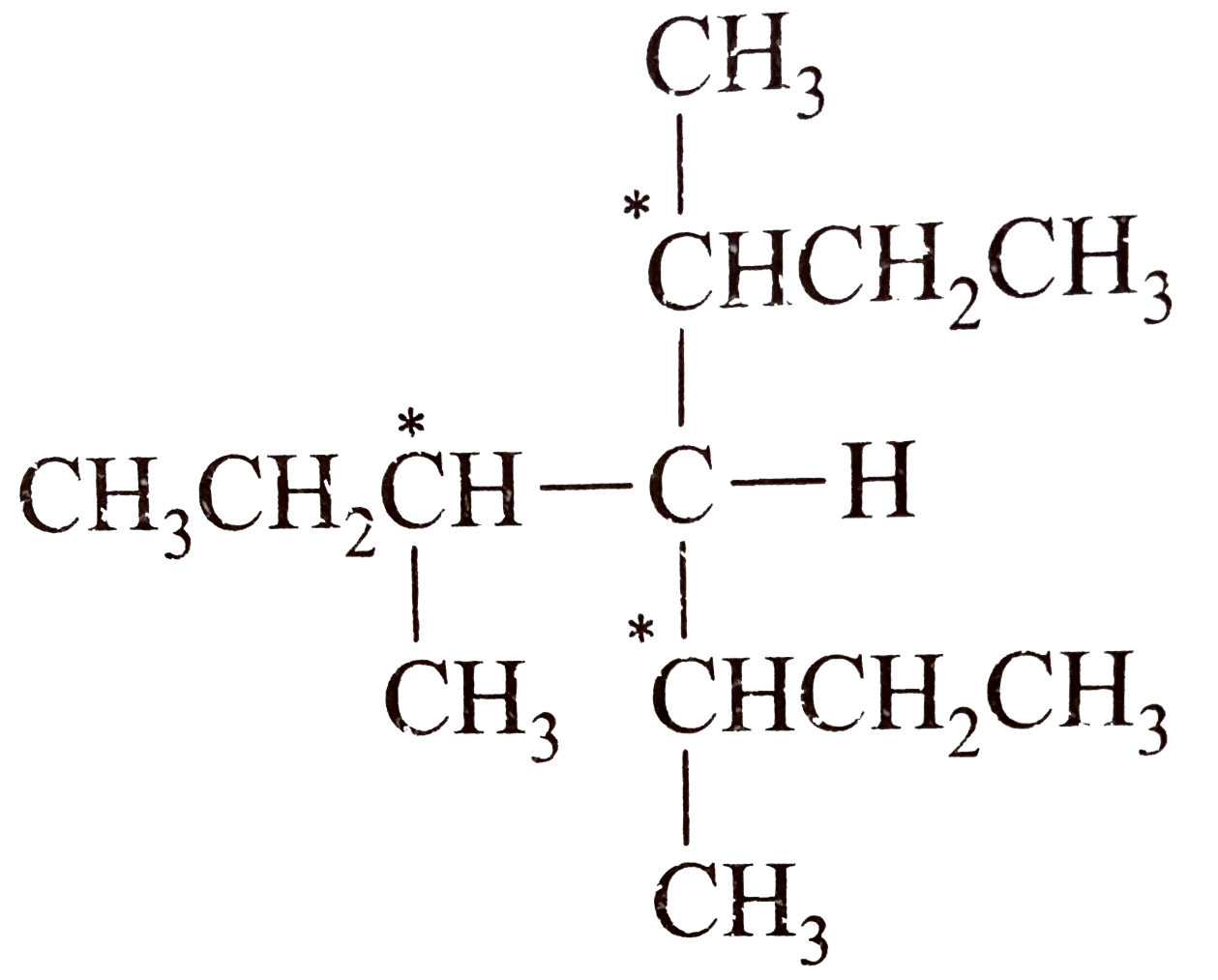



Topper's Solved these Questions
Similar Questions
Explore conceptually related problems
R SHARMA-STEREOCHEMISTRY-Level IV
- Which of the following is not corrrect?
Text Solution
|
- Which of the following is incorrect?
Text Solution
|
- The compound 1,3-ibromo-2-methy1 butane, CH(3)CHBrCH(CH(3))CH(2)Br, ha...
Text Solution
|
- Which of the following configuration represents a therosteroisomer?
Text Solution
|
- Which of the following moleules possesses a peseudoasymmetric carbon a...
Text Solution
|
- Which of the following molecules has a pro-chiral centre?
Text Solution
|
- How may 2,3,4,5-terahydroxyadipic acids are possible?
Text Solution
|
- How many optically active stereoisomers are possible for tri-sec-buty1...
Text Solution
|
- How many steroisomers are possible for tetra-sec-buty1 methane?
Text Solution
|
- Which of the following molecules is chiral?
Text Solution
|
- Cyclohexene on raction with cold dilute KMnO(4) solutioon gives
Text Solution
|
- Hydrogenation of the compound with H(2) in the presence of Lindle...
Text Solution
|
- Cyclohexene on reaction with m-chloroperoxbenzpic acid forms a compoun...
Text Solution
|
- Consider the following sequence of reactions How many structures ...
Text Solution
|
- In the reaction the major product formed is
Text Solution
|
- Which one of the following conformations of cyclohexane is chiral?
Text Solution
|
- P and Q are isomers of dicarboxylic acid C(4)H(4)O(4). Bothdecolorize ...
Text Solution
|
- Which of the following is correct? (i) The smallest alkene which can...
Text Solution
|
- The total number of acylic isomers (including steroisomers) of C(4)H(7...
Text Solution
|