

Home
Class 11
PHYSICS
A ball of mass in m= 1 kg is hung vertic...

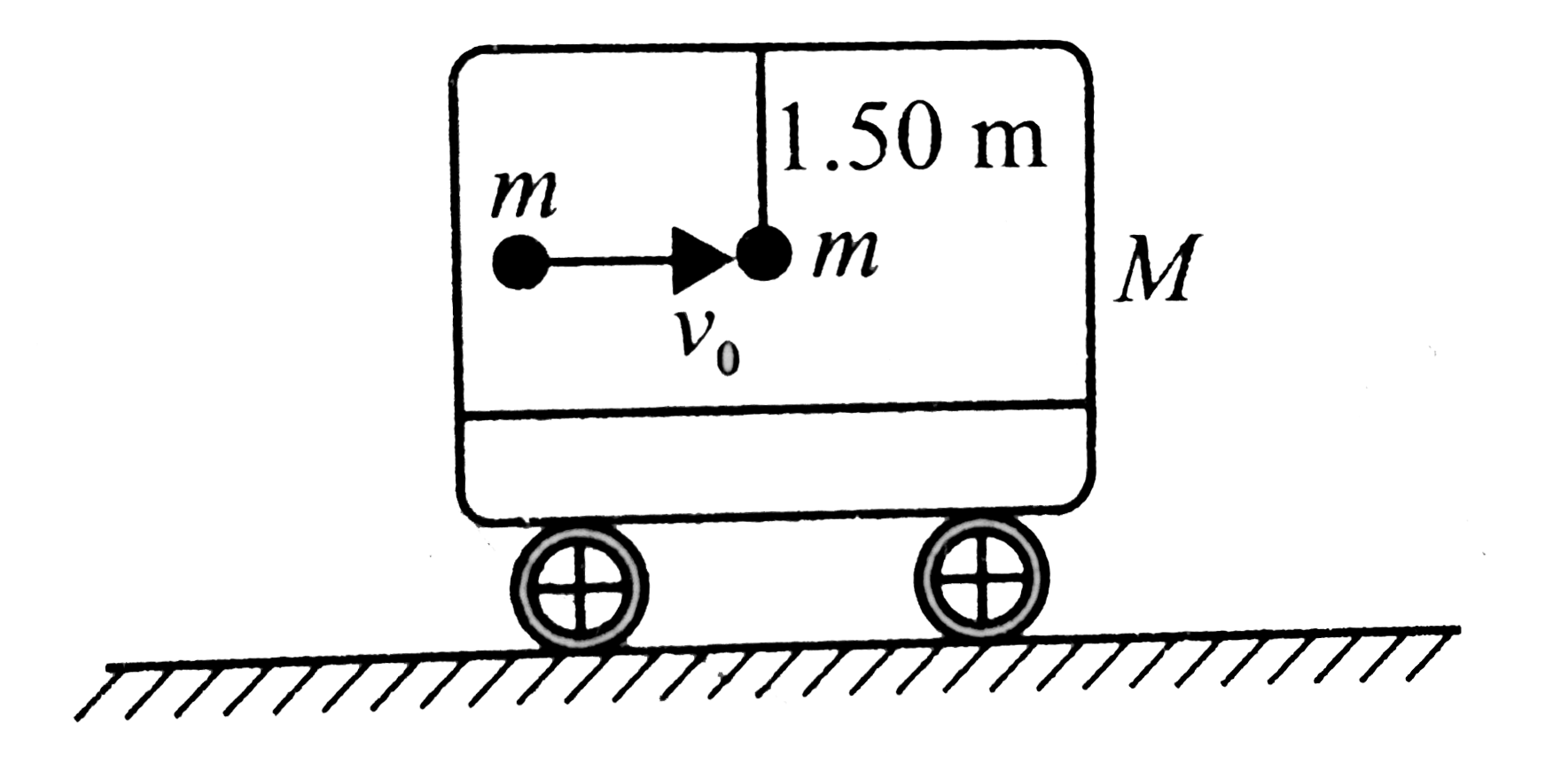
A ball of mass in `m= 1 kg` is hung vertically by a thread of length `l = 1.50 m`. Upper end of the thread is attached to the ceiling of a trolley of mass `M= 4 kg`. Initially, the trolley is stationary and it is free to move along horizontal rails without friction. A shell of mass `m=1 kg`, moving horizontally with velocity `v_(0) = 6 m//s` collides with the ball and gets stuck with it. As a result, the thread starts to deflect towards right.

The maximum deflection of the thread with the vertical is

Promotional Banner

Similar Questions

Explore conceptually related problems

A ball of mass in m= 1 kg is hung vertically by a thread of length l = 1.50 m . Upper end of the thread is attached to the ceiling of a trolley of mass M= 4 kg . Initially, the trolley is stationary and it is free to move along horizontal rails without friction. A shell of mass m=1 kg , moving horizontally with velocity v_(0 )= 6 m//s collides with the ball and gets stuck with it. As a result, the thread starts to deflect towards right. At the time of maximum deflection of the thread with vertical, the trolley will move with velocity

A ball of mass in m= 1 kg is hung vertically by a thread of length l = 1.50 m . Upper end of the thread is attached to the ceiling of a trolley of mass M= 4 kg . Initially, the trolley is stationary and it is free to move along horizontal rails without friction. A shell of mass m=1 kg , moving horizontally with velocity v_(0 )= 6 m//s collides with the ball and gets stuck with it. As a result, the thread starts to deflect towards right. At the time of maximum deflection of the thread with vertical, the trolley will move with velocity

A ball of mass in m= 1 kg is hung vertically by a thread of length l = 1.50 m . Upper end of the thread is attached to the ceiling of a trolley of mass M= 4 kg . Initially, the trolley is stationary and it is free to move along horizontal rails without friction. A shell of mass m=1 kg , moving horizontally with velocity v_(0 )= 6 m//s collides with the ball and gets stuck with it. As a result, the thread starts to deflect towards right. At the time of maximum deflection of the thread with vertical, the trolley will move with velocity

A ball of mass in m= 1 kg is hung vertically by a thread of length l = 1.50 m . Upper end of the thread is attached to the ceiling of a trolley of mass M= 4 kg . Initially, the trolley is stationary and it is free to move along horizontal rails without friction. A shell of mass m=1 kg, moving horizontally with velocity v_(0) = 6 m//s collides with the ball and gets stuck with it. As a result, the thread starts to deflect towards right. The velocity of the combined body just after collision is

A ball of mass in m= 1 kg is hung vertically by a thread of length l = 1.50 m . Upper end of the thread is attached to the ceiling of a trolley of mass M= 4 kg . Initially, the trolley is stationary and it is free to move along horizontal rails without friction. A shell of mass m=1 kg, moving horizontally with velocity v_(0) = 6 m//s collides with the ball and gets stuck with it. As a result, the thread starts to deflect towards right. The velocity of the combined body just after collision is

A ball of mass m = 1 kg is hung vertically by a thread of length 1=1.50 m . Upper end of the thread is attached to the ceiling of a trolley of mass M = 4kg . Initially, the trolley is stationary and it is free to move along horizontal rails with out friction. A shell of mass m=1 kg , moving horizontally with velocity v_(0) = 6m//s collides with thread starts to deflect towards right The maximum deflection of the thread with the vertical is

A ball of mass m = 1 kg is hung vertically by a thread of length 1=1.50 m . Upper end of the thread is attached to the ceiling of a trolley of mass M = 4kg . Initially, the trolley is stationary and it is free to move along horizontal rails with out friction. A shell of mass m=1 kg , moving horizontally with velocity v_(0) = 6m//s collides with thread starts to deflect towards right The velocity of the combined body just after collision is

A ball of mass m = 1 kg is hung vertically by a thread of length 1=1.50 m . Upper end of the thread is attached to the ceiling of a trolley of mass M = 4kg . Initially, the trolley is stationary and it is free to move along horizontal rails with out friction. A shell of mass m=1 kg , moving horizontally with velocity v_(0) = 6m//s collides with thread starts to deflect towards right At the time a maximum deflection of the thread with vertical, the trolley will move with velocity

In the arrangements shown in the figure masses of each ball is 1 kg and mass of trolley is 4 kg . In the figure, shell of mass 1 kg moving horizontally with velocity v = 6 ms^(-1) collides with the ball and get stuck to it then its maximum deflection of the thread (length 1.5 m ) with vertical

In the arrangements shown in the figure masses of each ball is 1 kg and mass of trolley is 4 kg . In the figure, shell of mass 1 kg moving horizontally with velocity v = 6 ms^(-1) collides with the ball and get stuck to it then its maximum deflection of the thread (length 1.5 m ) with vertical