Home
Class 11
PHYSICS
A particle moves in the xy plane with a ...

A particle moves in the `xy` plane with a constant acceleration `omega` directed along the negative y-axis. The equation of motion of particle has the form `y = cx -dx^(2)`, where `c` and `d` are positive constants. Find the velocity of the particle at the origin of coordinates.

Text Solution

Verified by Experts
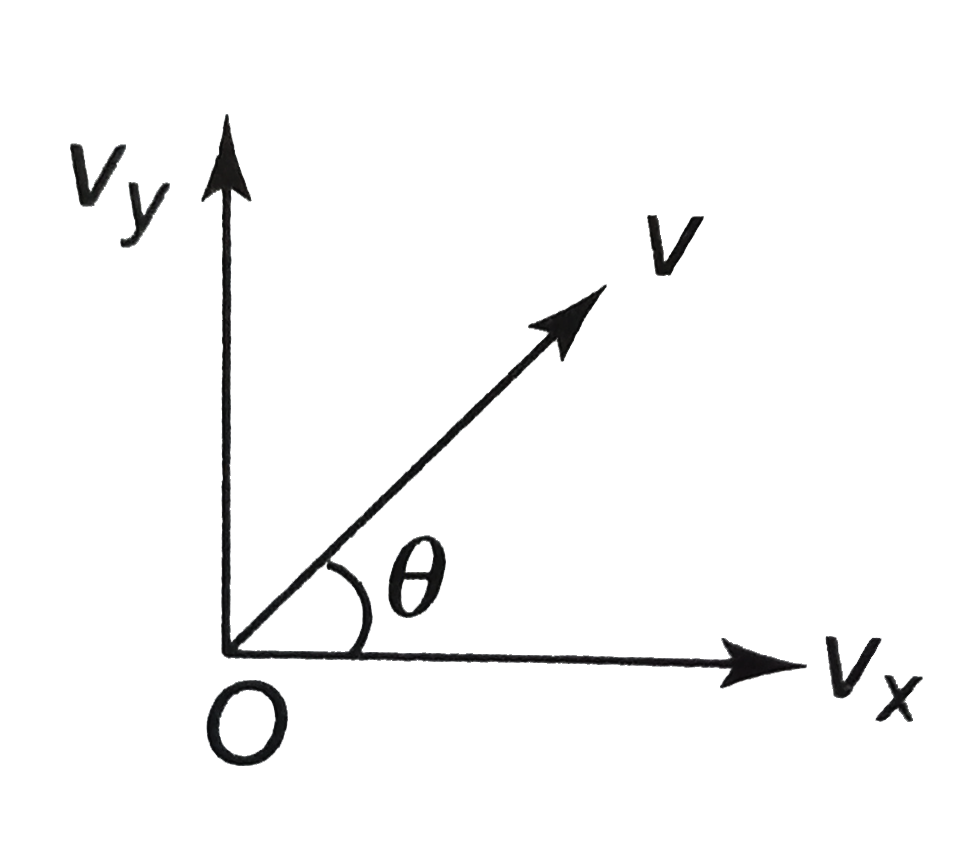
Proceed as in the previous problem, here `omega = g`
`= sqrt((omega(1 + c^(2)))/(2d)), theta = tan^(-1) ( c)`
OR
`y = c x - d x^(2)`
`(d y)/(d t) = c(d x)/(d t) - d.2x(d x)/(d t)`
`v_(y) = c v_(x) - 2 d x v_(x)`
`(d v_(y))/(d t) = c(d v_(x))/(d t) - 2 d [x(d v_(x))/(d t) + v_(x).(d x)/(d t)]`
`a_(y) = c.a_(x) - 2 d[x a_(x) + v_(x)^(2)]`
`a_(x) = 0, a_(y) = - omega`
`- omega = - 2d v_(x)^(2) rArr v_(x) = sqrt((omega)/(2 d))` (indepedent of `x`)
`v_(y) = c v_(x) - 2d x v_(x)`
At origin,
`x = 0, v_(y) = c v_(x) = csqrt((omega)/(2 d))`
`v = sqrt(v_(x)^(2) + v_(y)^(2))`
`= sqrt((omega)/(2 d) + (c^(2) omega)/(2 d)) = sqrt((omega(1 + c^(2)))/(2 d)`
`tan theta = (v_(y))/(v_(x)) = c rArr = theta ta^(-1)( c)`
Promotional Banner

Topper's Solved these Questions

  • MOTION IN A PLANE

    CP SINGH|Exercise Exercises|69 Videos
  • LAWS OF THERMODYNAMICS

    CP SINGH|Exercise EXERCISE|131 Videos
  • MOTION IN A STRAIGHT LINE

    CP SINGH|Exercise EXERCISES|128 Videos

Similar Questions

Explore conceptually related problems

A particle moves in the plane x y with constant acceleration a directed along the negative y-axis. The equation of motion of the particle has the form y = k_(1)x-k_(2)x^(2) , where k_(1) and k_(2) are positive constants. Find the velocity of the particle at the origin of coordinates.

A particle moves in the plane xy with constant acceleration 'a' directed along the negative y-axis. The equation of motion of the particle has the form y= px - qx^2 where p and q are positive constants. Find the velocity of the particle at the origin of co-ordinates.

A particle moves in the xy-plane with constant acceleration a directed along the negative y-axis. The equation of path of the particle has the form y= bx - cx^2 , where b and c are positive constants. Find the velocity of the particle at the origin of coordinates.

A particle moves in the x-y plane with constant acceleration alpha directed along the negative direction of the y-axis.the equation of the trajectory of the particle is y=ax- bx^2 , where a and b are constants. Find the velocity of the particle when it passes through the origin.

A particle moves in the xy plane with a constant acceleration 'g' in the negative-direction. Its equqaiton of motion is y = ax-bx^(2) , where a and b are constants. Which of the following are correct?

A particle moves in a plane with constant acceleration in a direction different from the initial velocity. The path of the particle will be

A particle moves uniformly with speed v along a parabolic path y = kx^(2) , where k is a positive constant. Find the acceleration of the particle at the point x = 0.

A particle moving along the X-axis executes simple harmonic motion, then the force acting on it is given by where, A and K are positive constants.

A particle movesin the X-Y plane with a constasnt acceleration of 1.5 m/s^2 in the direction making an angle of 37^0 with the X-axis.At t=0 the particle is at the orign and its velocity is 8.0 m/s along the X-axis. Find the velocity and the position of the particle at t=4.0 s.

CP SINGH-MOTION IN A PLANE-Exercises
  1. A particle moves in the xy plane with a constant acceleration omega di...

    Text Solution

    |

  2. Two balls are rolling on a flat surface. One has velocity components ...

    Text Solution

    |

  3. A particle moving with a velocity equal to 0.4 m//s is subjected to an...

    Text Solution

    |

  4. The height y and distance x along the horizontal plane of a projectile...

    Text Solution

    |

  5. In the above problem the direction of the initial velocity with the x-...

    Text Solution

    |

  6. The coordinates of a moving particle at any time t are given by x = al...

    Text Solution

    |

  7. A body starts from rest from the origin with an acceleration of 3 m//s...

    Text Solution

    |

  8. A ball is thrown upwards and returns to the ground describing a parabo...

    Text Solution

    |

  9. At what angle to the horizontal should an object be projected so that ...

    Text Solution

    |

  10. The velocity at the maximum height of a projectile is half of its velo...

    Text Solution

    |

  11. The range of a projectile, thrown with an initial speed u at the angle...

    Text Solution

    |

  12. A projectile is projected with a kinetic energy K. If it has the maxim...

    Text Solution

    |

  13. A projectile is projected with the initial velocity (6i + 8j) m//s. Th...

    Text Solution

    |

  14. A projectile is thrown at an angle of 40^(@) with the horizontal and i...

    Text Solution

    |

  15. Two projectiles A and B are projected with an angle of projection 15^(...

    Text Solution

    |

  16. It was calculated that a shell when fired from a gun with a certain ve...

    Text Solution

    |

  17. Galileo writes that for angles of projection of a projectile at angles...

    Text Solution

    |

  18. Choose the correct option (i) The speed of a projectile at its maxim...

    Text Solution

    |

  19. If a body A of mass m is thrown with velocity v at an angle of 30^(@) ...

    Text Solution

    |

  20. A particle is thrown such that its time of flight is 10 s and horizont...

    Text Solution

    |

  21. A ball of mass m is thrown vertically upwards. Another ball of same ma...

    Text Solution

    |

