Home
Class 11
PHYSICS
Two horizontal discs A and B of radii r ...

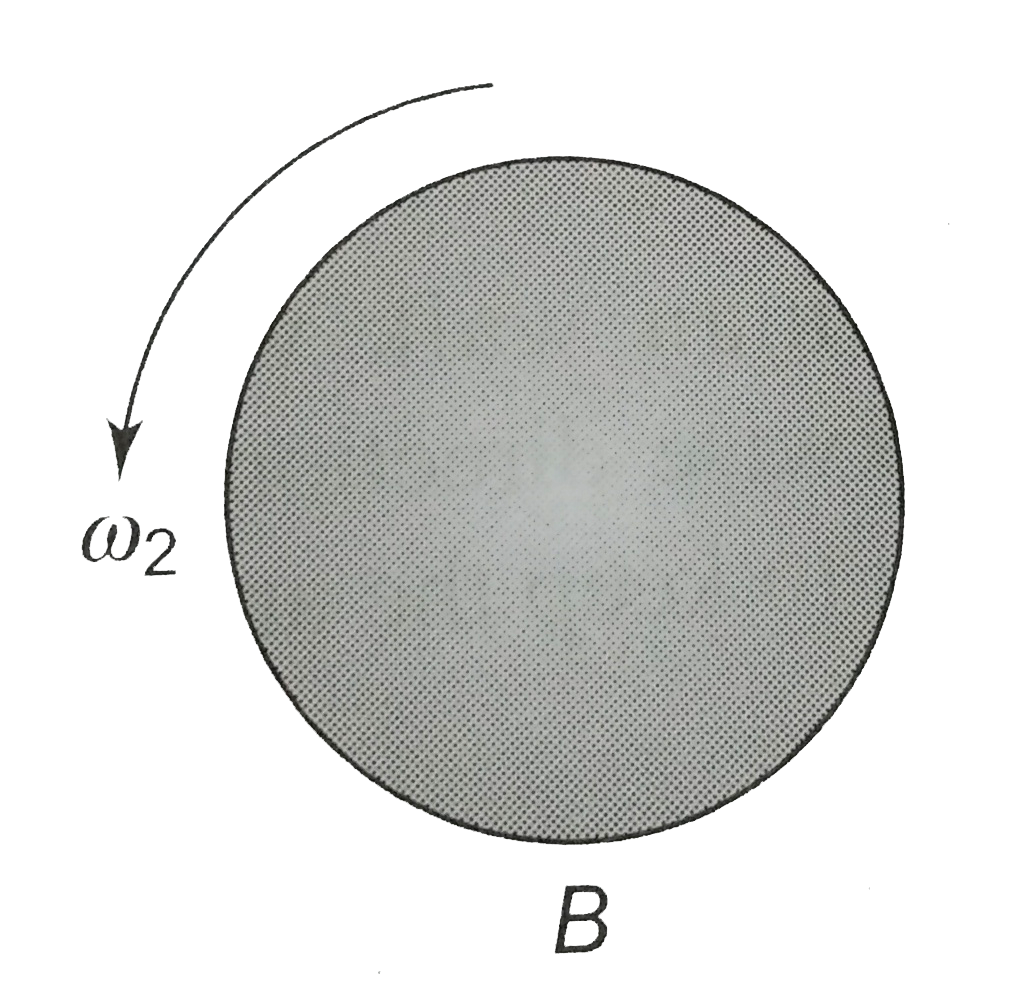
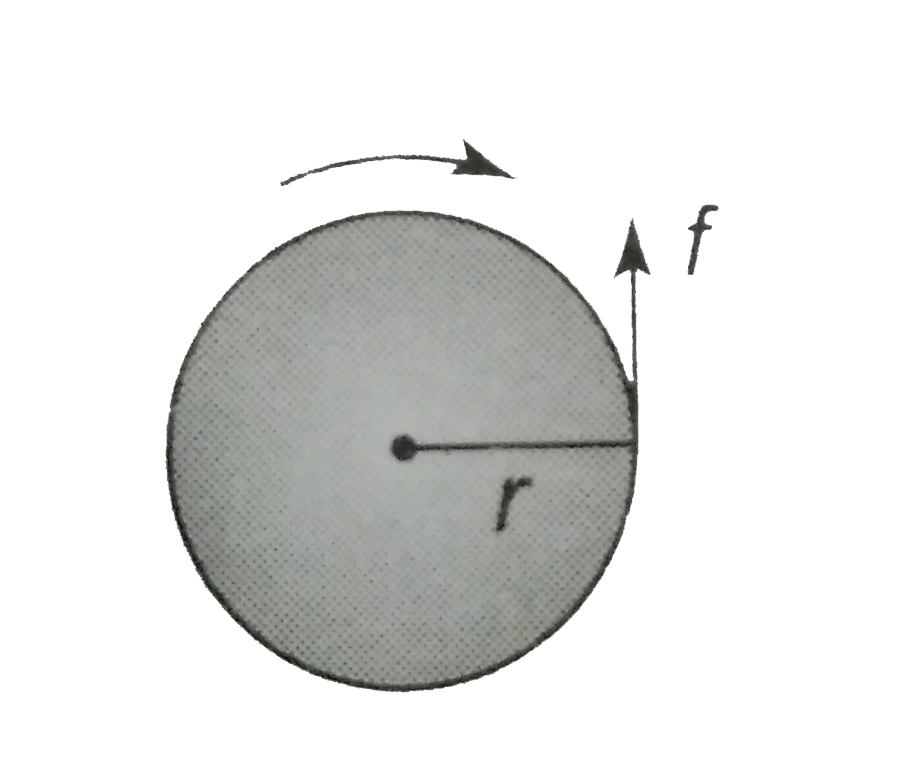
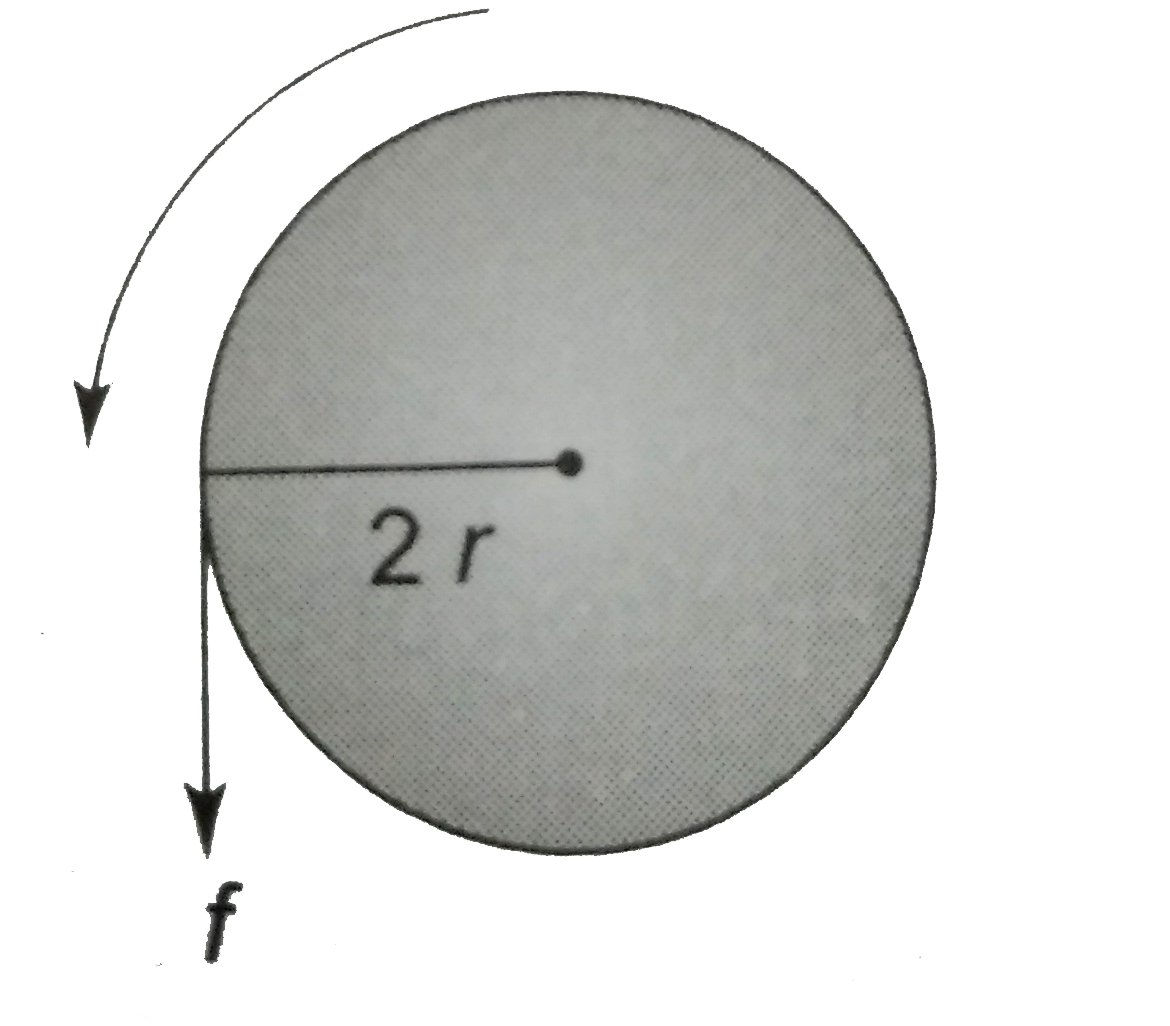
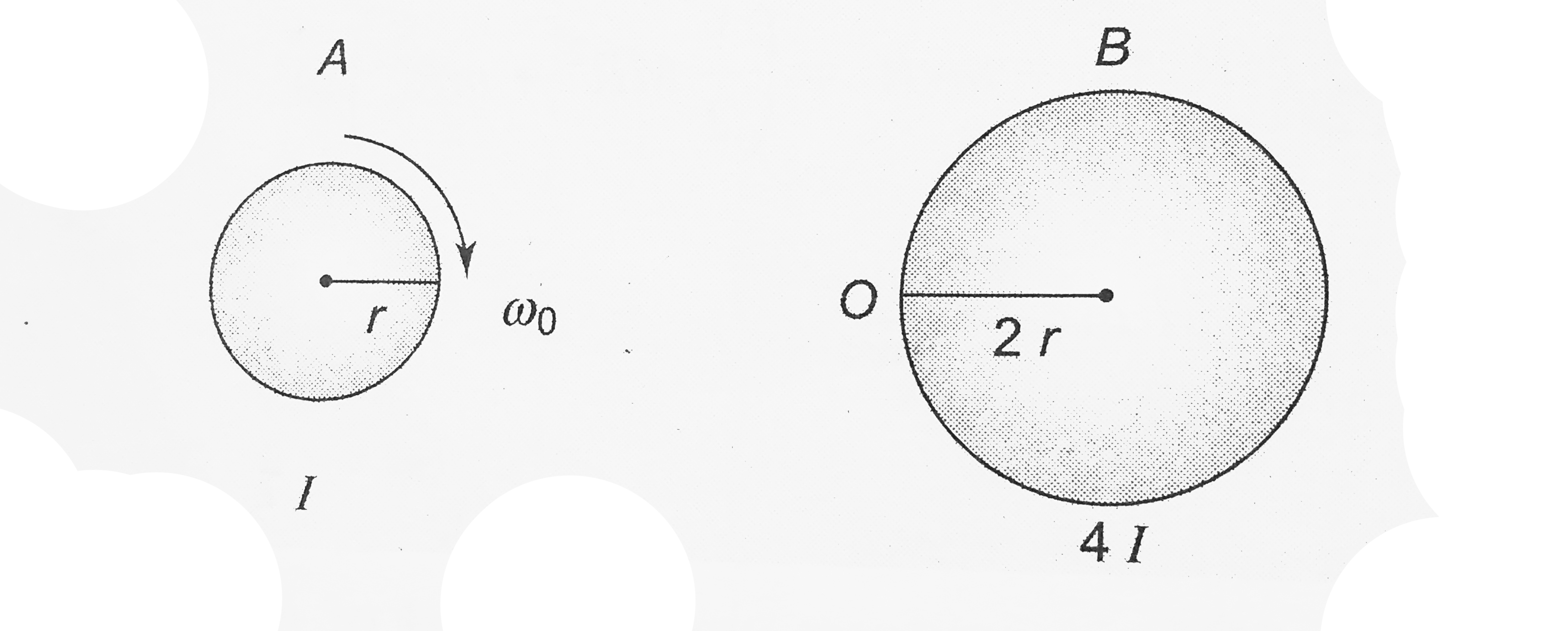
Two horizontal discs `A` and `B` of radii `r` and `2r` having moments of inertia `I` and `4I` about their axes. Initially, disc `A` is rotating with `omega_(0)` and disc `B` is at rest. Their rims are now brought in contact. The discs first slip over each other at the contact but slipping finally ceases due to the fricition between them. Find the angular speeds of the discs after the slipping ceases. Also, find the loss in kinetic energy.

Text Solution

Verified by Experts
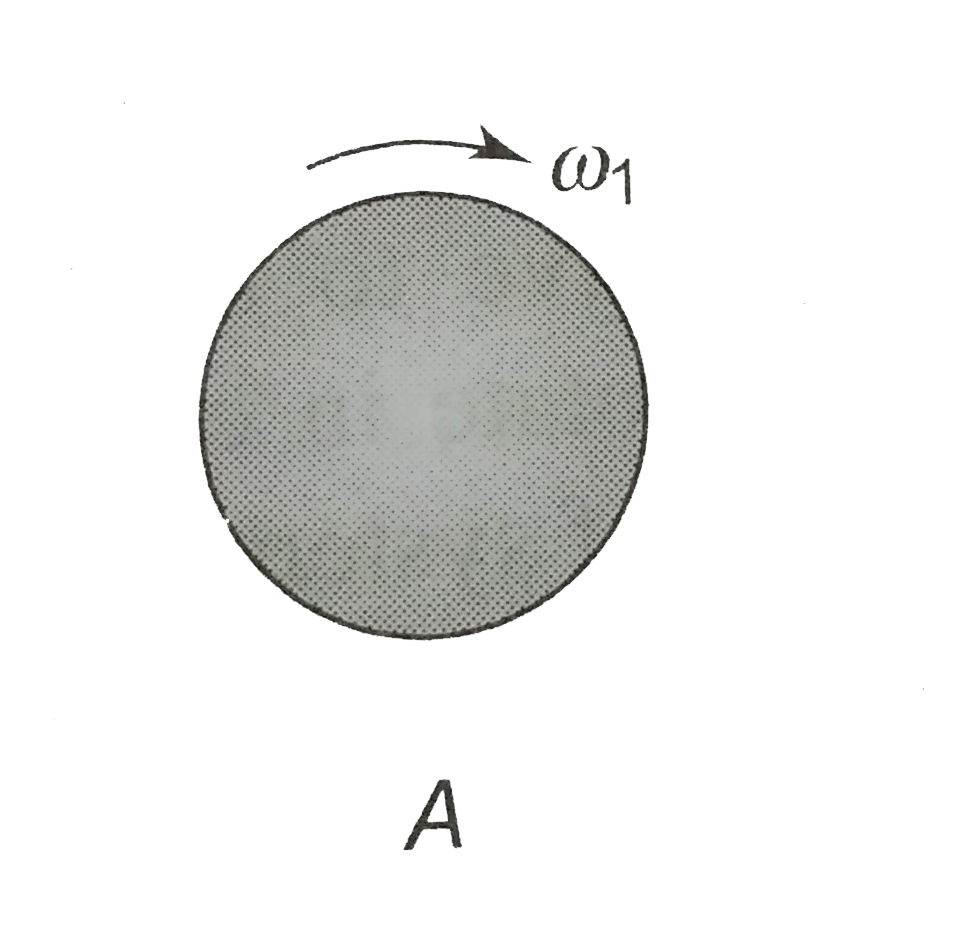
The friction between discs will disappear when there is no relative motion between them, i.e. their linear speed at the point of contact is same, i.e.
`omega_(1)r=omega_(2)xx2r` (`i`)

The friction will decrease angular speed of `A` while it will increase angular speed of `B`. Let the friction act for time `t`.

Angular impulse
`A:-frt=I(omega_(1)-omega_(0))` (`ii`)
`B:fxx2rt=4I(omega_(2)-0)` (`iii`)
Dividing (`ii`) by (`iii`), we get
`-(1)/(2)=(omega_(1)-omega_(0))/(4omega_(2))=(omega_(1)-omega_(0))/(4(omega_(1))/(2))` (since `omega_(2)=(omega_(1))/(2)`)
`-omega_(1)=omega_(1)-omega_(0)impliesomega_(1)=(omega_(0))/(2)`
`omega_(2)=(omega_(1))/(2)=(omega_(0))/(4)`
Initial `K.E., K_(i)=(1)/(2)Iomega_(0)^(2)`
Final `K.E., K_(f)=(1)/(2)I((omega_(0))/(2))^(2)+(1)/(2)xx4I((omega_(0))/(4))^(2)`
`(Iomega_(0)^(2))/(8)+(Iomega_(0)^(2))/(8)=(1)/(4)Iomega_(0)^(2)`
Loss in `K.E.=K_(i)-K_(f)=(1)/(4)Iomega_(0)^(2)`

Promotional Banner

Topper's Solved these Questions

  • ROTATIONAL MOTION

    CP SINGH|Exercise Exercise|172 Videos
  • RELATIVE MOTION

    CP SINGH|Exercise EXERCISE|33 Videos
  • SIMPLE HARMONIC MOTION

    CP SINGH|Exercise Exercises|125 Videos

Similar Questions

Explore conceptually related problems

Figure shows two cylinders of raddi r_1 and r_2 having moments of inertia I_1 and I_2 about their respective axes. Initially the cylinders rotate about their axes with angular speed omega_1 and omega_2 as shown in the figure. The cylinders are moved closer to touch each other keeping the axes parallel. The cylinders first slipover each other at the contact but the slipping finally ceases due to the friction between them. Find the angular speeds of the sylinders after the slipping ceases.

Two horizontal discs of different radii are free to rotate about their central vertical axes: One is given some angular velocity, the other is stationary. Their rims arc now brought in contact. There is friction between the rims. Then

the disc of the radius r is confined to roll without slipping at A and B if the plates have the velocities shown, determine the angular velocity of the disc.

Two discs of moments of inertia I_(1) and I_(2) about their respective axes (normal to the disc and passing through the centre) and rotating with angular speeds omega_(1) and omega_(2) are brought into contact face to face with their axes of rotation coincident. (a) Does the law of conservation of angular momentum apply to the situation ? Why ? (b) Find the angular speed of the two-disc system. (c ) Calculate the loss in kinetic energy of the system in the process. (d) Account for this loss.

Two discs of moments of inertia I_1 and I_2 about their respective axes, rotating with angular frequencies, omega_1 and omega_2 respectively, are brought into contact face to face with their axes of rotation coincident. The angular frequency of the composite disc will be A .

Two discs of radii R and 2R are pressed against eachother. Initially, disc wit radius R is rotating with angular velocity omega and other disc is stationary. Both discs are hinged at their respective centres and are free to rotate about them. Moment of inertiaof smaller disc is I and of bigger disc is 2I about their respective axis of rotation. Find the angular velocity of bigger disc after long time.

Two discs of moments of inertia I_(1) and I_(2) about their respective axes (normal to the disc and passing through the centre), and rotating with angular speed omega_(1) and omega_(2) are brought into contact face to face with their axes of rotation coincident (i) What is the angular speed of the two-disc system ? (ii) Show that the kinetic energy of the combined system is less than the sum of the initial kinetic energies of the two discs. How do you account for this loss in energy ? Take omega_(1) ne omega_(2) .

CP SINGH-ROTATIONAL MOTION-Exercise
  1. Two horizontal discs A and B of radii r and 2r having moments of inert...

    Text Solution

    |

  2. Three point masses, each of mass m, are placed at the corners of an eq...

    Text Solution

    |

  3. The moment of inertia of a disc of mass M and radius R about an axis. ...

    Text Solution

    |

  4. Let I(A) and I(B) be moments of inertia of a body about two axes A and...

    Text Solution

    |

  5. A closed cylindrica tube containing some water (not filling the entire...

    Text Solution

    |

  6. A uniform cylinder has radius R and length L. If the moment of inertia...

    Text Solution

    |

  7. A solid sphere of mass M, radius R and having moment of inertia about ...

    Text Solution

    |

  8. Two circular discs are of same thickness. The diameter of A is twice t...

    Text Solution

    |

  9. The moment of inertia of a circular disc of mass M and radius R about ...

    Text Solution

    |

  10. From a uniform wire, two circular loops are made (i) P of radius r and...

    Text Solution

    |

  11. The moment of inertia of a uniform rod about a perpendicular axis pass...

    Text Solution

    |

  12. The density of a rod AB increases linearly from A to B its midpoint is...

    Text Solution

    |

  13. The M.I. of a rod about an axis through its center and perpendicular t...

    Text Solution

    |

  14. The moment of inertia of a thin uniform rod of mass M and length L abo...

    Text Solution

    |

  15. Three rings, each of mass m and radius r, are so placed that they touc...

    Text Solution

    |

  16. Two rings A (2m,R) and B (m,R) are placed such that these are perpendi...

    Text Solution

    |

  17. If I(0) is the moment of inertia body about an axis passing through it...

    Text Solution

    |

  18. A rod of length L is made of a uniform length L//2 of mass M(1) and a ...

    Text Solution

    |

  19. Four spheres each of mass M and diameter 2r, are placed with their cen...

    Text Solution

    |

  20. The ratio of the radii of gyration of a circular disc about a tangenti...

    Text Solution

    |

  21. One quarter sector is cut from a uniform circular disc of radius R. Th...

    Text Solution

    |