Home
Class 11
PHYSICS
(a) The right block collides with left b...

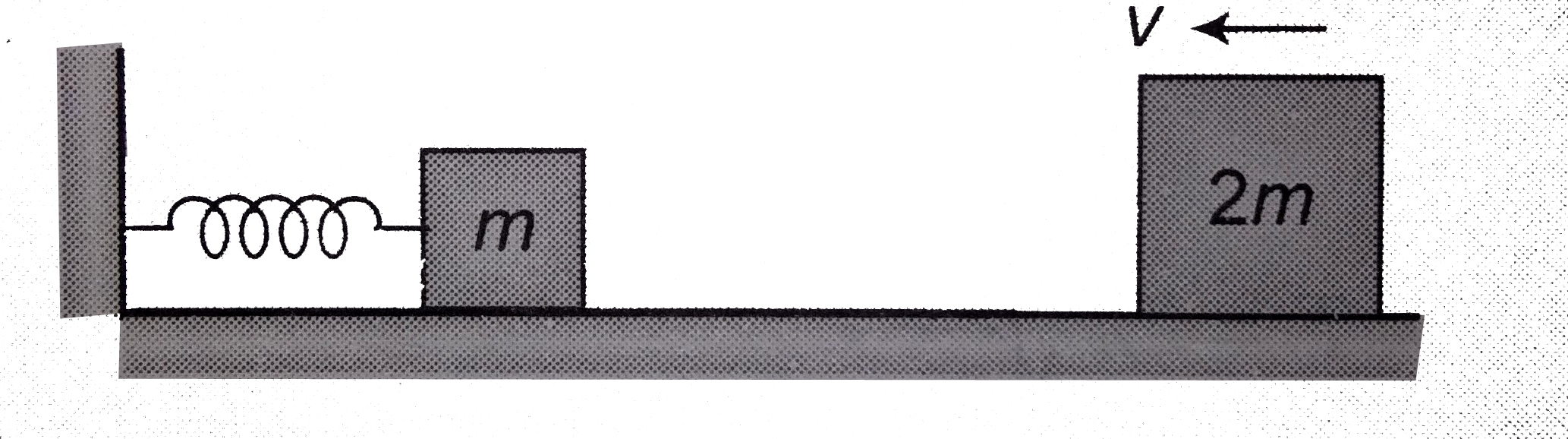
(a) The right block collides with left block and sticks to it. Find amplitude of the resulting SHM.

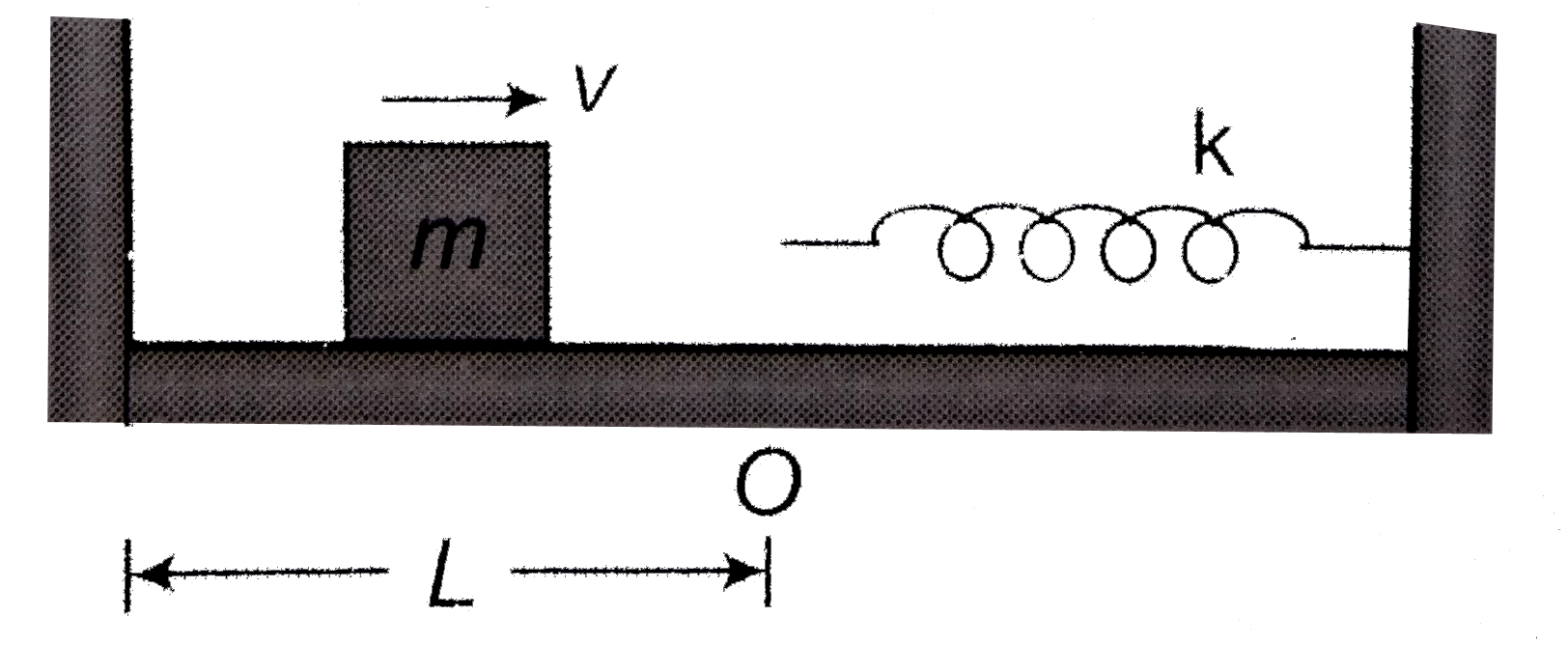
(b) The block starts from left wall and moves with constant speed v. All collisions are elastic. Find time period of periodic motion.

Text Solution

Verified by Experts
(a)
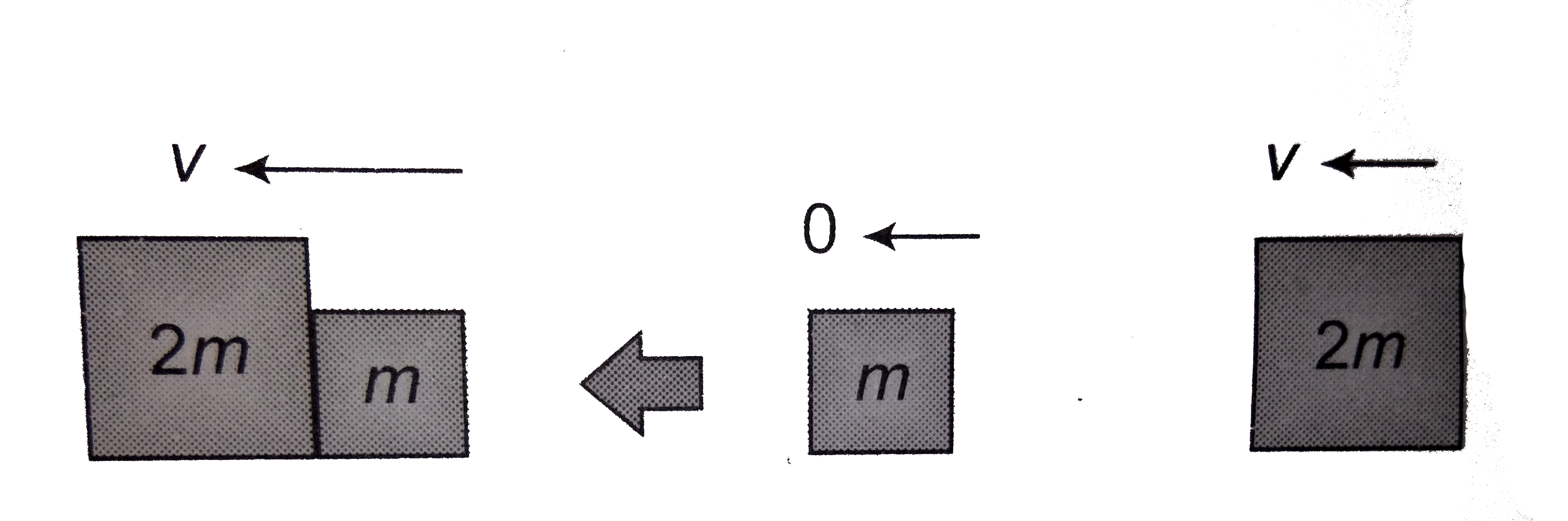
By momentum conservation
`2mv=(m+2m)VimpliesV=(2v)/(3)`
K.E. of combined block
`=1/2(2m+m)V^2=(3m)/(2)((2v)/(3))^2=2/3mv^2`
Let A be the amplitude
`2/3mv^2=1/2kA^2impliesA=vsqrt((4m)/(3k))`
(b) The block reaches to spring with speed v. The block compresses the spring by distance x such that `1/2mv^2=1/2kx^2`. Now block moves toward left, when it leaves contact with spring, its speed is v. The time for which block is in contact with spring `t_1=T/2=pisqrt(m/k)`.
Time taken by block to move from left wall to spring and then spring to left wall
`t_2=L/v+L/v=(2L)/(v)`
Thus block undergoes periodic motion with time period
`t_1+t_2=pisqrt(m/k)+(2L)/(v)`.
Promotional Banner

Topper's Solved these Questions

  • SIMPLE HARMONIC MOTION

    CP SINGH|Exercise Exercises|125 Videos
  • ROTATIONAL MOTION

    CP SINGH|Exercise Exercise|172 Videos
  • SOUND WAVES

    CP SINGH|Exercise Exercises|130 Videos

Similar Questions

Explore conceptually related problems

The surface shown in the diagram are smooth and all collisions are elastic. Find the time period of the periodic motion.

The left block in filgure collides inelastically with the right block and sticks to it. Find the amplitude of the resulting simple harmonic motion.

The left block in figure collides inelastically with the right block and sticks to it. Find the amplitude of the resulting simple harmonic motion.

The left block in figure collides inelastically with the right block and striks to it. Find the amplitude of the resulting simple harmonic motion

Find the time period of SHM of the block of mass M

The right block in figure moces at a speed V towards the left block placed in equilibrium. All the surfaces are smooth and all the collisions are elastic. Find the time period motion. Neglect the width of the blocks.

The right block in figure moces at a speed V towards the left block placed in equilibrium. All the surfaces are smooth and all the collisions are elastic. Find the time period motion. Neglect the width of the blocks.

A block of mass m is connected to three springs as shown in Fig. The block is displaced down slightly and left free, it starts oscillating. Find time period of oscillations.

Three blocks of identical masses are placed on a frictionless table as shown . The centre block is at rest , whereas the other two blocks are moving directly towards the stationary block with identical speed v . The centre block is initially closer to the left block than the right one . All collisions are elastic . After long time , which of the following is true .

CP SINGH-SIMPLE HARMONIC MOTION-Exercises
  1. (a) The right block collides with left block and sticks to it. Find am...

    Text Solution

    |

  2. Select the correct statements. (i) A simple harmonic motion is neces...

    Text Solution

    |

  3. A student says that he had applied a force F=-ksqrtx on a particle and...

    Text Solution

    |

  4. Which of the following quantities are always negative in a simple har...

    Text Solution

    |

  5. Which of the followign quantities are always zero in a simple harmonic...

    Text Solution

    |

  6. The time period of a particle in simple harmonic motion is equal to th...

    Text Solution

    |

  7. The average acceleration in one tiome period in a simple harmonic moti...

    Text Solution

    |

  8. A partilce is executive simple harmonic motion given by x=5sin(4t-pi...

    Text Solution

    |

  9. A particle starts SHM from the mean position. Its amplitude is A and t...

    Text Solution

    |

  10. A body of mass 5g is executing SHM with amplitude 10cm, its velocity i...

    Text Solution

    |

  11. A particle is vibrating in SHM. If its velocities are v1 and v2 when t...

    Text Solution

    |

  12. The phase (at a time t) of a particle in simple harmonic motion tells

    Text Solution

    |

  13. Which of the following equation does not represent a simple harmonic m...

    Text Solution

    |

  14. Which of the following is a simple harmonic motion

    Text Solution

    |

  15. The equation of SHM of a particle is (d^2y)/(dt^2)+ky=0, where k is a ...

    Text Solution

    |

  16. A particle is executing SHM. Then the graph of acceleration as a funct...

    Text Solution

    |

  17. A particle is executing SHM. Then the graph of velocity as a function ...

    Text Solution

    |

  18. For a simple pendulum the graph between length and time period will be

    Text Solution

    |

  19. Out of the following function reporesenting motion of a particle which...

    Text Solution

    |

  20. A particle excuting S.H.M. of amplitude 4 cm and T = 4 sec .The time t...

    Text Solution

    |

  21. A particle is executing SHM of amplitude 4cm and time period 12s. The ...

    Text Solution

    |