Home
Class 11
PHYSICS
The pulley shown in figure has a moment ...

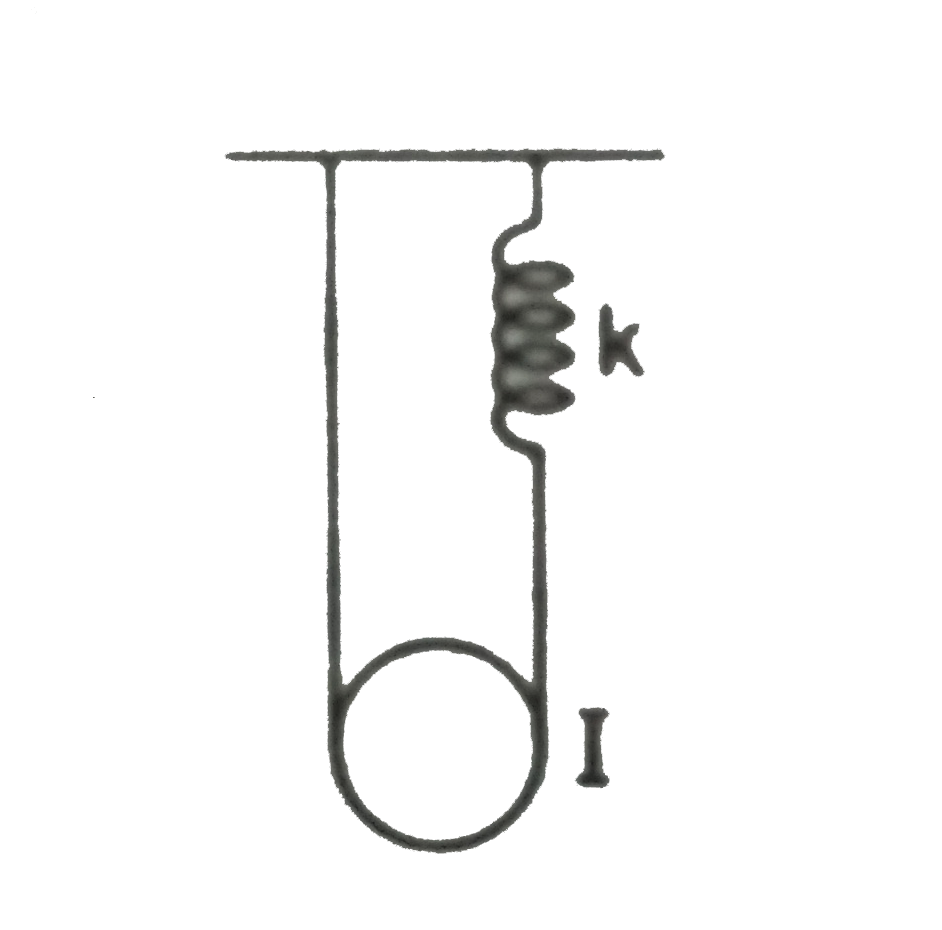
The pulley shown in figure has a moment of inertias I about its xis and mss m. find the tikme period of vertical oscillastion of its centre of mass. The spring has spring constant k and the string does not slip over the pulley.

Text Solution

Verified by Experts
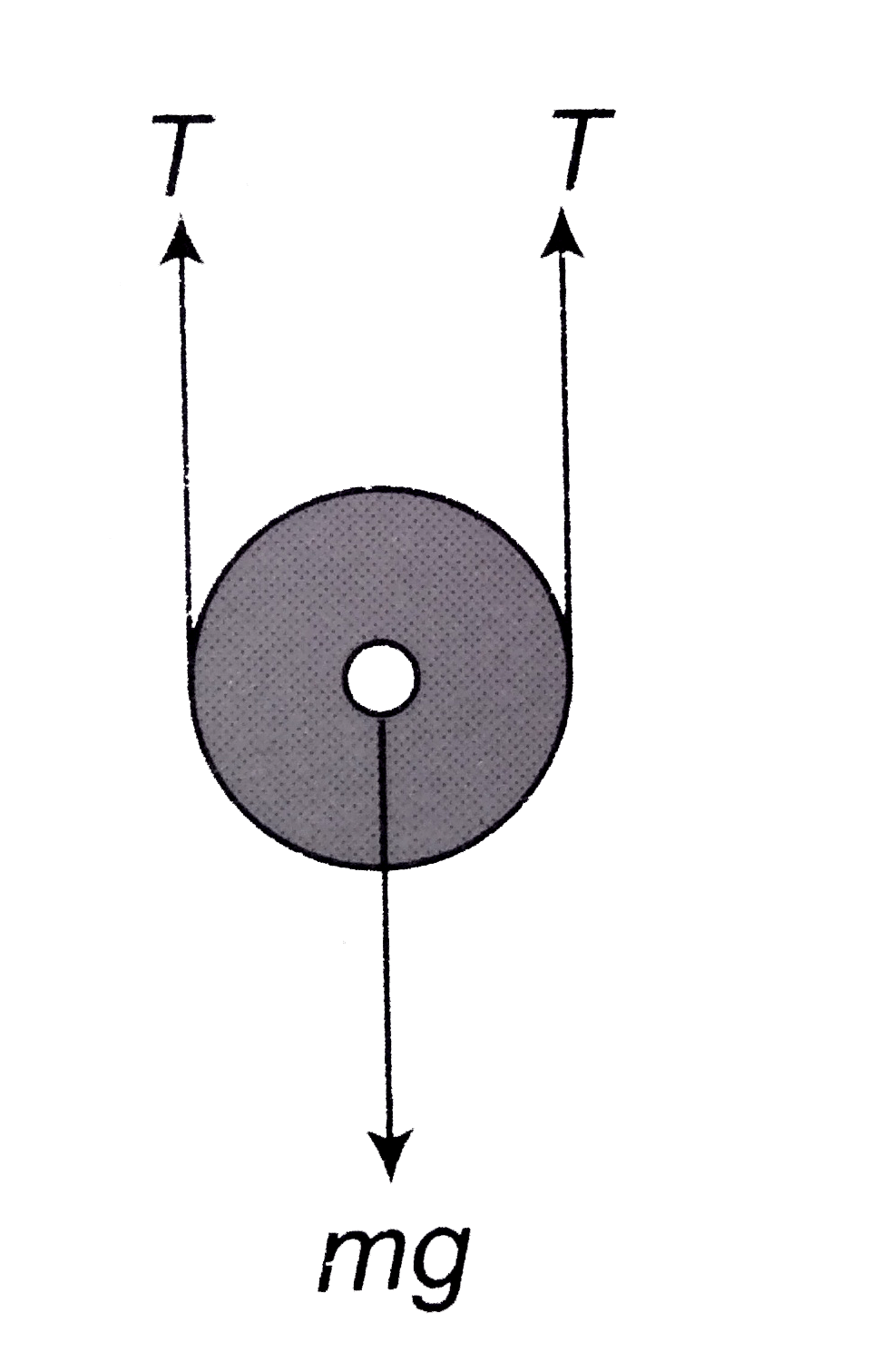
Let in equilibrium extension of spring is `x_0`, tension in spring is `T=kx_0`

`mg=2T=2kx_0`
`x_0=(mg)/(2k)`
After equilibrium position, pulley goes down by x, spring extends by `2x`.
The energy of the system is
`E=1/2mv^2+1/2Iomega^2-mgx+1/2k(x_0+2x)^2`
`=1/2mv^2+1/2I(v^2)/(r^2)-mgx+1/2k(x_0+2x)^2`
Since total energy is constant
`(dE)/(dt)=0`
`0=1/2(m+I/r^2)2v(dv)/(dt)-mg((dx)/(dt))`
`+1/2k*2(x_0+2x)2(dx)/(dt)`
`=(m+I/r^2)va-mgv+2k(x_0+2x)v`
`=(m+I/r^2)a-mg+2kx_0+4kx`
`(m+I/r^2)a=-4kx`
`a=-(4k)/((m+I//r^2))x=-omega^2x`
`T=2pisqrt((m+I//r^2)/(4k))`
Promotional Banner

Topper's Solved these Questions

  • SIMPLE HARMONIC MOTION

    CP SINGH|Exercise Exercises|125 Videos
  • ROTATIONAL MOTION

    CP SINGH|Exercise Exercise|172 Videos
  • SOUND WAVES

    CP SINGH|Exercise Exercises|130 Videos

Similar Questions

Explore conceptually related problems

The pulley of mass m shown in figure has moment of inertia I about its axis. Find the time period of vertical oscillation of its centre of mass. The spring has spring constant k and the string does not slip over the pulley.

The pulley shown in figure has a moment of inertia I about it's axis and its radius is R. Find the magnitude of the acceleration of the two blocks. Assume that the string is light and does not slip on the pulley.

Find the time period of oscillation of block of mass m. Spring, and pulley are ideal. Spring constant is k.

Figure shows two blocks of masses m and M connected bky a string pasing over a pulley. The horizontal table over which the mass m slides is smooth. The pulley has a radius r and moment of inertia I about its axis and it can freely rotte about this axis. Find the accelerationof the mass M asuming that the string does not slip on the pulley.

In the situation as shown in figure time period of small vertical oscillation of block will be - (String, springs and pulley are ideal)

An object of mass m, oscillating on the end of a spring with spring constant k has amplitude A. its maximum speed is

The pulley shown in figure has a radius 10 cm and moment of inertia 0.5 kg-m^2 about its axis. Assuming the inclined planes to be frictionless, calculate the acceleration of the 4.0 kg block.

Find the frequency of small oscillations of the arrangement illustrated in figure. The radius of the pulley is R , its moment of inertia relative to the rotation axis is I , the mass of the body is m , and the spring stiffness is x .The mass of the thread and the spring is negligible , the thread does not slide over the pulley, there is no friction in the axis of the pulley

CP SINGH-SIMPLE HARMONIC MOTION-Exercises
  1. The pulley shown in figure has a moment of inertias I about its xis an...

    Text Solution

    |

  2. Select the correct statements. (i) A simple harmonic motion is neces...

    Text Solution

    |

  3. A student says that he had applied a force F=-ksqrtx on a particle and...

    Text Solution

    |

  4. Which of the following quantities are always negative in a simple har...

    Text Solution

    |

  5. Which of the followign quantities are always zero in a simple harmonic...

    Text Solution

    |

  6. The time period of a particle in simple harmonic motion is equal to th...

    Text Solution

    |

  7. The average acceleration in one tiome period in a simple harmonic moti...

    Text Solution

    |

  8. A partilce is executive simple harmonic motion given by x=5sin(4t-pi...

    Text Solution

    |

  9. A particle starts SHM from the mean position. Its amplitude is A and t...

    Text Solution

    |

  10. A body of mass 5g is executing SHM with amplitude 10cm, its velocity i...

    Text Solution

    |

  11. A particle is vibrating in SHM. If its velocities are v1 and v2 when t...

    Text Solution

    |

  12. The phase (at a time t) of a particle in simple harmonic motion tells

    Text Solution

    |

  13. Which of the following equation does not represent a simple harmonic m...

    Text Solution

    |

  14. Which of the following is a simple harmonic motion

    Text Solution

    |

  15. The equation of SHM of a particle is (d^2y)/(dt^2)+ky=0, where k is a ...

    Text Solution

    |

  16. A particle is executing SHM. Then the graph of acceleration as a funct...

    Text Solution

    |

  17. A particle is executing SHM. Then the graph of velocity as a function ...

    Text Solution

    |

  18. For a simple pendulum the graph between length and time period will be

    Text Solution

    |

  19. Out of the following function reporesenting motion of a particle which...

    Text Solution

    |

  20. A particle excuting S.H.M. of amplitude 4 cm and T = 4 sec .The time t...

    Text Solution

    |

  21. A particle is executing SHM of amplitude 4cm and time period 12s. The ...

    Text Solution

    |

