Home
Class 11
PHYSICS
(a) A particle is subjected to two simpl...

(a) A particle is subjected to two simple harmonic motions
`x_1=A_1sin omegat` and `x_2=A_2 sin (omegat+pi//3)`.
Find (i) the displacement at `t=0`, (ii) the maximum speed of the particle and (iii) the maximum acceleration of the particle.
(b) A particle is subjected to two simple harmonic motions, one along the x-axis and the other on a line making an angle of `45^@` with the x-axis. The two motions are given by
`xy=x_0sinomegat` and `s=s_0sin omegat`
Find the amplitude of the resultant motion.

Text Solution

Verified by Experts
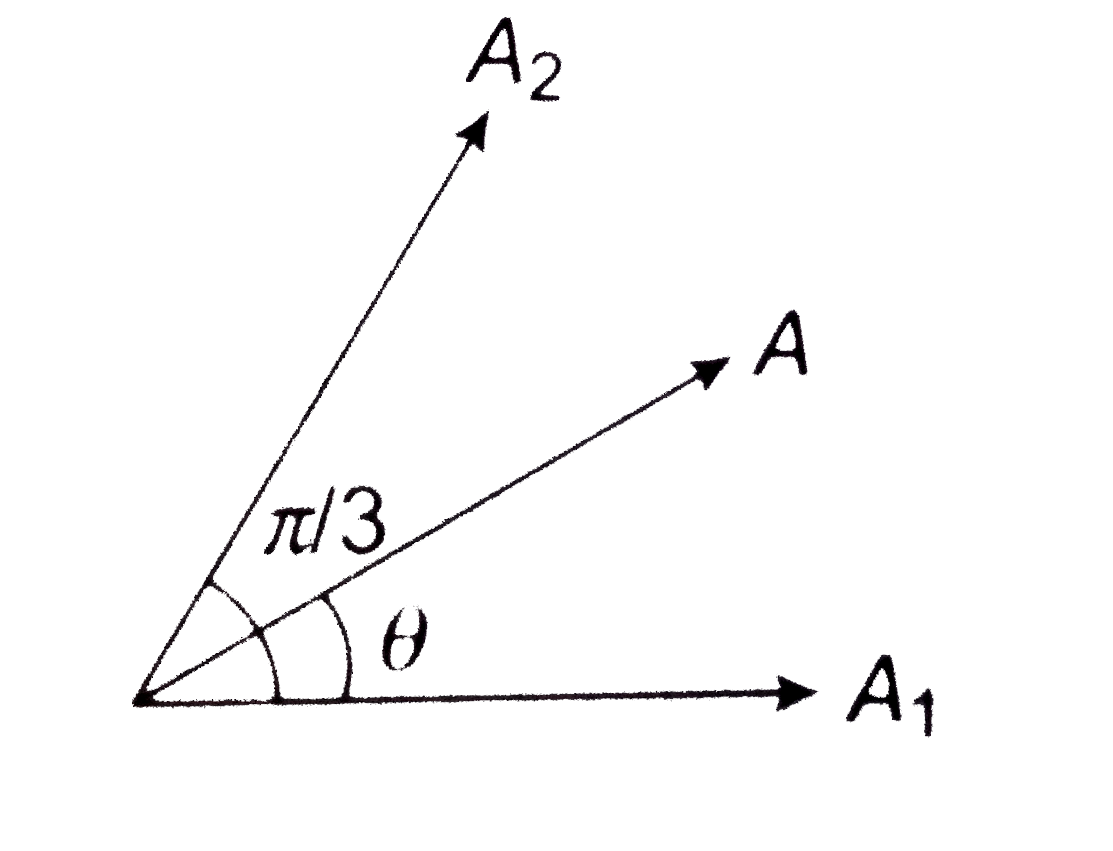
(a) `x_1=A_1sinomegat`, `x_2=A_2sin(omegat+pi//3)`
`x=x_1+x_2=Asin(omegat+phi)`

`A=sqrt(A_1^2+A_2^2+2A_1A_2cos(phi=pi//3))`
`=(A_1^2+A_2^2+A_1A_2)^(1/2)`
`tan theta=(A_2sinpi//3)/(A_1+A_2cospi/3)=(A_2xxsqrt3//2)/(A_1+A_2xx1//2)`
`=(sqrt3A_2)/(2A_1+A_2)`
(i) `x=Asin(omegat+theta)`
At `t=0`, `x=Asintheta`
`=(A_1^2+A_2^2+A_1A_2)^(1/2)(sqrtA_2)/((4A_1^2+A_2^2+4A_1A_2+3A_2^2)^(1/2))`
`=(sqrt3A_2)/(2)`
OR
`t=0`, `x_1=A_1sinomegat=0`,
`x_2=A_2sin(omegat+pi//3)=(sqrt3A_2)/(2)`
`x=x_1+x_2=(A_2sqrt3)/(2)`
(ii) `v_(max)=omegaA=omega(A_1^2+A_2^2+A_1A_2)^(1/2)`
(iii) `a_(max)=omega^2A=omega^2(A_1^2+A_2^2+A_1A_2)^(1/2)`
(b) `x=x_0 sin omega t` along x-axis
`s=s_0 sin omegat` along `y=x` line
component of s along coordinate axes
`x^'=s_0sinomegatcos45^@=s_0/sqrt2 omegat`
`y^'=s_0sin omegat sin 45^@=s_0/sqrt2 sin omegat`
`X=x+x^'=(x_0+s_0/sqrt2)sin omegat`, `Y=y^'=(s_0)/(sqrt2)sinomegat`
`r=sqrt(X^2+Y^2)=[(x_0+s_0/sqrt2)^2+(s_0/sqrt2)^2]^(1/2)sin omegat`
Resultant amplitude
`=[(x_0+s_0/sqrt2)^2+(s_0/sqrt2)^2]^(1/2)=[x_0^2+s_0^2+sqrt2x_0s_0]^(1/2)`
Promotional Banner

Topper's Solved these Questions

  • SIMPLE HARMONIC MOTION

    CP SINGH|Exercise Exercises|125 Videos
  • ROTATIONAL MOTION

    CP SINGH|Exercise Exercise|172 Videos
  • SOUND WAVES

    CP SINGH|Exercise Exercises|130 Videos

Similar Questions

Explore conceptually related problems

A particle is subjected to two simple harmonic motions, one along the X-axis and the other on a line making an angle of 45^@ with the X-axis. The two motions are given by x=x_0 sinomegat and s=s_0 sin omegat . find the amplitude of the resultant motion.

A partical is subjucted to two simple harmonic motions x_(1) = A_(1) sin omega t and x_(2) = A_(2) sin (omega t + pi//3) Find(a) the displacement at t = 0 , (b) the maximum speed of the partical and ( c) the maximum acceleration of the partical.

A particle is subjected to two simple harmonic motions x_1=A_1 sinomegat and x_2=A_2sin(omegat+pi/3) Find a the displacement at t=0, b. the maxmum speed of the particle and c. the maximum acceleration of the particle

A particle is subjected to two simple harmonic motions. x_(1) = 4.0 sin (100pi t) and x_(2) = 3.0 sin(100pi t + (pi)/(3)) Find (a) the displacement at t = 0 (b) the maximum speed of the particle and (c ) the maximum acceleration of the particle.

A 20g particle is subjected to two simple harmonic motions x_1=2sin10t , x_2=4sin(10t+(pi)/(3)) . Where x_1 and x_2 are in metres and t is in seconds.

A particle is subjected to two simple harmonic motions along x and y directions according to x=3sin100pit , y=4sin100pit .

A particle is subjected to two simple harmonic motions x_(1)=4 sin(100pit) and x_(2)==3 sin ^((100pi t + (pi)/(2)) Then maximum acceleration of the particle is

A 20gm particle is subjected to two simple harmonic motions x_(1)=2 sin 10t, x_(2)=4 sin (10t+(pi)/(3)) , where x_(1) & x_(2) are in metre & t is in sec .

A particle is subjected to two SHMs x_(1) = A_(1) sin omegat and x_(2) = A_(2)sin (omegat +(pi)/(4)) . The resultant SHM will have an amplitude of

In simple harmonic motion,the particle is

CP SINGH-SIMPLE HARMONIC MOTION-Exercises
  1. (a) A particle is subjected to two simple harmonic motions x1=A1sin ...

    Text Solution

    |

  2. Select the correct statements. (i) A simple harmonic motion is neces...

    Text Solution

    |

  3. A student says that he had applied a force F=-ksqrtx on a particle and...

    Text Solution

    |

  4. Which of the following quantities are always negative in a simple har...

    Text Solution

    |

  5. Which of the followign quantities are always zero in a simple harmonic...

    Text Solution

    |

  6. The time period of a particle in simple harmonic motion is equal to th...

    Text Solution

    |

  7. The average acceleration in one tiome period in a simple harmonic moti...

    Text Solution

    |

  8. A partilce is executive simple harmonic motion given by x=5sin(4t-pi...

    Text Solution

    |

  9. A particle starts SHM from the mean position. Its amplitude is A and t...

    Text Solution

    |

  10. A body of mass 5g is executing SHM with amplitude 10cm, its velocity i...

    Text Solution

    |

  11. A particle is vibrating in SHM. If its velocities are v1 and v2 when t...

    Text Solution

    |

  12. The phase (at a time t) of a particle in simple harmonic motion tells

    Text Solution

    |

  13. Which of the following equation does not represent a simple harmonic m...

    Text Solution

    |

  14. Which of the following is a simple harmonic motion

    Text Solution

    |

  15. The equation of SHM of a particle is (d^2y)/(dt^2)+ky=0, where k is a ...

    Text Solution

    |

  16. A particle is executing SHM. Then the graph of acceleration as a funct...

    Text Solution

    |

  17. A particle is executing SHM. Then the graph of velocity as a function ...

    Text Solution

    |

  18. For a simple pendulum the graph between length and time period will be

    Text Solution

    |

  19. Out of the following function reporesenting motion of a particle which...

    Text Solution

    |

  20. A particle excuting S.H.M. of amplitude 4 cm and T = 4 sec .The time t...

    Text Solution

    |

  21. A particle is executing SHM of amplitude 4cm and time period 12s. The ...

    Text Solution

    |

