Home
Class 11
PHYSICS
The ratio of the amplitudes of the simpl...

The ratio of the amplitudes of the simple harmonic oscillations given by `y_1=Asinomegat` and

A

`1`

B

`2`

C

`1//sqrt2`

D

`sqrt2`

Text Solution

Verified by Experts

The correct Answer is:
D

`y_1=Asinomegat` (i)
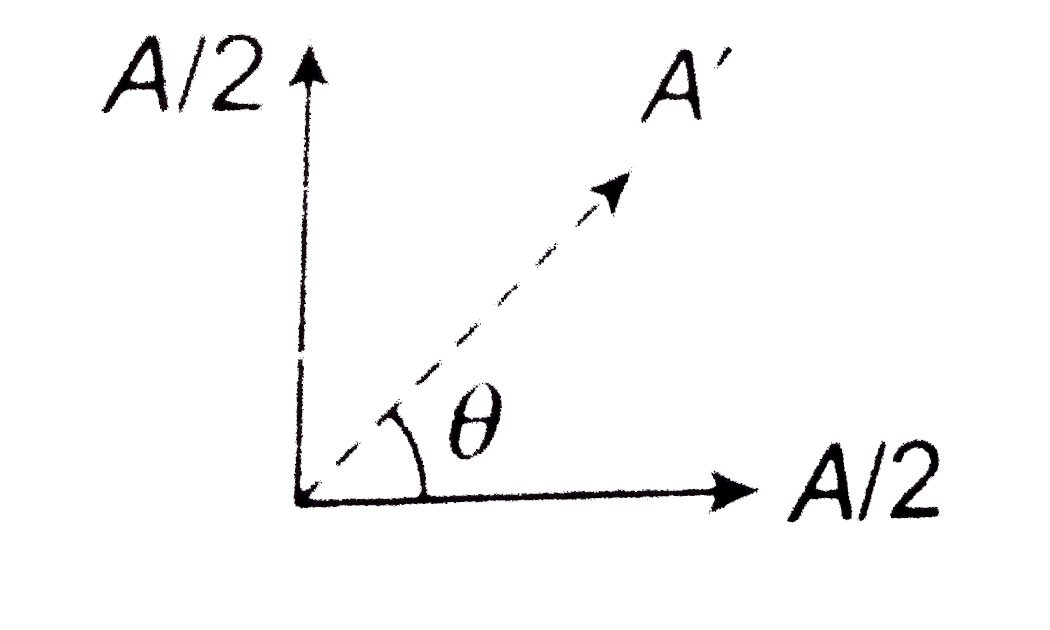
`y_2=A/2sinomegat+A/2cosomegat`
`=A/2sinomegat+A/2sin(pi/2+omegat)`
`=A^'sin(omegat+theta)`

`A^'=sqrt2.A/2=A/sqrt2`
`theta=45^@=pi//4`
`y_2=A/sqrt2sin(omegat+pi//4)`
`A/A^'=(A)/(A//sqrt2)=sqrt2`
OR
`y_2=A/2sinomegat+A/2cosomegat=A/2(sinomegat+cosomegat)`
`=A/2sqrt2(1/sqrt2sinomegat+1/sqrt2cosomegat)`
`=A/2sqrt2(sinomegatcospi//4+cosomegatsinpi//4)`
`=A/sqrt2sin(omegat+pi//4)`
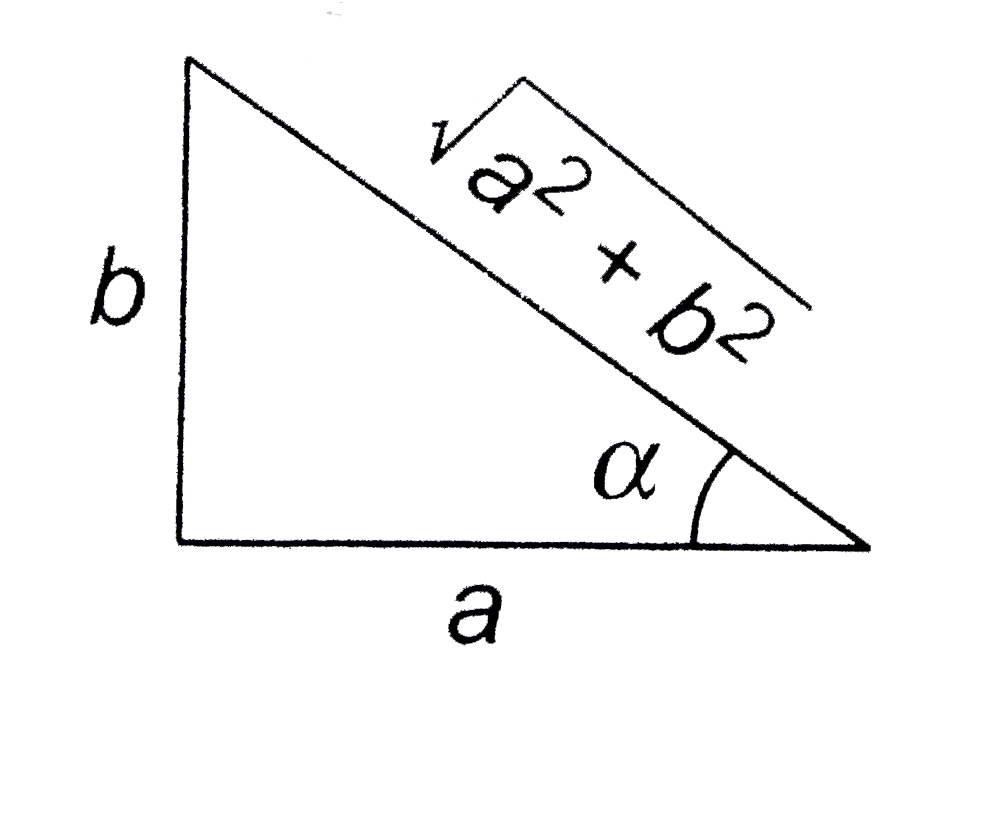
Note: `a sin theta+b cos theta` (can be converted into a single term as)
`=sqrt(a^2+b^2)((a)/(sqrt(a^2+b^2))sintheta+(b)/(sqrt(a^2+b^2))costheta)`

`=sqrt(a^2+b^2)(sinthetacostheta+costhetasinalpha)`
`=sqrt(a^2+b^2)sin(theta+alpha)`
Promotional Banner

Topper's Solved these Questions

  • SIMPLE HARMONIC MOTION

    CP SINGH|Exercise Exercises|125 Videos
  • ROTATIONAL MOTION

    CP SINGH|Exercise Exercise|172 Videos
  • SOUND WAVES

    CP SINGH|Exercise Exercises|130 Videos

Similar Questions

Explore conceptually related problems

Simple harmonic oscillations are

The phase of simple harmonic oscillator is

The amplitude of given simple harmonic motion is y=(3sinomegat+4cosomegat)m

The displacement equation of a simple harmonic oscillator is given by y=A sin omegat-Bcos omegat The amplitude of the oscillator will be

Assertion: If the amplitude of a simple harmonic oscillator is doubled, its total energy becomes double. Reason: The toal energy is directly proportional to the amplitude of vibration of the harmonic oscillator.

The displacement of a particle executing simple harmonic motion is given by y=A_(0)+Asinomegat+Bcosomegat Then the amplitude of its oscillation is given by :

In a simple harmonic oscillator, at the mean position

The displacement of a particle executing simple harmonic motion is given by y=A_(0)+A sin omegat+B cos omegat . Then the amplitude of its oscillation is given by

CP SINGH-SIMPLE HARMONIC MOTION-Exercises
  1. The motion of a particle is given by x=A sin omegat+Bcos omegat. The m...

    Text Solution

    |

  2. A particle moves on the X-axis according to the equation x=A+Bsinomega...

    Text Solution

    |

  3. The ratio of the amplitudes of the simple harmonic oscillations given ...

    Text Solution

    |

  4. The minimum phase difference between the two simple harmonic oscillati...

    Text Solution

    |

  5. A body executes SHM of period 3s under the influence of one force, and...

    Text Solution

    |

  6. The displacement of a particle is given by r=A(haticosomegat+hatjsinom...

    Text Solution

    |

  7. Electrons in an oscilloscope are deflected by two mutually perpendicul...

    Text Solution

    |

  8. Two particles A and B execute simple harmonic motions of period T and ...

    Text Solution

    |

  9. Two simple pendulum of length 5m and 20m respectively are given small ...

    Text Solution

    |

  10. Two simple pandulum whose lengths are 100cm and 121cm are suspended si...

    Text Solution

    |

  11. Two particles execute SHM of the same time period along the same strai...

    Text Solution

    |

  12. Two pendulum of lengths 1m and 16m are in phase at the mean position a...

    Text Solution

    |

  13. Time period of is simple pendulum of length L is T(1) and the point ti...

    Text Solution

    |

  14. A disc of radius R and mass M is plvoted at the rim and is set for sma...

    Text Solution

    |

  15. The composition of two simple harmonic motions of equal periods at rig...

    Text Solution

    |

  16. The amplitude and maximum velocity will be respectively X= 3 sin 2t +...

    Text Solution

    |

  17. A particle moves on the X-axis according to the equation x=x0 sin^2ome...

    Text Solution

    |

  18. A particle moves in the X-Y plane according to the equation vecr=(veci...

    Text Solution

    |

  19. A point mass is subjected to two simultaneous sinusoidal displacements...

    Text Solution

    |

  20. Three simle harmionic motions in the same direction having the same am...

    Text Solution

    |