Home
Class 11
PHYSICS
Three simle harmionic motions in the sam...

Three simle harmionic motions in the same direction having the same amplitude (a) and same period are superposed. If each differs in phase from the next by `45^@`, then.

A

(i), (ii)

B

(ii), (iii)

C

(i), (iii)

D

(i), (iv)

Text Solution

Verified by Experts

The correct Answer is:
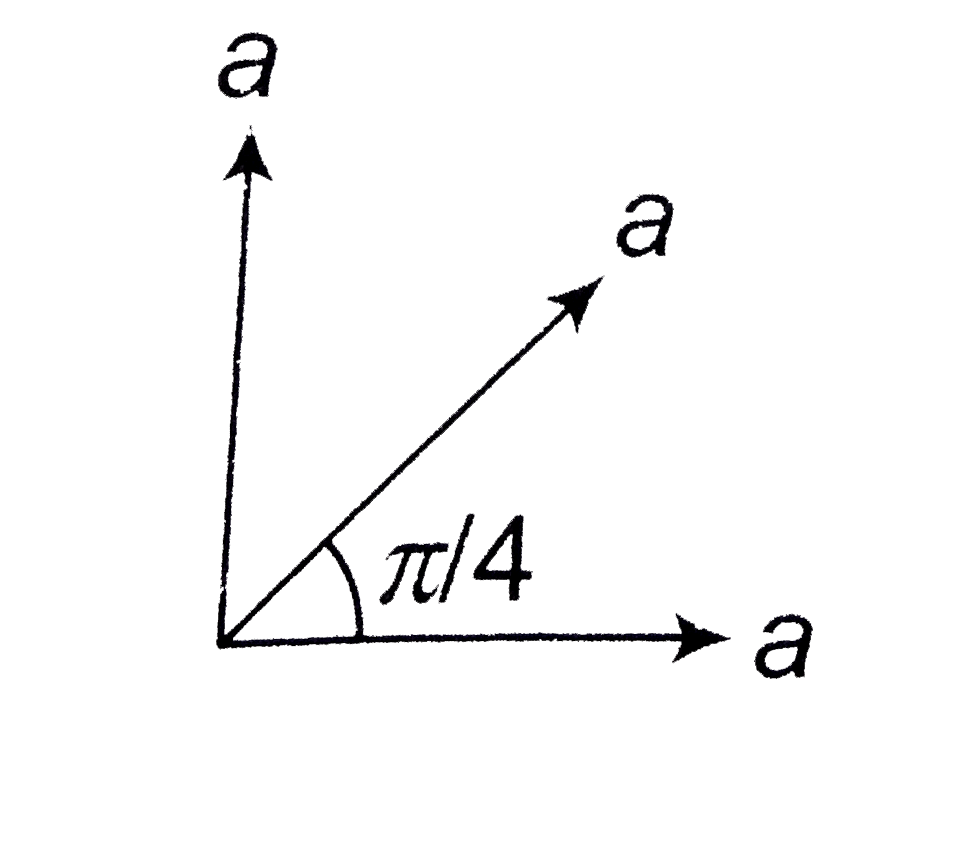
C

`x_1=asinomegat`,
`x_2=asin(omegatt+pi/4)`, `x_3=asin(omegat+pi/2)`
`x=x_1+x_2+x_3=Asin(omegat+theta)`

Resultant amplitude `=sqrt2a+a=(sqrt2+1)a=A`
`theta=pi/4`
`x=(sqrt2+1)asin(omegat+pi/4)`
`E^'/E=A^2/a^2=(sqrt2+1)^2=2+1+2sqrt2=3+2sqrt2`
Promotional Banner

Topper's Solved these Questions

  • SIMPLE HARMONIC MOTION

    CP SINGH|Exercise Exercises|125 Videos
  • ROTATIONAL MOTION

    CP SINGH|Exercise Exercise|172 Videos
  • SOUND WAVES

    CP SINGH|Exercise Exercises|130 Videos

Similar Questions

Explore conceptually related problems

Three simple harmonic motions in the same direction having the same amplitude and same period are superposed. If each differ in phase from the next by 45^(@) , then

Three simple harmonic motions in the same direction having each of amplitude "a" and the same period are superposed. If each differs in phase from the next by pi//4 then

Three simple harmonic motions in the same direction having same amplitude and the same period are superposed. If each differs in phase from the next by lambda//2 then which of the following is wron. ( i ) Resultant amplitude is (sqrt(2)+1) a ( ii ) Phase of resultant motion relative to first is 90^(@) ( iii ) The energy associated with the resulting motion is 3 times the energy associated with any single motion

Three simple harmonic motions in the same direction each of amplitude a and periodic time T , are superposed. The first and second and the second and third differ in phase from each other by (pi)/(4) , with the first and third not being identical . Then.

A particle is subjected to two simple hasrmonic motions in the same direction having equal amplitudes and equal frequency. If the resultant amplitude is equal to the amplitude of the individual motions, find the phase difference between the individual motions.

A particle is subjected to two simple harmonic motion in the same direction having equal amplitudes and equal frequency. If the resultant amplitude is equal to the amplitude of the individual motions. Find the phase difference between the individual motions.

A particle is subjected to two simple harmonic motions in the same direction having equal amplitudes and equal frequency. If the resulting amplitude is equal to the amplitude of individual motions, the phase difference between them is

A particle is subjected to two simple harmonic motions in the same direction having equal amplitude and equal frequency. If the resultant amplitude is equal to the amplitude of individual motions, what is the phase difference between the motions.

When two mutually perpendicular simple harmonic motions of same frequency, amplitude and phase are susperimposed

The vectors of the same quantity having same magnitude and same direction are called __________

CP SINGH-SIMPLE HARMONIC MOTION-Exercises
  1. A particle moves in the X-Y plane according to the equation vecr=(veci...

    Text Solution

    |

  2. A point mass is subjected to two simultaneous sinusoidal displacements...

    Text Solution

    |

  3. Three simle harmionic motions in the same direction having the same am...

    Text Solution

    |

  4. Function x=Asin^2omegat+Bcos^2omegat+Csinomegatcosomegat represents SH...

    Text Solution

    |

  5. A particle of mass m oscillates with simple harmonic motion between po...

    Text Solution

    |

  6. For a particle executing SHM, the displacement x is given by x = A cos...

    Text Solution

    |

  7. A particle of mass m is released from rest and follow a particle part ...

    Text Solution

    |

  8. The free and of a simple pendulum is attached to the ceiling of a box....

    Text Solution

    |

  9. A body of mass m falls from a height h onto the pan of a spring balanc...

    Text Solution

    |

  10. A small block is connected to one end of a massless spring of un - str...

    Text Solution

    |

  11. Suppose a tunnel is dug along a diameter of the earth. A particle is d...

    Text Solution

    |

  12. A simple pendulum has time period (T1). The point of suspension is now...

    Text Solution

    |

  13. A particle of mass (m) is executing oscillations about the origin on t...

    Text Solution

    |

  14. A particle oscillating under a force vecF=-kvecx-bvecv is a (k and b a...

    Text Solution

    |

  15. The amplitude of a vibrating body situated in a resisting medium

    Text Solution

    |

  16. The amplitude of a damped oscillator becomes half in one minutes. The ...

    Text Solution

    |

  17. In case of a forced vibration the resonance wave becomes very sharp wh...

    Text Solution

    |

  18. A particle with restoring force proportional to displacement and resis...

    Text Solution

    |

  19. A weakly damped harmonic oscillator of frequency n1 is driven by an ex...

    Text Solution

    |

  20. The amplitude of vibration of a particle is given by am=(a0)//(aomega^...

    Text Solution

    |

