

Home
Class 11
PHYSICS
A particle of mass m oscillates with sim...

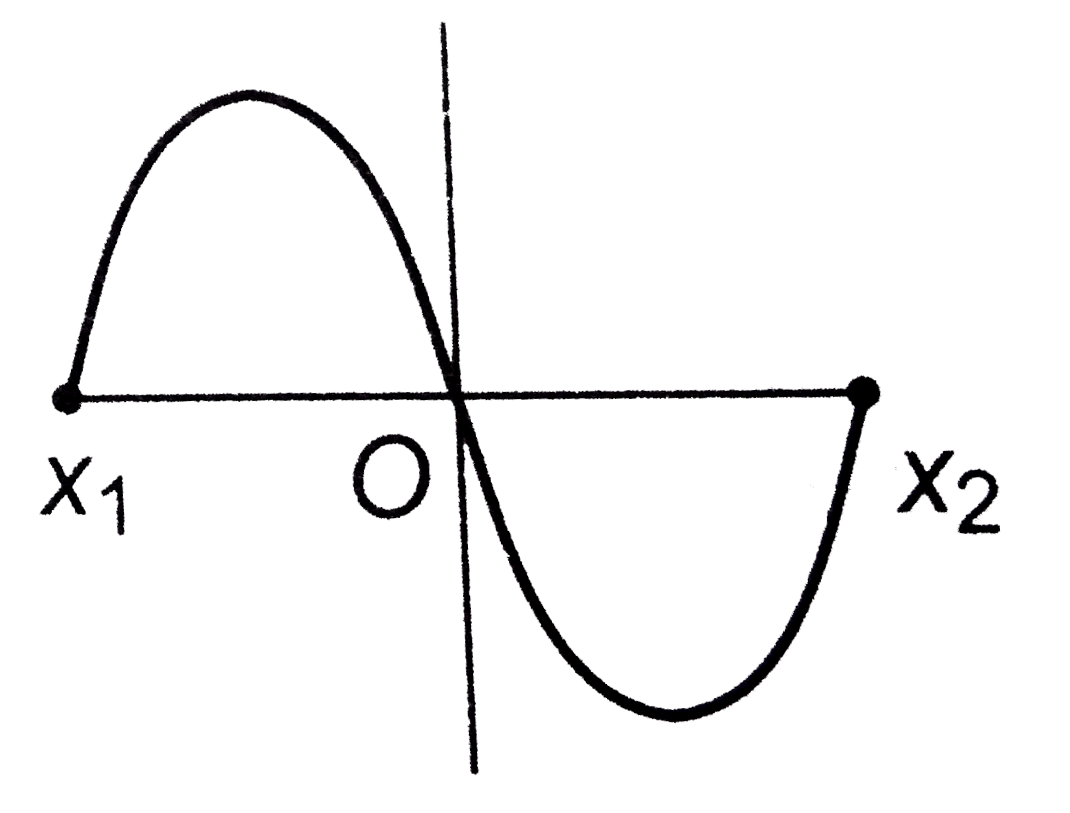
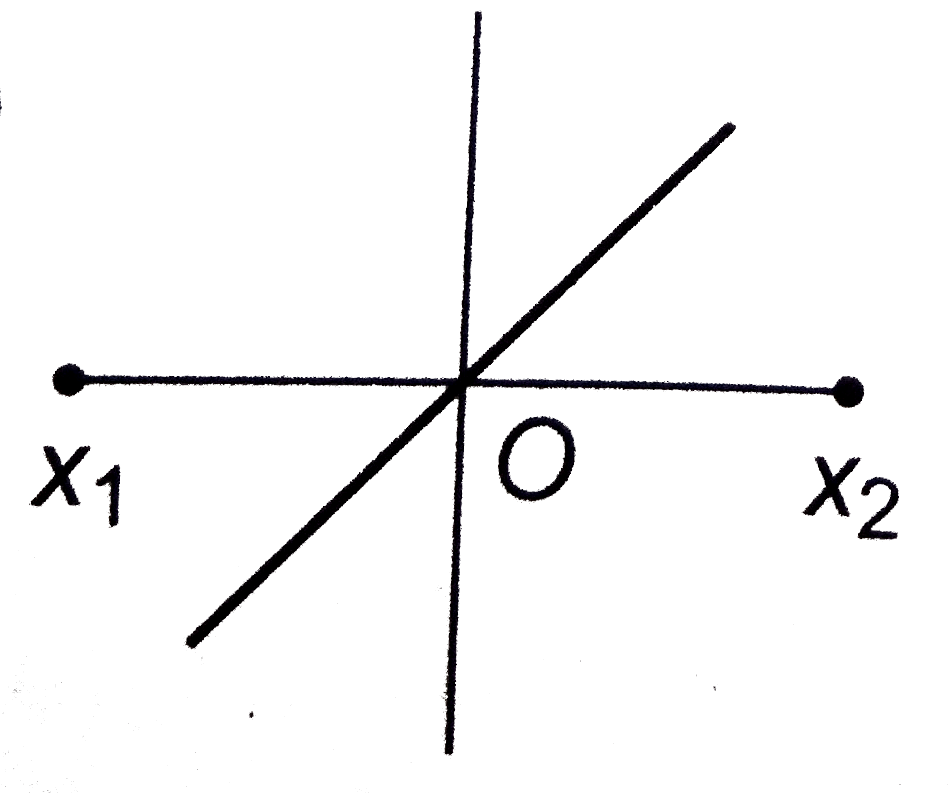
A particle of mass `m` oscillates with simple harmonic motion between points `x_(1)` and `x_(2)` the equilibrium position being `O` its potential energy in plotted it will be as given bellow in the graph

A

B

C

D

Text Solution

Verified by Experts

The correct Answer is:

D


`U=1/2momega^2x^2`
At `O`, `x=0`, `U=0`
U v/s x will be parabola, open upward
Promotional Banner

Topper's Solved these Questions

  • SIMPLE HARMONIC MOTION

    CP SINGH|Exercise Exercises|125 Videos
  • ROTATIONAL MOTION

    CP SINGH|Exercise Exercise|172 Videos
  • SOUND WAVES

    CP SINGH|Exercise Exercises|130 Videos

Similar Questions

Explore conceptually related problems

A particle of mass m oscillates with simple harmonic motion between points x_(1) and x_(2) , the equilibrium position being O. Its potential energy is plotted. It will be as given below in the graph

The potential energy of a particle, executing a simple harmonic motion, at a dis"tan"ce x from the equilibrium position is proportional to

A particle executes simple harmonic motion of ampliltude A. At what distance from the mean position is its kinetic energy equal to its potential energy?

A particle oscillates simple harmonic motion with a period of 16 s . Two second after crossing the equilibrium position its velocity becomes 1 m//s . The amplitude is

A particle is executing simple harmonic motion between exterme positions given by (-1,-2,-3)cm and (1,2,1)cm . Its amplitude of oscillation is

A particle is vibrating in a simple harmonic motion with an amplitude of 4 cm . At what displacement from the equilibrium position, is its energy half potential and half kinetic

A particle starts oscillating simple harmonically from its equilibrium position then, the ration of kinetic energy and potential energy of the particle at the time T//12 is: (T="time period")

A body is executing a simple harmonic motion such that its potential energy is U_(1) at U_(2)at y When the displacement is x+y the potential energy will be

CP SINGH-SIMPLE HARMONIC MOTION-Exercises
  1. Three simle harmionic motions in the same direction having the same am...

    Text Solution

    |

  2. Function x=Asin^2omegat+Bcos^2omegat+Csinomegatcosomegat represents SH...

    Text Solution

    |

  3. A particle of mass m oscillates with simple harmonic motion between po...

    Text Solution

    |

  4. For a particle executing SHM, the displacement x is given by x = A cos...

    Text Solution

    |

  5. A particle of mass m is released from rest and follow a particle part ...

    Text Solution

    |

  6. The free and of a simple pendulum is attached to the ceiling of a box....

    Text Solution

    |

  7. A body of mass m falls from a height h onto the pan of a spring balanc...

    Text Solution

    |

  8. A small block is connected to one end of a massless spring of un - str...

    Text Solution

    |

  9. Suppose a tunnel is dug along a diameter of the earth. A particle is d...

    Text Solution

    |

  10. A simple pendulum has time period (T1). The point of suspension is now...

    Text Solution

    |

  11. A particle of mass (m) is executing oscillations about the origin on t...

    Text Solution

    |

  12. A particle oscillating under a force vecF=-kvecx-bvecv is a (k and b a...

    Text Solution

    |

  13. The amplitude of a vibrating body situated in a resisting medium

    Text Solution

    |

  14. The amplitude of a damped oscillator becomes half in one minutes. The ...

    Text Solution

    |

  15. In case of a forced vibration the resonance wave becomes very sharp wh...

    Text Solution

    |

  16. A particle with restoring force proportional to displacement and resis...

    Text Solution

    |

  17. A weakly damped harmonic oscillator of frequency n1 is driven by an ex...

    Text Solution

    |

  18. The amplitude of vibration of a particle is given by am=(a0)//(aomega^...

    Text Solution

    |

  19. The equation (d^2y)/(dt^2)+b(dy)/(dt)+omega^2y=0 represents the eq...

    Text Solution

    |

  20. The equation of a damped simple harmonic motion is m(d^2x)/(dt^2)+b(dx...

    Text Solution

    |

