Home
Class 11
PHYSICS
A small block is connected to one end of...

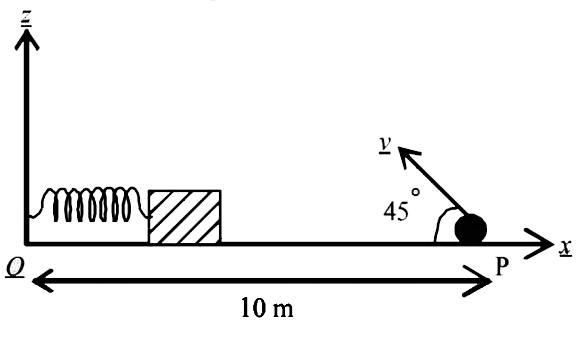
A small block is connected to one end of a massless spring of un - stretched length `4.9 m`. The other end of the spring (see the figure) is fixed. The system lies on a horizontal frictionless surface. The block is stretched by `0.2 m` and released from rest at `t = 0`. It then executes simple harmonic motion with angular frequency `(omega) = (pi//3) rad//s`. Simultaneously at `t = 0`, a small pebble is projected with speed (v) from point (P) at an angle of `45^@` as shown in the figure. Point (P) is at a horizontal distance of `10 m from O`. If the pebble hits the block at `t = 1 s`, the value of (v) is `(take g = 10 m//s^2)`.
.

A

`sqrt50m//s`

B

`sqrt(51)m//s`

C

`sqrt(52)m//s`

D

`sqrt(53)m//s`

Text Solution

Verified by Experts

The correct Answer is:

A

For block `x=Asin(omegat+phi)`
`t=0`, `x=Aimpliessinphi=1impliesphi=pi//2`
`x=Asin(omegat+phi)=Asin(omegat+pi//2)=Acosomegat`
At `t=1s`, `x=Acosomegaxx1=0.2cos((2pi)/(3))=0.1m`
Distance of block from `O=4.9+0.1=5m`
Range for pebble `=10-5=5m`
`R=(v^2)/(g)sin(2xx45^@)`
`5=(v^2)/(10)impliesv=sqrt(50)m//s`
Promotional Banner

Topper's Solved these Questions

  • SIMPLE HARMONIC MOTION

    CP SINGH|Exercise Exercises|125 Videos
  • ROTATIONAL MOTION

    CP SINGH|Exercise Exercise|172 Videos
  • SOUND WAVES

    CP SINGH|Exercise Exercises|130 Videos

Similar Questions

Explore conceptually related problems

A small block is connected to one end of a massless spring of un-stretched length 4.9 m. The other end of the spring (see the figure) is fixed. The system lies on a horizontal frictionless surface. The block is stretched by 0.2 m and released from rest at t = 0. It then executes simple harmonic motion with angular frequency omega = (pi)/(3) rad/s . Simultaneously at t = 0, a small pebble is projected with speed nu from point P at an angle of 45^(@) as shown in the figure. Point P is at a horizontal distance of 10 m from O. If the pebble hits the block at t = 1s, the value of nu is (take g = 10 m/ s^(2) )

A 100 g block is connected to a horizontal massless spring of force constant 25.6(N)/(m) As shown in Fig. the block is free to oscillate on a horizontal frictionless surface. The block is displaced 3 cm from the equilibrium position and , at t=0 , it is released from rest at x=0 It executes simple harmonic motion with the postive x-direction indecated in Fig. The position time (x-t) graph of motion of the block is as shown in Fig. Q. When the block is at position A on the graph, its

A 100 g block is connected to a horizontal massless spring of force constant 25.6(N)/(m) As shown in Fig. the block is free to oscillate on a horizontal frictionless surface. The block is displaced 3 cm from the equilibrium position and , at t=0 , it is released from rest at x=0 It executes simple harmonic motion with the postive x-direction indecated in Fig. The position time (x-t) graph of motion of the block is as shown in Fig. Q. When the block is at position B on the graph its.

A 100 g block is connected to a horizontal massless spring of force constant 25.6(N)/(m) As shown in Fig. the block is free to oscillate on a horizontal frictionless surface. The block is displaced 3 cm from the equilibrium position and , at t=0 , it is released from rest at x=0 It executes simple harmonic motion with the postive x-direction indecated in Fig. The position time (x-t) graph of motion of the block is as shown in Fig. When the block is at position C on the graph, its

A 100 g block is connected to a horizontal massless spring of force constant 25.6(N)/(m) As shown in Fig. the block is free to oscillate on a horizontal frictionless surface. The block is displaced 3 cm from the equilibrium position and , at t=0 , it is released from rest at x=0 It executes simple harmonic motion with the postive x-direction indecated in Fig. The position time (x-t) graph of motion of the block is as shown in Fig. Position of the block as a function of time can now be expressed as

A 100 g block is connected to a horizontal massless spring of force constant 25.6(N)/(m) As shown in Fig. the block is free to oscillate on a horizontal frictionless surface. The block is displaced 3 cm from the equilibrium position and , at t=0 , it is released from rest at x=0 It executes simple harmonic motion with the postive x-direction indecated in Fig. The position time (x-t) graph of motion of the block is as shown in Fig. Velocity of the block as a function of time can be expressed as

A particle of mass m is fixed to one end of a massless spring of spring constant k and natural length l_(0) . The system is rotated about the other end of the spring with an angular velocity omega ub gravity-free space. The final length of spring is

A block of mass m is attached to one end of a mass less spring of spring constant k. the other end of spring is fixed to a wall the block can move on a horizontal rough surface. The coefficient of friction between the block and the surface is mu then the compession of the spring for which maximum extension of the spring becomes half of maximum compression is .

A spring with one end attached to a mass and the other to a right support is stretched and released

CP SINGH-SIMPLE HARMONIC MOTION-Exercises
  1. Three simle harmionic motions in the same direction having the same am...

    Text Solution

    |

  2. Function x=Asin^2omegat+Bcos^2omegat+Csinomegatcosomegat represents SH...

    Text Solution

    |

  3. A particle of mass m oscillates with simple harmonic motion between po...

    Text Solution

    |

  4. For a particle executing SHM, the displacement x is given by x = A cos...

    Text Solution

    |

  5. A particle of mass m is released from rest and follow a particle part ...

    Text Solution

    |

  6. The free and of a simple pendulum is attached to the ceiling of a box....

    Text Solution

    |

  7. A body of mass m falls from a height h onto the pan of a spring balanc...

    Text Solution

    |

  8. A small block is connected to one end of a massless spring of un - str...

    Text Solution

    |

  9. Suppose a tunnel is dug along a diameter of the earth. A particle is d...

    Text Solution

    |

  10. A simple pendulum has time period (T1). The point of suspension is now...

    Text Solution

    |

  11. A particle of mass (m) is executing oscillations about the origin on t...

    Text Solution

    |

  12. A particle oscillating under a force vecF=-kvecx-bvecv is a (k and b a...

    Text Solution

    |

  13. The amplitude of a vibrating body situated in a resisting medium

    Text Solution

    |

  14. The amplitude of a damped oscillator becomes half in one minutes. The ...

    Text Solution

    |

  15. In case of a forced vibration the resonance wave becomes very sharp wh...

    Text Solution

    |

  16. A particle with restoring force proportional to displacement and resis...

    Text Solution

    |

  17. A weakly damped harmonic oscillator of frequency n1 is driven by an ex...

    Text Solution

    |

  18. The amplitude of vibration of a particle is given by am=(a0)//(aomega^...

    Text Solution

    |

  19. The equation (d^2y)/(dt^2)+b(dy)/(dt)+omega^2y=0 represents the eq...

    Text Solution

    |

  20. The equation of a damped simple harmonic motion is m(d^2x)/(dt^2)+b(dx...

    Text Solution

    |
