Home
Class 11
PHYSICS
An aluminium cube of side 20cm floats in...

An aluminium cube of side `20cm` floats in mercury. How much farther will the block sink when tempereture rises from `27^(@)C` to `77^(@)C` ? Density of aluminium and mercury at `27^(@)C` are `2.7` and `13.6g//cc` while the coeficient of volume expansion of mercury and linear expansion of aluminium are `1.8xx10^(-4)//^(@)C` and `23xx10^(-6)//^(@)C` respectively.

Text Solution

Verified by Experts
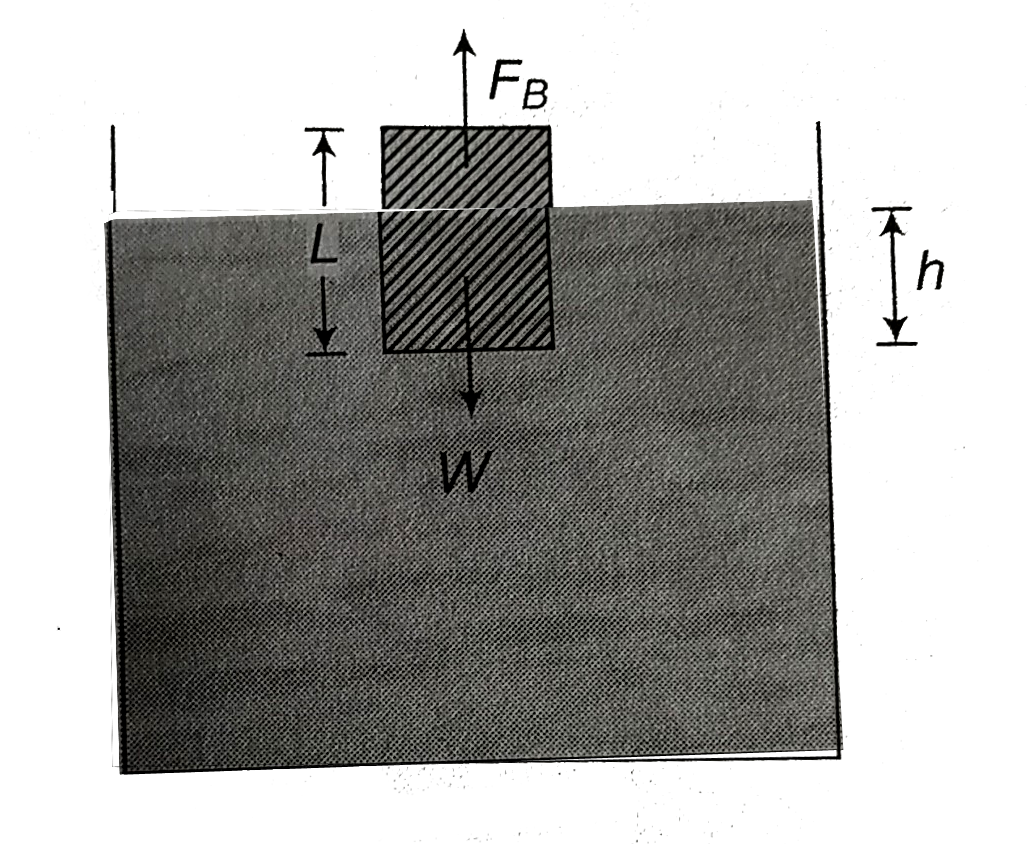
In case of floatation
Weight=Upthrust
`W=F_(b)`
`sigmaV_(g)=pV'_(g)`
`sigmaV=pV'`
`sigma` : density of material of block
`p` : density of liquid
`V` , volume of block
`V'` : immersed volume of block
`sigmaV=pV'`
`sigmaL^(3)=pL^(2)h`
`h=(sigma)/(p)L=(2.7xx20)/(13.6)=3.97cm`
`L` : side of cube, `h` : length of cube immersed in liquid As weight of block remains same `sigmaV_(g)=p_(27)V'_(27)g=p_(27)V'_(77)g`
`p_(27)L^(2)h=p_(77)L'^(2)h'`
`L'=L(1+alpha_(s)Deltatheta),p_(77)=(p_(27))/(1+gamma_(m)Deltatheta)`
`(h')/(h)=((1+gamma_(m)Deltatheta))/((1+alpha_(s)Deltatheta)^(2))=((1+gamma_(m)Deltatheta))/((1+2alpha_(s)Deltatheta))`
`=(1+gamma_(m)Deltatheta)(1+2alphaDeltatheta)=1+(gamma_(m)-2alpha_(s))Deltatheta`
`=1+(1.8xx10^(-4)-2xx23xx10^(-6))(77-27)`
`=1.0067`
`Deltah=h-h=0.0067h=0.0067xx3.97=0.0266cm`
Promotional Banner

Topper's Solved these Questions

  • TEMPERATURE AND THERMAL EXPANSION

    CP SINGH|Exercise EXERCISES|64 Videos
  • SOUND WAVES

    CP SINGH|Exercise Exercises|130 Videos
  • UNITS, DIMENIONS AND MEASUREMENTS

    CP SINGH|Exercise Exercises|63 Videos

Similar Questions

Explore conceptually related problems

An iron rod of length 50cm is joined at an end to an aluminium rod of length 100cm . All measurements refer to 20^(@)C . Find the length of the composite system at 100^(@)C and its average coefficient of linear expansion. The coefficient of linear expansion of iron and aluminium are 12xx10^(-6)//^(@)C and 24xx10^(-6)//^(@)C respectively.

Find the ratio of the lengths of an iron rod and an aluminium rod for which the difference in the lengths in independent of temperature. Coefficients of linear expansion of iron and aluminium are 12 xx10^(-6) 0^C^(-1) and 23 xx 10^(-6) 0^C(-1) respectively.

What should be the sum of lengths of an aluminium and steel rod at 0^(@)C is, so that all the temperature their difference in length is 0.25m . (Take coefficient of linear expansion for aluminium and steel at 0^(@)C as 22 xx 10^(-6)//.^(@)C and 11 xx 10^(-5)//.^(@)C respectively.)

A glass flask of volume one litre at 0^(@)C is filled level full of mercury at this temperature. The flask and mercury are now heating to 100^(@)C . How much mercury will spill out if coefficient of volume expansion of mercury is 1.2xx10^(-4)//^(@)C and linear expansion of glass is 1.0xx10^(-4)//^(@)C respectively ?

A glass flask of volume one litre at 0^(@)C is filled, level full of mercury at this temperature. The flask and mercury are now heated to 100^(@)C . How much mercury will spill out if coefficient of volume expansion of mercury is 1.82 xx 10^(-4)//^(@)C and linear expansion of glass is 0.1 xx 10^(-4)//^(@)C respectively?

An iron rod of length 50 cm is joined at an end to an aluminum rod of length 100 cm. All measurements refer to 20^(@)C . The coefficients of linear expansion of iron and aluminum are 12xx10^(-6)//^(@)C and 24xx10^(-6)//^(@)C , respectively. The average coefficient of expansion of composite system is :

A glass vessel of volume 100 cm^(3) is filled with mercury and is heated from 25^(@)C to 75^(@)C . What volume of mercury will overflow? Coefficient of linear expansion of glass = 1.8 xx 10^(-6)//'^(@)C and coefficeient of volume expansion of mercury is 1.8 xx 10^(-4)//'^(@)C .

A barometer having a brass scale reads 77.24 cm at a temperature of 20^(@)C . The scale is graduated to be accurate at 0^(@)C . What would be the readint at 0^(@)C ? Coefficient of cubical expansion of mercury =18xx10^(-5).^(@)C^(-1) and linear expansion of brass -19xx10^(-6).^(@)C^(-1)

Coefficient of volume expansion of mercury is 0.18xx10^(-3)//.^(@)C . If the density of mercury at 0^(@)C is 13.6g/cc, then its density at 200^(@)C is

CP SINGH-TEMPERATURE AND THERMAL EXPANSION-EXERCISES
  1. An aluminium cube of side 20cm floats in mercury. How much farther wil...

    Text Solution

    |

  2. A system X is neither in thermal equilibrium with Y nor with Z. The sy...

    Text Solution

    |

  3. If the temperature of a partient is 40^(@)C , his temperature on the F...

    Text Solution

    |

  4. The reading of Centigrade thermometer coincides with that of Fahrenhei...

    Text Solution

    |

  5. Maximum density of H2O is at the temperature

    Text Solution

    |

  6. At what temperature the Fahrenheit and kelvin scales of temperature gi...

    Text Solution

    |

  7. If a graph is plotted taking the temperature in Fahrenheit along the Y...

    Text Solution

    |

  8. Which of the curves in figure represents the telation between Celsius ...

    Text Solution

    |

  9. which of the following pairs may give equal numerical values of the te...

    Text Solution

    |

  10. In which of the following pairs of temperature scales, the size of a d...

    Text Solution

    |

  11. A centigrade and a Fehrenheit thermometer are dipped in boiling water....

    Text Solution

    |

  12. On a new scale of temperature (which is linear) and called the W scale...

    Text Solution

    |

  13. What is the correct value of 0^(@) C on the Kelvin scale?

    Text Solution

    |

  14. The change in temperature of a body is 50^(@)C . The change on the Kel...

    Text Solution

    |

  15. For a constant volume gas thermometer, one should fill the gas at

    Text Solution

    |

  16. The gas thermometer are more sensitive than the liquid thermometers b...

    Text Solution

    |

  17. A temperature T is measured by a constant volume gas thermometer (i)...

    Text Solution

    |

  18. A constant volume gas thermopmeter shows pressure reading of 50cm and...

    Text Solution

    |

  19. A constant pressure air thermometer gave a reading of 47.5 units of vo...

    Text Solution

    |

  20. The thermometer suitable for measuring a temperature of about 2000^(@)...

    Text Solution

    |

  21. The temperature of the sun is measured with

    Text Solution

    |

