

Home
Class 12
PHYSICS
Two large parallel conducting plates of ...


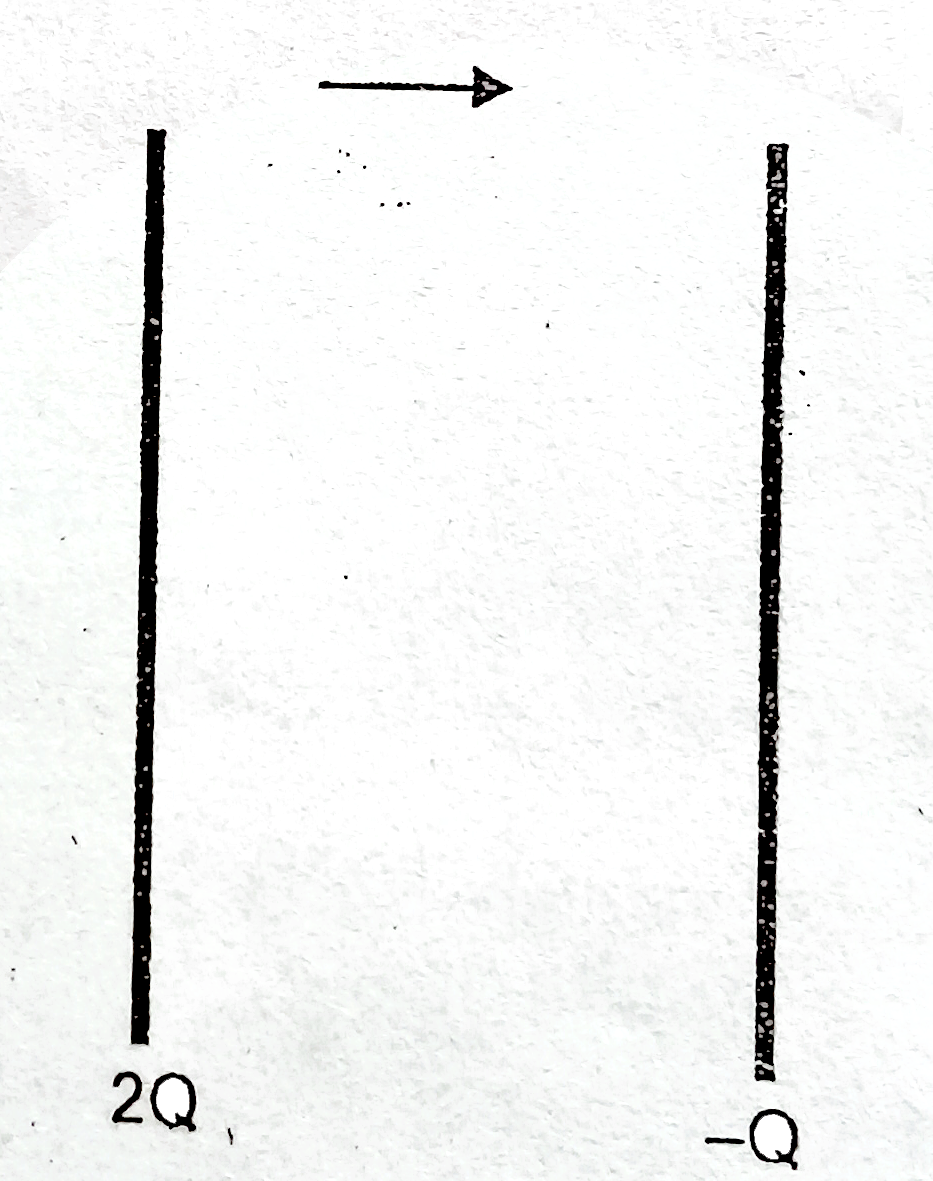
Two large parallel conducting plates of net charge `2Q` and `-Q` are placed in a uniform external electric field `(Q)/(2Aepsilon_(0))` prependicular to plates as shown. The surface area of each plates is A. The charge on the left surface of the left plate and right surface of the right plate are respectively.

Promotional Banner

Similar Questions

Explore conceptually related problems

Two large thin conducting plates with a small gap in between are placed in a uniform electric field E (perpendicular to the plates.)The area of each plate is A, and charges +Q and -Q are given to these plates as shown in figure. If R,S, and T are three points in space, then the

Two large thin conducting plates with a small gap in between are placed in a uniform electric field E (perpendicular to the plates.)The area of each plate is A, and charges +Q and -Q are given to these plates as shown in figure. If R,S, and T are three points in space, then the

The ratio of charge on left surface of plate A to the charge on the right surface of plate B is +Q +3Q -20 (A) (B) (C)

Two large conducting plates of a parallel plate capacitor are given charges Q and 3Q respectively. If the electric field in the region between the plates is E_0 , then the force of interaction between the plates is

Two large conducting plates of a parallel plate capacitor are given charges Q and 3Q respectively. If the electric field in the region between the plates is E_0 , then the force of interaction between the plates is

Three large plates A, B and C are placed parallel to each other and charges are given as shown. The charge that appears on the left surface of plate B is

Three metallic isolated plates are given charges as shown in figure, the sum of the charges on the outer surfaces of the two plates ( 1 ) and ( 3 ) is (where -3Q and 4Q are total charges of plates ( 1 ) and ( 3 ) respectively.)

Three metallic isolated plates are given charges as shown in figure, the sum of the charges on the outer surfaces of the two plates ( 1 ) and ( 3 ) is (where -3Q and 4Q are total charges of plates ( 1 ) and ( 3 ) respectively.)

Three charged conducting plates are separated by small distances as shown in figure. The charges on the plates are shown. Find the ratio of charge on right surface and left surface of the middle plate.

Three charged conducting plates are separated by small distances as shown in figure. The charges on the plates are shown. Find the ratio of charge on right surface and left surface of the middle plate.