

Home
Class 11
PHYSICS
Two rods A and B of same cross-sectional...

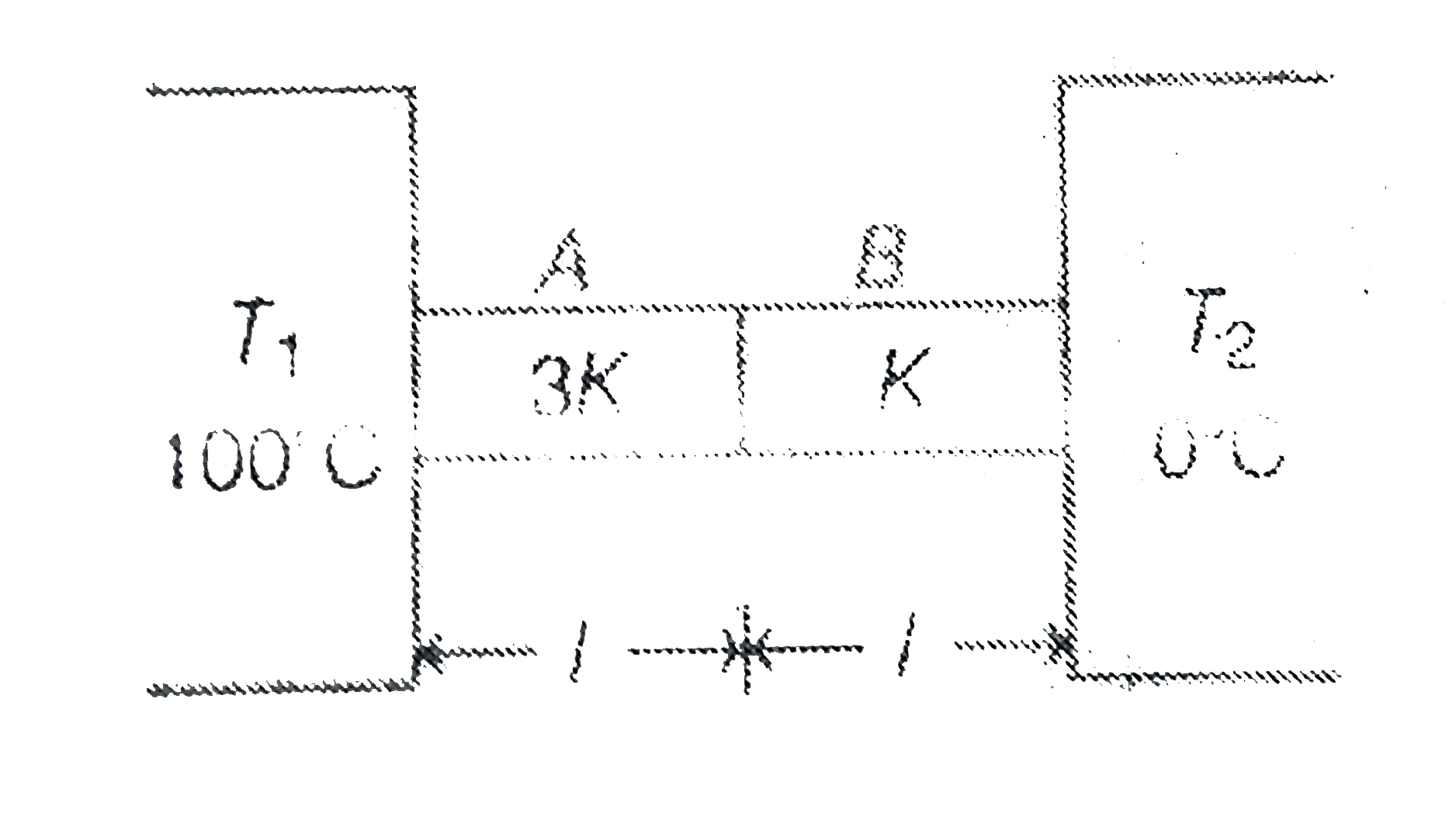
Two rods A and B of same cross-sectional area A and length l are connected in series between a source `(T_(1)=100^(@)C)` and a sink `(T_(2)-0^(@)C)` as shown in figure. The rod is laterally insulated.

The ratio of the thermal resistance of the rods is

Promotional Banner

Similar Questions

Explore conceptually related problems

Two rods A and B of same cross sectional are A and length l connected in series between a source (T_(1) =100^(@)C) and a sink (T_(2) =0^(@)C) as shown in The rod is laterally insulated The ratio of thermal resistance of the rod is .

Two rods A and B of same cross-sectional area A and length l are connected in series between a source (T_(1)=100^(@)C) and a sink (T_(2)-0^(@)C) as shown in figure. The rod is laterally insulated. If T_(A) and T_(B) are the temperature drops across the rod A and B, then

Two rods A and B of same cross-sectional area A and length l are connected in series between a source (T_(1)=100^(@)C) and a sink (T_(2)-0^(@)C) as shown in figure. The rod is laterally insulated. If T_(A) and T_(B) are the temperature drops across the rod A and B, then

Two rods A and B of same cross-sectional area A and length l are connected in series between a source (T_(1)=100^(@)C) and a sink (T_(2)-0^(@)C) as shown in figure. The rod is laterally insulated. If G_(A) and G_(B) are the temperature gradients across the rod A and B, then

Two rods A and B of same cross-sectional area A and length l are connected in series between a source (T_(1)=100^(@)C) and a sink (T_(2)-0^(@)C) as shown in figure. The rod is laterally insulated. If G_(A) and G_(B) are the temperature gradients across the rod A and B, then

Two rods A and B of same cross sectional are A and length l connected in series between a source (T_(1) =100^(@)C) and a sink (T_(2) =0^(@)C) as shown in The rod is laterally insulated If A_(A) and T_(B) are the temperature drops across temperature gradients the rod A and B then .

Two rods A and B of same length and cross-sectional area are connected in series and a temperature difference of 100^@C is maintained across the combination as shoen in Fig. If the thermal conductivity of the rod A is 3 k and that of rod B is k, Then i.Determine the thermal resistance of each rod. ii. determine the heat current flowing through each rod. iii. determine the heat current flowing through each rod. iv. plot the variation of temperature along the length of the rod.

Two rods A and B of same length and cross-sectional area are connected in series and a temperature difference of 100^@C is maintained across the combination as shoen in Fig. If the thermal conductivity of the rod A is 3 k and that of rod B is k, Then i.Determine the thermal resistance of each rod. ii. determine the heat current flowing through each rod. iii. determine the heat current flowing through each rod. iv. plot the variation of temperature along the length of the rod.