

Home
Class 11
PHYSICS
A planet of mass m revolves in elliptica...

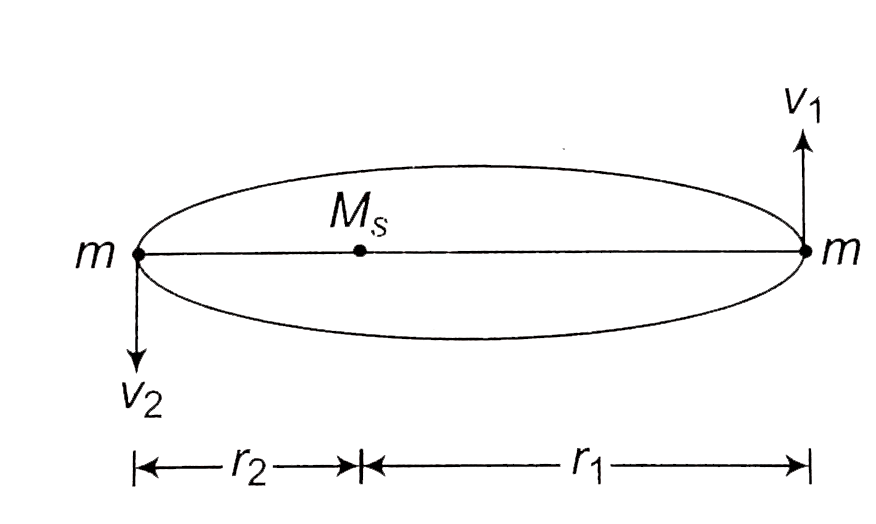
A planet of mass `m` revolves in elliptical orbit around the sun of mass `M` so that its maximum and minimum distance from the sun equal to `r_(a)` and `r_(p)` respectively. Find the angular momentum of this planet relative to the sun.

Text Solution

Verified by Experts


By momentum conservation
`L=mv_(1)r_(1)=mv_(2)r_(2)implies v_(1)r_(1)=v_(2)r_(2) implies v_(2)=(r_(1))/(r_(2))v_(1)`
By conservation
`1/2mv_(1)^(2)-(GM_(s)m)/(r_(1))=1/2mv_(2)^(2)-(GM_(s)m)/(r_(2))`
`v_(1)^(2)-v_(2)^(2)=2GM_(s)(1/(r_(1))-1/(r_(2)))`
`v_(1)^(2)-((r_(1))/(r_(2)))^(2)v_(1)^(2)=2GM_(s)((r_(2)-r_(1))/(r_(1)r_(2)))`
`v_(1)=sqrt((2GM_(s)r_(2))/(r_(1)(r_(1)+r_(2))))`
`L=mv_(1)r_(1)=msqrt((2GM_(s)r_(2))/(r_(1)(r_(1)+r_(2)))) r_(1)=msqrt((2GM_(s)r_(1)r_(2))/((r_(1)+r_(2))))`
Promotional Banner

Topper's Solved these Questions

Similar Questions

Explore conceptually related problems

A planet of mass m moves along an ellipse around the sun so that its maximum and minimum distance from the sun are equal to r_(1) and r_(2) respectively. Find the angular momentum of this planet relative to the centre of the sun. mass of the sun is M .

A planet of mass m moves along an ellipse around the Sun so that its maximum and minimum distances from the Sun are equal to r_1 and r_2 respectively. Find the angular momentum M of this planet relative to the centre of the Sun.

A planet of mass m moves along an ellipse around the sum of mass M so that its maximum and minimum distances from sum are a and b respectively. Prove that the angular momentum L of this planet relative to the centre of the sun is L=msqrt((2GGMab)/((a+b)))

A planet of mass moves alng an ellipes around the sun so that its maximum distance from the sum are equal to r_(1) and r_(2) respectively . Find the angular momenture L of this planet relative to the centre of the sun. [Hint :L Rember that at the maximum and minimum distance velocity is perpendicular to tthe position vectors of the planet . Apply the princples of conservation of angula r momenture and energy .]

A comet of mass m moves in a highly elliptical orbit around the sun of mass M the maximum and minium distacne of the comet from the centre of the sun are r_(1) and r_(2) respectively the magnitude of angular momentum of the comet with respect to the centre of sun is

A planet of mass m is moving in an elliptical orbit about the sun (mass of sun = M). The maximum and minimum distances of the planet from the sun are r_(1) and r_(2) respectively. The period of revolution of the planet wil be proportional to :

A planet of mass m moves around the Sun of mass Min an elliptical orbit. The maximum and minimum distance of the planet from the Sun are r_(1) and r_(2) , respectively. Find the relation between the time period of the planet in terms of r_(1) and r_(2) .

A planet revolves in elliptical orbit around the sun. (see figure). The linear speed of the planet will be maximum at

A planet of small mass m moves around the sun of mass M along an elliptrical orbit such that its minimum and maximum distance from sun are r and R respectively. Its period of revolution will be:

A planet of mass m is moving in an elliptical orbit around the sun of mass M . The semi major axis of its orbit is a, eccentricity is e . Find speed of planet V_(1) at perihelion P

CP SINGH-GRAVITATION-EXERCISE
  1. A planet of mass m revolves in elliptical orbit around the sun of mass...

    Text Solution

    |

  2. Two identical copper spheres of radius R are in contact with each othe...

    Text Solution

    |

  3. Two sphere of masses m and M are situated in air and the gravitational...

    Text Solution

    |

  4. Two particles of equal mass 'm' go around a circle of radius R under t...

    Text Solution

    |

  5. Two point masses A and B having masses in the ratio 4:3 are separated ...

    Text Solution

    |

  6. If R is the radius of the earth and g the acceleration due to gravity ...

    Text Solution

    |

  7. Mass remaining constant, the radius of the earth shrinks by 1%. The ac...

    Text Solution

    |

  8. Two planets have the same average density but their radii are R(1) and...

    Text Solution

    |

  9. The density of a newly discovered planet is twice that of earth. The a...

    Text Solution

    |

  10. Acceleration due to gravity on moon is 1//6 of the acceleration due to...

    Text Solution

    |

  11. Consider a planet in some solar system which has a mass double the mas...

    Text Solution

    |

  12. Which graph correctley presents the variation of acceleration due to g...

    Text Solution

    |

  13. Let the acceleration due to gravity be g(1) at a height h above the ea...

    Text Solution

    |

  14. The weight of an object in the coal mine, sea level and at the top of ...

    Text Solution

    |

  15. Suppose the earth increases its speed of rotation . At what new time p...

    Text Solution

    |

  16. Suppose the acceleration due to gravity at earth's surface is 10ms^-2 ...

    Text Solution

    |

  17. Two bodies of masses m and 4m are placed at a distance r. The gravitat...

    Text Solution

    |

  18. Four particles each of mass m are placed at the vertices of a square o...

    Text Solution

    |

  19. Infinite number of masses, each of 1 kg, are placed along the x-axis a...

    Text Solution

    |

  20. A particle of mass M is placed at the centre of a uniform spherical sh...

    Text Solution

    |

  21. The magnitude of the gravitational field at distance r(1) and r(2) fro...

    Text Solution

    |