A
B
C
D
Text Solution
Verified by Experts
The correct Answer is:
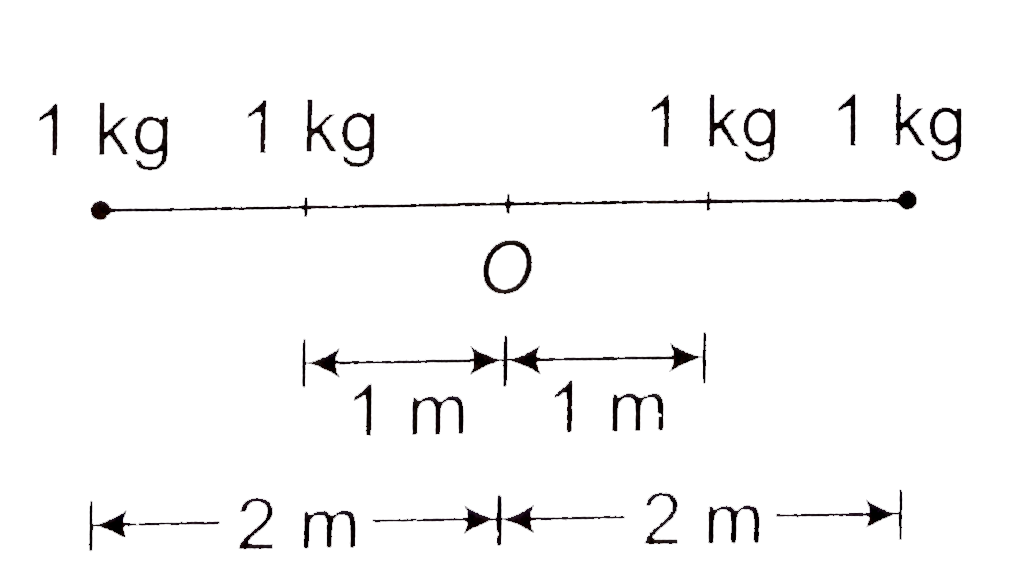



Topper's Solved these Questions
Similar Questions
Explore conceptually related problems
CP SINGH-GRAVITATION-EXERCISE
- Two bodies of masses m and 4m are placed at a distance r. The gravitat...
Text Solution
|
- Four particles each of mass m are placed at the vertices of a square o...
Text Solution
|
- Infinite number of masses, each of 1 kg, are placed along the x-axis a...
Text Solution
|
- A particle of mass M is placed at the centre of a uniform spherical sh...
Text Solution
|
- The magnitude of the gravitational field at distance r(1) and r(2) fro...
Text Solution
|
- A spherically symmetric gravitational system of particles has a mass d...
Text Solution
|
- A planet is moving in an elliptic orbit. If T,V,E and L stand, respect...
Text Solution
|
- A satellite revolves around the earth in an elliptical orbit. Its spee...
Text Solution
|
- For a planet moving and the sun in an elliptical orbit, which of the f...
Text Solution
|
- Which of the following quantities remain constant in a planetary motio...
Text Solution
|
- Figure shows the motion of a planet around the Sun S in an elliptical ...
Text Solution
|
- The earth E moves in an elliptical orbit with the sun S at one of the ...
Text Solution
|
- The largest and the shortest distance of the earth from the sun are r(...
Text Solution
|
- A plenet moving along an elliptical orbit is closest to the sun at a d...
Text Solution
|
- If the distance between the earth and the sun were half its present va...
Text Solution
|
- The mean radius of the earth's orbit of mercury is 6xx10^(10)m. The me...
Text Solution
|
- The radius of the earthR and acceleration due to gravity at its surfac...
Text Solution
|
- In the previous problem, the minimum speed with which the body must be...
Text Solution
|
- If the acceleration due to gravity at the surface of the earth is g, t...
Text Solution
|
- A small mass m is moved slowly from the surface of the earth to a heig...
Text Solution
|