Home
Class 11
PHYSICS
(a) A source of sound S and a detector D...

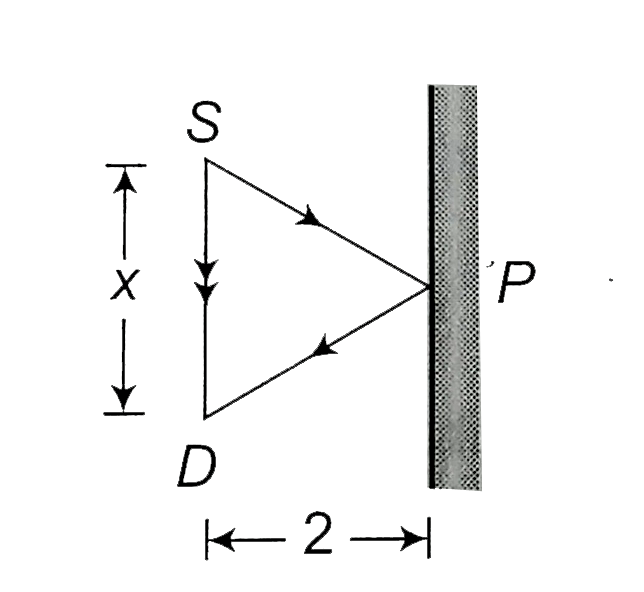
(a) A source of sound `S` and a detector `D` are placed at some distance from one another. A big cardboard is placed near the detector and perpendicular to the line `SD` as shown in figure. It is gradually moved away and it is found that the intensity changes from a maximum to a minimum as the board is moved through a distance of `20 cm.` Find the frequency of the sound emitted. Velocity of sound in are is `336 m//s.`

(b) A source emitting sound of frequency `180 Hz` is placed in front of a wall at a distance of `2 m` from it. A detector is also placed in front of the wall at the same distance from it. find the minimum distance between the source and the detector for which the detector detects a maximum of sound . Speed of sound in air `= 360 m//s.`

Text Solution

Verified by Experts

(a)
`Delta x = (S DP + PD) - SD = n lambda (i)`
`Delta x' = (S DP + 2x + PD) - SD = (2n + 1) (lambda)/(2) (ii)`
`(ii) - (i)`
`2x = (lambda)/(2) = (v)/(2f)`
`f = (v)/(4x) = (336)/(4 xx 0.2) = 420 Hz`
(b)
Path difference `Delta x = SPD - SD = 2 SP - SD`
`= [2(2^(2) + x^(2)/(4))^(1//2) - x ]`
For maximum intensity
`Delta x = n lambda = (nv)/(f)`
`[2(2^(2) + x^(2)/(4))^(1//2) -x] = n((360)/(180))`
For minimum value of `x,n = 1`
`[2(4 + x^(2)/(4))^(1//2) -x] = 2`
`2(4 + x^(2)/(4))^(1//2) = x + 2 rArr (4 + x^(2)/(4))^(1//2)`
`= (1 + x/(2))`
Squaring both sides
`4 + (x^(2))/(4) = 1 + (x^(2))/(4) + x`
`x = 3 m`
Promotional Banner

Topper's Solved these Questions

  • SOUND WAVES

    CP SINGH|Exercise Exercises|130 Videos
  • SIMPLE HARMONIC MOTION

    CP SINGH|Exercise Exercises|125 Videos
  • TEMPERATURE AND THERMAL EXPANSION

    CP SINGH|Exercise EXERCISES|64 Videos

Similar Questions

Explore conceptually related problems

A source emitting sound of frequency 180 Hz is alced in front of a wall at a distance of 2 m from it. A detector is also placed in front of the weal at the same distance from it. Find the minimum distance between the source and the detector for which the detector detects a maximum of sound. Speed of sound in air =360ms^-1 .

A source emitting sound of frequency 180 Hz is placed in front of a wall at distance of 2 m from it . A detector is also placed in front of the wall at the same distance from it. From the minimum distance between the source and the detector for which the detector detects a maximum of sound. Speed of sound in air = 360 m//s .

A source emitting sound of frequency 165 Hz is placed in frount of a wall at a distance of 2 m from it. A detector is also placed in fornt of the wall at the same distance from it. Find the distance between the source and the detector for which the detector detects phase difference of 2pi between the direct and reflected wave. Speed of sound in air = 330 m//s .

A soure of sound of frequency 165 hz is placed in front of a wall at a distance 2 m from it. A dtector is also placed in front of the wall at the same distance from it. Find the minimum distance between the source and detector for which maximum sound is recorded int he detector . the speed of sound is 330 m/s

A source of sound emitting waves at 360 H_(Z) is placed in front of a vertical wall, at a distance 2 m from it. A detector is also placed in front of the wall at the same distance from it. Find the minimum distance between the source and the detestor for which the detector detects a maximum of sound. Take speed of sound in air = 360 m//s . Assume that there is not phase change in reflected wave.

In Quincke's experiment the sound detected is changed from a maximum to a minimum when the sliding tube is moved through a distance of 2.50 cm. Find the frequency of sound if the speed of sound in air is 340 m s^-1 .

A sound wave completes one oscillation in 0.002 s and moves a distance of 30 cm. Find the frequency of the wave.

A source of sound emitting a 1200 Hz note travels along a straight line at a speed of 170 m s^-1 . A detector is placed at a distance of 200 m from the line of motion of the source. (a) Find the frequency of sound received by the detector at the instant when the source gets closest to it. (b) Find the distance between the source and the detector at the instant it detects the frequency 1200 Hz. Velocity of sound in air = 340 m s^-1 .

CP SINGH-SOUND WAVES-Exercises
  1. (a) A source of sound S and a detector D are placed at some distance f...

    Text Solution

    |

  2. Choose the correct statement.

    Text Solution

    |

  3. Velocity of sound in air is 332 ms^-1. Its velocity in vacuum will be

    Text Solution

    |

  4. A big explosion on the moon cannot be heard on the earth because

    Text Solution

    |

  5. The speed of sound in a medium depends on

    Text Solution

    |

  6. Consider the following statements: Assertion (A) The velocity of so...

    Text Solution

    |

  7. How does the speed v of sound in air depend on the atmospheric pressur...

    Text Solution

    |

  8. The velocity of sound in air is affected by change in the (i) atmosp...

    Text Solution

    |

  9. Laplace's correction in the formula for the speed of sound given by Ne...

    Text Solution

    |

  10. Speed of sound in gas is proportional to

    Text Solution

    |

  11. Velocity of sound in air (i) increases with temperature (ii) decr...

    Text Solution

    |

  12. The density of oxygen is 16 times the density of hydrogen. What is the...

    Text Solution

    |

  13. The temperature at which the speed of sound in air becomes double of i...

    Text Solution

    |

  14. A sample of oxygen at NTP has volume V and a sample of hydrogen at NTP...

    Text Solution

    |

  15. The ratio of the velocity of sound in hydrogen gas to that in helium g...

    Text Solution

    |

  16. If c(0) and c denote the sound velocity and the rms velocity of the mo...

    Text Solution

    |

  17. A source emits sound of frequency 600Hz inside water. The frequency he...

    Text Solution

    |

  18. A stone is dropped into a well. If the depth of water below the top be...

    Text Solution

    |

  19. The speed of sound waves having a frequency of 256 Hz compared with th...

    Text Solution

    |

  20. The extension in a string, obeying Hooke's law, is x. The speed of sou...

    Text Solution

    |

  21. It is possible to distinguish between the transverse and longitudinal ...

    Text Solution

    |