

Home
Class 11
PHYSICS
(a) A tuning fork produces 4 beats per s...

(a) A tuning fork produces `4` beats per second with another tuning fork of frequency `256 Hz`. The first one is now loaded with a little wax and the beat frequency is found to increase to `6` per second. What was the original frequency of the tuning fork ?
(b) A plano wire `A` vibrates at a fundamental frequncy of `600 Hz`. A second identical wire `B` produces `6` betas per second with it, when of the tension in `A` is slightly increased. Find the ratio of the tension in `A` to the tension to `B`.
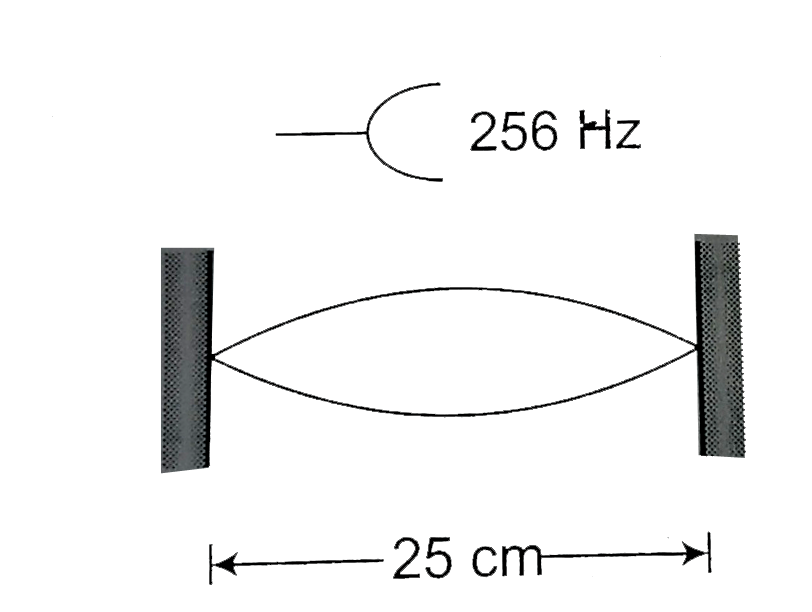
( c) A tunnig fork if frequency `256 Hz` produces `4` beats per second with a wire of length `25 cm` vibrating in its fundamental mode. The beat frequency decreases when the length is slightly shortened. What could be the minimum length by whech the wire be shortened so that it produces no beats with the tuning fork?

Text Solution

Verified by Experts

(a) Let the frequency of tuning fork is `x`.
The value of `x` may be `256 +- 4 = 260 Hz or 250 Hz`. Now this fork is loaded with wax, its frequency decreases but beat frequency increases. This is possible when frequency of tuning fork is `252 Hz`.
(b) `f prop sqrt(T)`
`(606)/(600) = sqrt((T_(A))/(T_(B))) rArr (T_(A))/(T_(B))`
`= (1 + (6)/(600))^(2)`
`= (1 + 0.01)^(2) - 1.02`
(c)

When length is make smaller, frequency of string increases `f prop 1//l`.
But beat frequency decreases i.e. frequency of string is `256 - 4 = 252 Hz`.
For no beat frequency, frequency of string should be `256 Hz`.
`(f_(1))/(f_(2)) = (l_(2))/(l_(1))`
`(252)/(256) = (l_(2)) / (25) rArr l_(2) = 24.6 cm`
Decrease in length `= 25 - 24.6 = 0.4 cm`
Promotional Banner

Topper's Solved these Questions

  • SOUND WAVES

    CP SINGH|Exercise Exercises|130 Videos
  • SIMPLE HARMONIC MOTION

    CP SINGH|Exercise Exercises|125 Videos
  • TEMPERATURE AND THERMAL EXPANSION

    CP SINGH|Exercise EXERCISES|64 Videos

Similar Questions

Explore conceptually related problems

A tuning fork produces 4 beats per second with another 68. tuning fork of frequency 256 Hz. The first one is now loaded with a little wax and the beat frequency is found to increase to 6 per second. What was the original frequency of the tuning fork ?

A tunnig fork of frequency 256 Hz produces 4 beats per second with a wire of length 25 cm vibrating in its fundamental mode. The beat frequency decreases when the length is slightly shortened. What could be the minimum length by which the wire be shortened so that it produces no beats with the tuning fork ?

A tuning fork of frequency 256 H_(Z) produces 4 beats per second with a wire of legth 25 cm vibrating in its fundamental mode. The beat frequency decrease when the length is slightly shortened. What could be the minimum length by which the wire be shortened so that it produces no beats with the tuning fork?

A tuning fork produces 4 beats per second when sounded togetehr with a fork of frequency 364 Hz. When the first fork is loaded with a little wax ten the number of beats becomes two per second. What is the frequency of the first fork?

A tuning fork 'P' of frequency 280Hz produces 6 beats/s with unknown tuning fork 'Q'

A tuning fork produces 2 beats per second when sounded with another tuning fork of frequency 250 Hz. It gives the same number of beats per second when loaded with wax. The initial frequency of 1^(st) tuning fork is

A tuning fork gives 5 beats with another tuning fork of frequency 100 Hz . When the first tuning fork is loaded with wax, then the number of beats remains unchanged, then what will be the frequency of the first tuning fork

CP SINGH-SOUND WAVES-Exercises
  1. (a) A tuning fork produces 4 beats per second with another tuning fork...

    Text Solution

    |

  2. Choose the correct statement.

    Text Solution

    |

  3. Velocity of sound in air is 332 ms^-1. Its velocity in vacuum will be

    Text Solution

    |

  4. A big explosion on the moon cannot be heard on the earth because

    Text Solution

    |

  5. The speed of sound in a medium depends on

    Text Solution

    |

  6. Consider the following statements: Assertion (A) The velocity of so...

    Text Solution

    |

  7. How does the speed v of sound in air depend on the atmospheric pressur...

    Text Solution

    |

  8. The velocity of sound in air is affected by change in the (i) atmosp...

    Text Solution

    |

  9. Laplace's correction in the formula for the speed of sound given by Ne...

    Text Solution

    |

  10. Speed of sound in gas is proportional to

    Text Solution

    |

  11. Velocity of sound in air (i) increases with temperature (ii) decr...

    Text Solution

    |

  12. The density of oxygen is 16 times the density of hydrogen. What is the...

    Text Solution

    |

  13. The temperature at which the speed of sound in air becomes double of i...

    Text Solution

    |

  14. A sample of oxygen at NTP has volume V and a sample of hydrogen at NTP...

    Text Solution

    |

  15. The ratio of the velocity of sound in hydrogen gas to that in helium g...

    Text Solution

    |

  16. If c(0) and c denote the sound velocity and the rms velocity of the mo...

    Text Solution

    |

  17. A source emits sound of frequency 600Hz inside water. The frequency he...

    Text Solution

    |

  18. A stone is dropped into a well. If the depth of water below the top be...

    Text Solution

    |

  19. The speed of sound waves having a frequency of 256 Hz compared with th...

    Text Solution

    |

  20. The extension in a string, obeying Hooke's law, is x. The speed of sou...

    Text Solution

    |

  21. It is possible to distinguish between the transverse and longitudinal ...

    Text Solution

    |