Home
Class 11
PHYSICS
In a hall, a person receives direct soun...

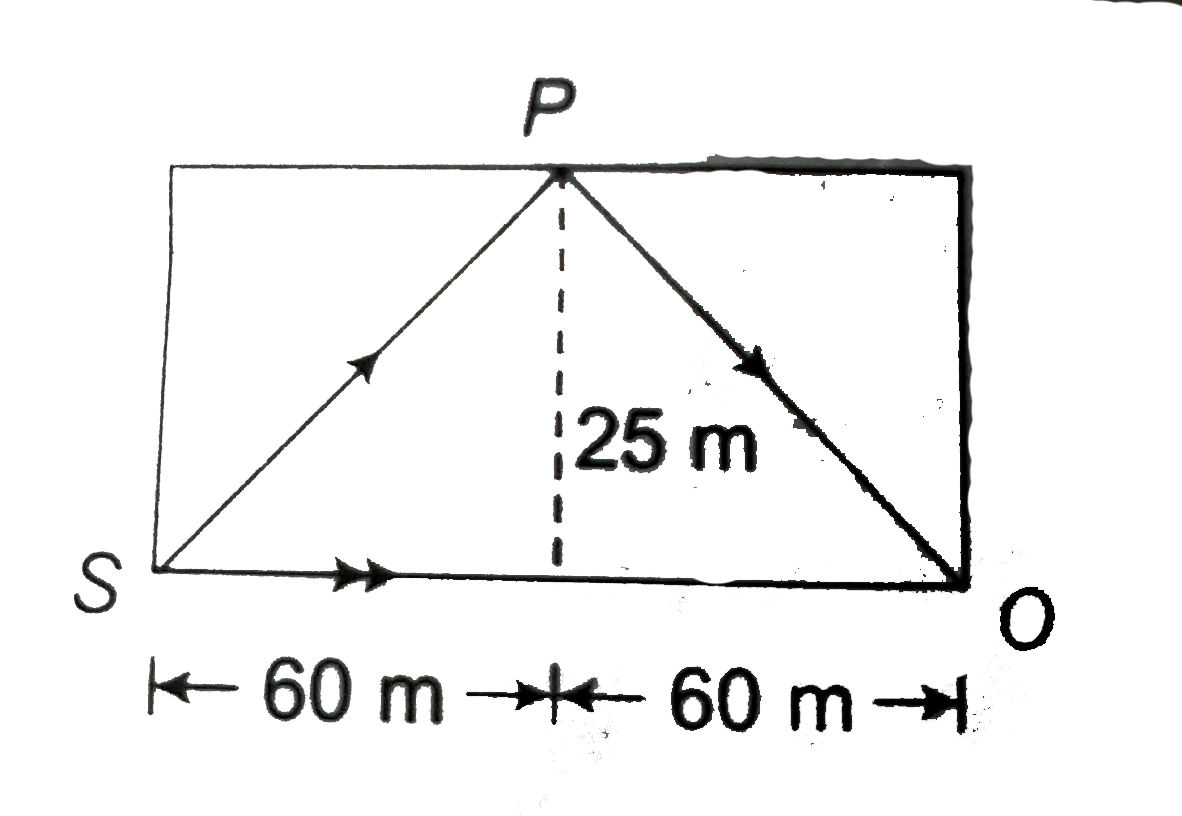
In a hall, a person receives direct sound waves from a source `120 m` away. He also receives waves from the same source which reach him after being reflected from the `25 m` high ceiling at a point halfway between them. The two waves interfere constructively for wavelengths (in metres)

A

`10, (10)/(2) m (10)/(3)`

B

`20, (20)/(3) m (20)/(5)`

C

`30, 20, 10, …`

D

`35, 25, 15, …`

Text Solution

Verified by Experts

The correct Answer is:
A


Path difference `Delta x = SPO - SO = 25 P - 50`
`= 2sqrt((60)^(2) + (25)^(2)) - 120 =10 m`
For constructive interference
`Delta x =n lambda rArr 10 = n lambda`
`lambda=10/n m`
`lambda = 10, (10)/(2), (10)/(3), (10)/(4)...m`
Promotional Banner

Topper's Solved these Questions

  • SOUND WAVES

    CP SINGH|Exercise Exercises|130 Videos
  • SIMPLE HARMONIC MOTION

    CP SINGH|Exercise Exercises|125 Videos
  • TEMPERATURE AND THERMAL EXPANSION

    CP SINGH|Exercise EXERCISES|64 Videos

Similar Questions

Explore conceptually related problems

In a large room, a person receives direct sound waves froma source 120 metres away from him. He also receives waves from the same source which reach him, being reflected from the 25 metre high ceiling at a point halfway between them. The two waves interfere constuctively for wavelength of

In a large room , a person receives waves from the same source which reach , being reflected from the 25 m high ceiling at a point halfway between them . The two waves interfere constructively for a wavelength of

In a large room , a person receives direct sound waves from a source 120 m away . He also receives waves from the same source which reach him after being reflected from the 5 - m high ceiling at a point halfway between them . For which wavelengths will these two sound waves interfere constructively ?

A detector at x=0 receives waves from three sources each of amplitude A and frequencies f + 2,f and f-2 . The time at which intensity is maximum, is

A thin glass slab G1 is held over a large glass slab G2, creating an air gap of uniform thickness t = 0.5 mum between them. Electromagnetic wave having wavelengths ranging from 0.4 mum "to" 1.15 mum is incident normally on the slab G1. When interference between waves reflected from boundaries of air gap (the two reflected waves are shown in fig as R1 and R2) was studied, it was found that only two wavelengths interfered constructively. One of these two wavelengths is lambda_(1) = 0.04 mum . Find the other wavelength (lambda_(2)) that interferes constructively.

A person standing at a distance of 6 m from a source of sound receives sound wave in two ways, one directly from the source and other after reflection from a rigid boundary as shown in figure. The maximum wavelength for which, the person will receive maximum sound intensity, is

The path length difference between two waves coming from coherent sources for destructive interference should be

A source S and a detector D are placed at a distance d apart. A big cardboard is placed at a distance sqrt(2) d from the source and the detector as shown in figure. The source emits a wave of wavelength = d//2 which is received by the detector after reflection from the cardboard. It is found to be in phase with the direct wave received from the source. By what minimum distance should the cardboard be shifted away so that the reflected wave becomes out of phase with the direct wave?

CP SINGH-SOUND WAVES-Exercises
  1. A engine is approaching a hill at constant speed. When it is at a dist...

    Text Solution

    |

  2. A man stands between two parallel cliffs (not in middle). When he clap...

    Text Solution

    |

  3. In a hall, a person receives direct sound waves from a source 120 m aw...

    Text Solution

    |

  4. Two loudspeakers L1 and L2 driven by a common oscillator and amplifier...

    Text Solution

    |

  5. Vibrating tuning fork of frequency n is placed near the open end of a ...

    Text Solution

    |

  6. Two sources of sound are placed along the diameter of a circle of radi...

    Text Solution

    |

  7. Beats occur because of

    Text Solution

    |

  8. The phenomenon of beats can take place

    Text Solution

    |

  9. When beats are produced by two progressive waves of nearly the same fr...

    Text Solution

    |

  10. Two tuning forks of frequencies 256 Hz and 258 Hz are sounded together...

    Text Solution

    |

  11. Two sources of sound placed close to each other are wmitting progressi...

    Text Solution

    |

  12. Maximum number of beats frequency heard by a human being is

    Text Solution

    |

  13. Two vibrating tuning forks produce progressive waves given by y(1)=sin...

    Text Solution

    |

  14. When a tuning fork A of frequency 100 Hz is sounded with a tuning fork...

    Text Solution

    |

  15. Two tuning forks A and B vibrating simultaneously produce 5 beats//s. ...

    Text Solution

    |

  16. The freuquency of tuning forks A and B are respectively 3% more and 2%...

    Text Solution

    |

  17. Each of the two strings of length 51.6 cm and 49.1 cm are tensioned se...

    Text Solution

    |

  18. Two wires are fixed in a sanometer. Their tension are in the ratio 8:1...

    Text Solution

    |

  19. When beats are produced by two progressive waves of same amplitude and...

    Text Solution

    |

  20. 65 tuning forks are arranged in order of increasing frequency. Any two...

    Text Solution

    |

