Home
Class 11
PHYSICS
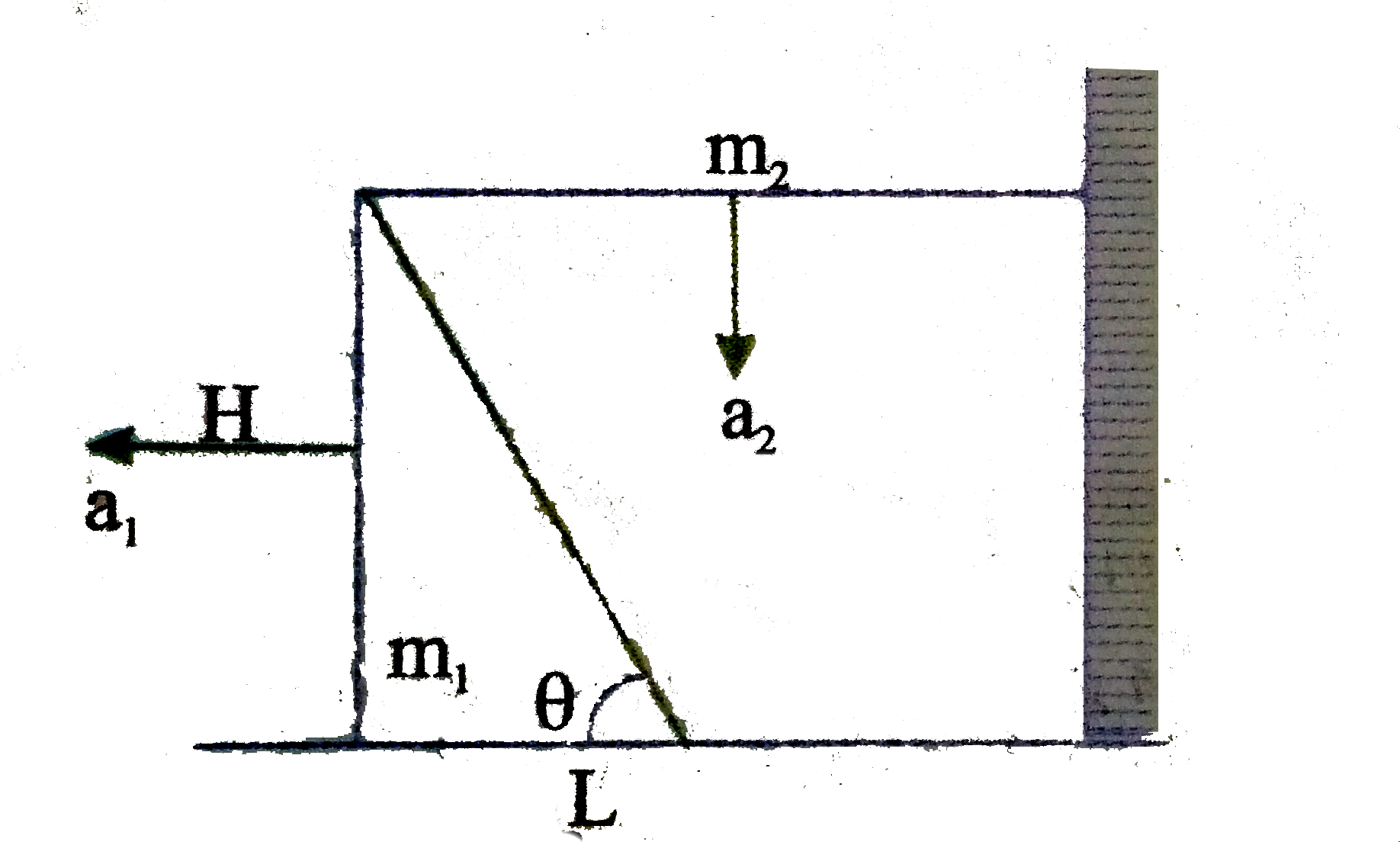
Find the relation between a(1) and a(2) ...

Find the relation between `a_(1)` and `a_(2)`
.

Text Solution

Verified by Experts

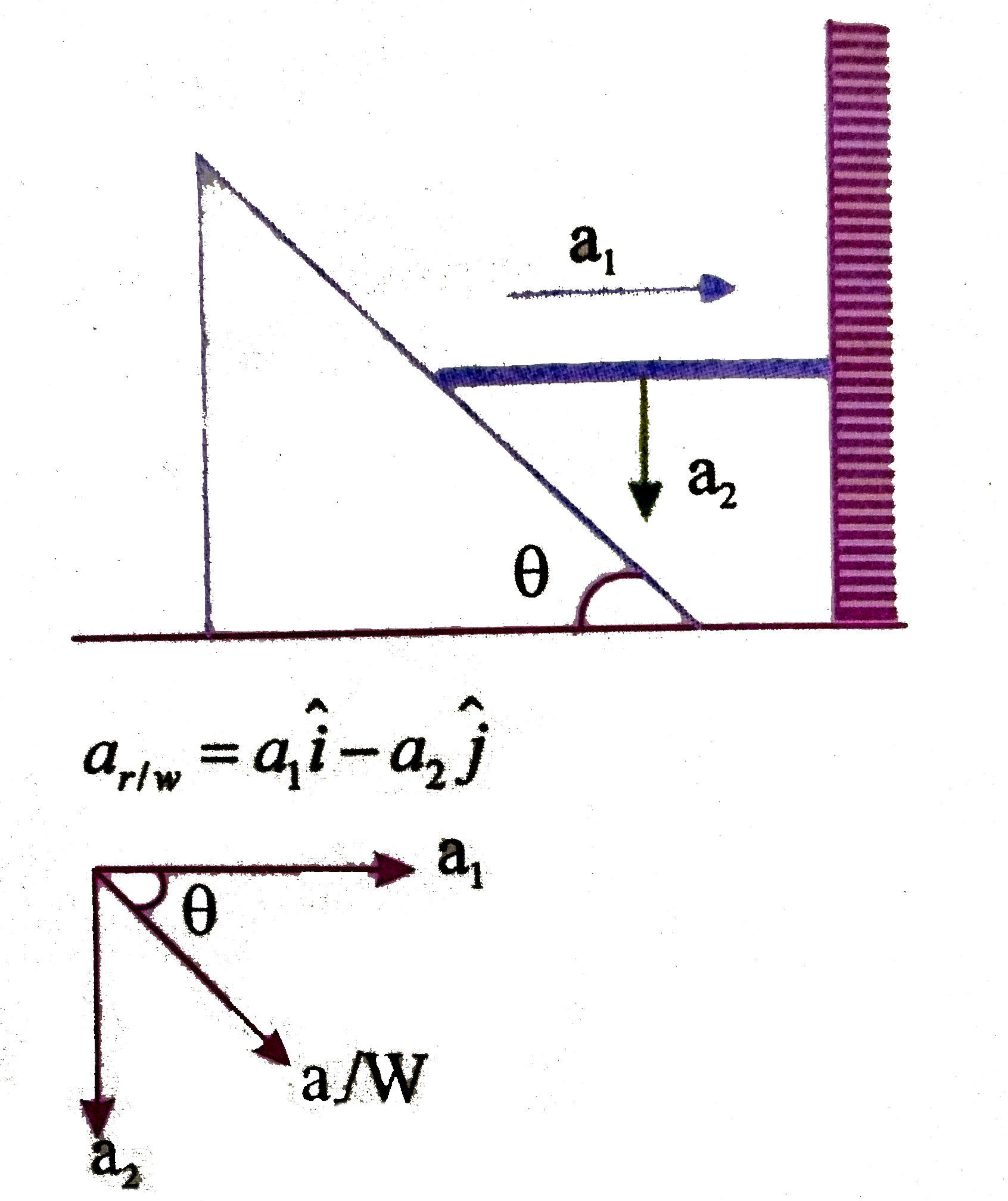
Acceleration of rod w.r.t wedge
`a_(r//w) = a_(1) hati -a_(2)hatj`
`veca_(r//w)` must be along the incline.
`tan theta = (a_(2))/(a_(1))`
.
Promotional Banner

Topper's Solved these Questions

  • NEWTONS LAWS OF MOTION

    NARAYNA|Exercise C.U.Q|73 Videos
  • NEWTONS LAWS OF MOTION

    NARAYNA|Exercise LEVEL -I (C.W)|47 Videos
  • MOTION IN A STRAIGHT LINE

    NARAYNA|Exercise Level 2 H.W|29 Videos
  • OSCILLATIONS

    NARAYNA|Exercise EXERCISE - IV|41 Videos

Similar Questions

Explore conceptually related problems

Using constraint method find the relation between of a_(1) and a_ (2) .

In the pulley-block arrangement shown in figure , find the relation between a_(A),a_(B) and a_(C)

A pulley-block arrangement is shown in the adjacent figure, if acceleration of m_(1), m_(2) and m_(3) are a_(1) ,a_(2) and a_(3) respectively, then relation between a_(1),a_(2) and a_(3) is ( All string and pulleys are ideal . )

A planet moving around sun sweeps area A_(1) in 2 days, A_(2) in 3 days and A_(3) in 6 days, then find the relation between A_(1),A_(2) and A_(3)

Make the constraint relation between a_(1),a_(2) and a_(3)

If the blocks are moving as shown in the figure the relation between a_(1) , a_(2) and a_(3) will be.

Find the relation between acceleration a_(1) and a_(2)

In the adjacent figure, all the pulleys are frictioniess and massless, all the stringes are also massless. The relation between a_(1),a_(2) and a_(3) is (where a_(1),a_(2) and a_(3) are the acceleration of masses m_(1),m_(2) and m_(3) respectively in the direction as shown in the figure)