Home
Class 11
PHYSICS
In the fig, find the acceleration of m(1...

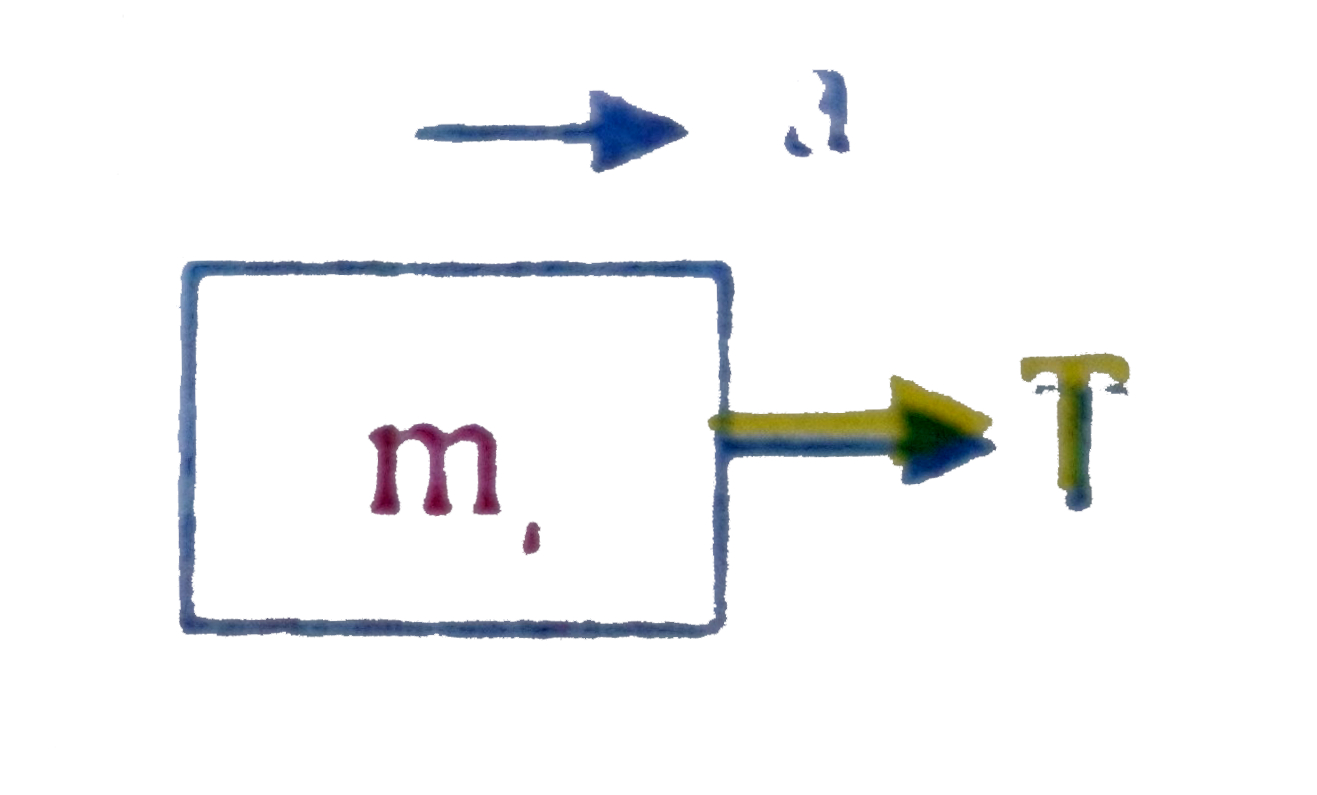
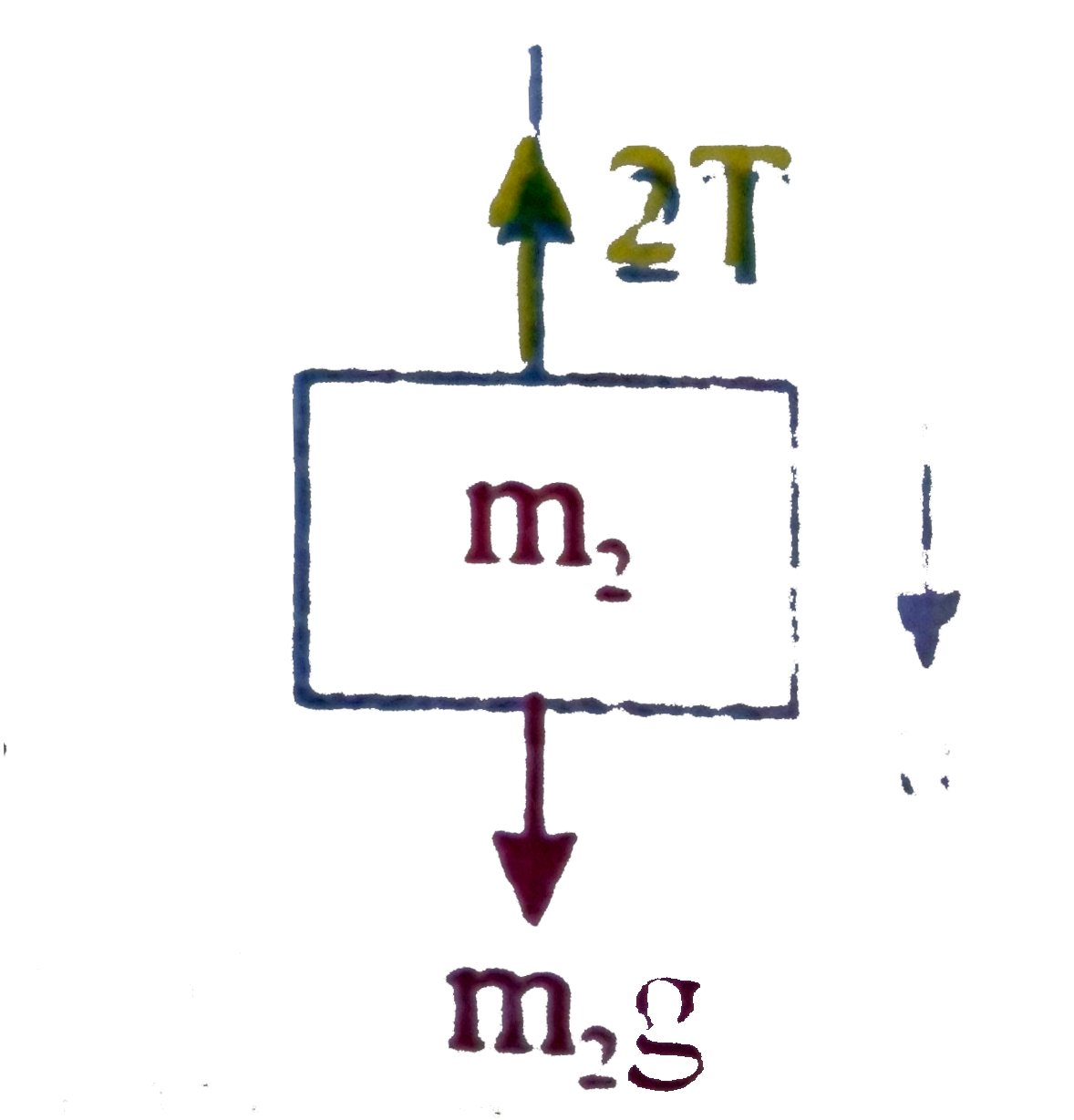
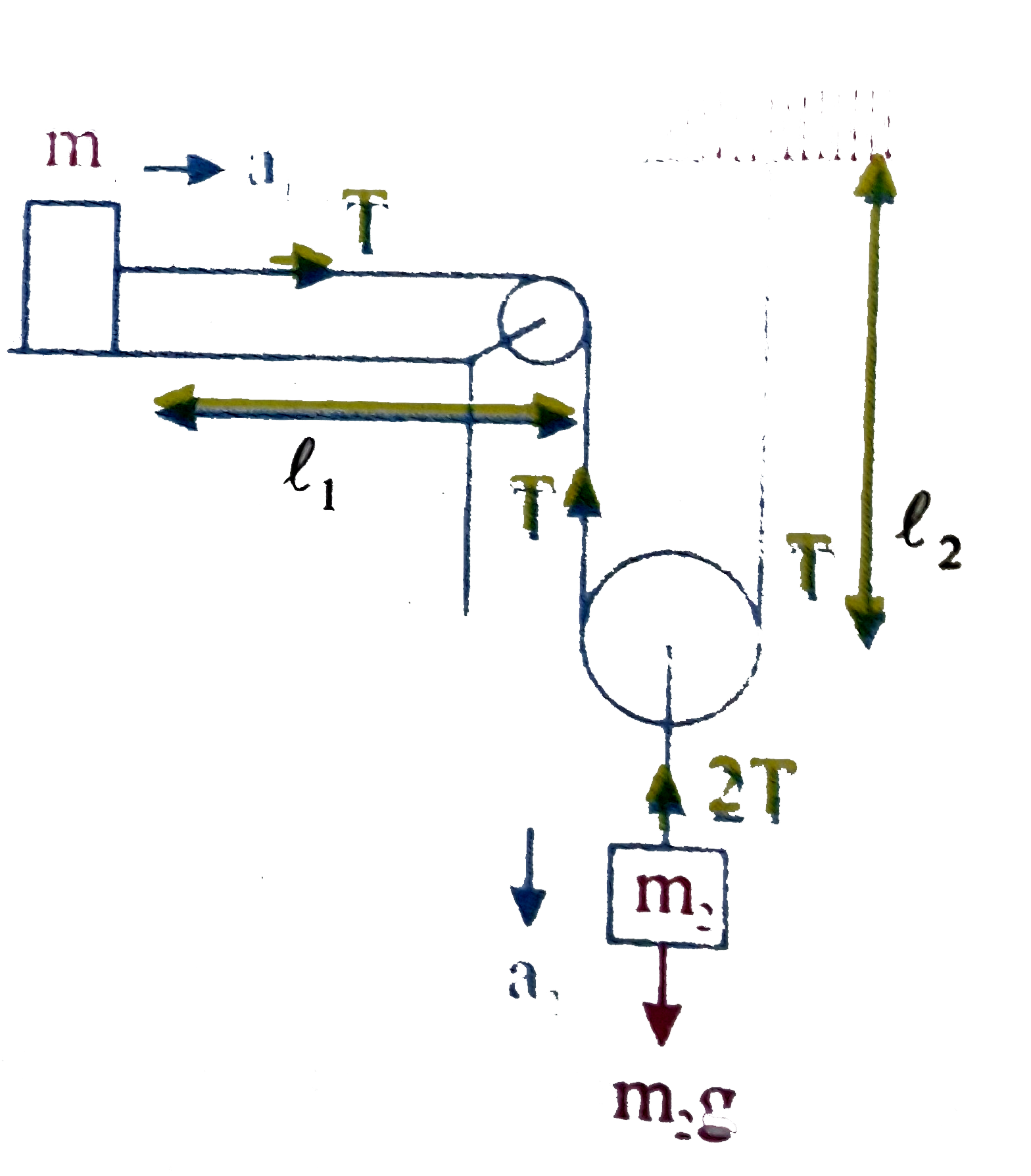
In the fig, find the acceleration of `m_(1)` and `m_(2)`
.

Text Solution

Verified by Experts

`l_(1)+2l_(2) = "constant"`
`a_(1) =2a_(2) , T =m_(1) a_(1)`
`m_(2) g-2T =m_(2)a_(2) ,m_(2)g =2m_(1)a_(1)+m_(2)a_(2)`
`m_(2)g =2m_(1) (2a_(2)) +m_(2)a_(2)`
`a_(2) =(m_(2)g)/(4m_(1)+m_(2)), a_(1) =(2m_(2)g)/(4m_(1)+m_(2))`

.
Promotional Banner

Topper's Solved these Questions

  • NEWTONS LAWS OF MOTION

    NARAYNA|Exercise C.U.Q|73 Videos
  • NEWTONS LAWS OF MOTION

    NARAYNA|Exercise LEVEL -I (C.W)|47 Videos
  • MOTION IN A STRAIGHT LINE

    NARAYNA|Exercise Level 2 H.W|29 Videos
  • OSCILLATIONS

    NARAYNA|Exercise EXERCISE - IV|41 Videos

Similar Questions

Explore conceptually related problems

In the fig, find the acceleration of mass m_(2) .

Three blocks arranged with pullwy and spring as shown in fig. If the string connecting blocks m_(2) and m_(3) is cut at point A, find the acceleration of masses m_(1), m_(2) and m_(3) . Just after the string is cut at point A.

If the pulley is massles and moves with an upward acceleration a_(0) . Find the acceleration of (m_1)and (m_2) w.r.t to elevator.

A situation is shown in figure-2.15, Find the acceleration of masses m_(1) abd m_(2) mass of pulley is m_(P) . Consider the string going over the pulley is massless and frictionless.

In the system shown in fig., all pulleys are mass less and the string is inextensible and light. (a) After the system is released, find the acceleration of mass m_(1) (b) If m_(1) = 1 kg, m_(2) = 2 kg "and" m_(3) = 3 kg then what must be value of mass m_(4) so that it accelerates downwards?

Find the acceleration of masses m_(1) and m_(2) moving down the smooth incline plane. The string and the pulley are masseless and frictionless.

Find the acceleration of masses m_(1) and m_(2) connected by an inextensible string, shown in figure-2.13(a). The string and pulley are assumed to be massless and frictionless.

For the system shown in fig, there is no friction anywhere. Masses m_(1) and m_(2) can move up or down in the slots cut in mass M. Two non-zero horizontal force F_(1) and F_(2) are applied as shown. The pulleys are massles and frictionless. Given m_(1) != m_(2) Let F_(1) and F_(2) are applied in such a way that m_(1) and m_(2) do not move w.r.t. M. then what is the magnitude of the acceleration of M? Let m_(1) gt m_(2) .

In the figure shown, the acceleration of block of mass m_(2) is 2m//s^(2) . The acceleration of m_(1) :