Home
Class 11
PHYSICS
Two blocks of masses 'm' and and 'M' are...

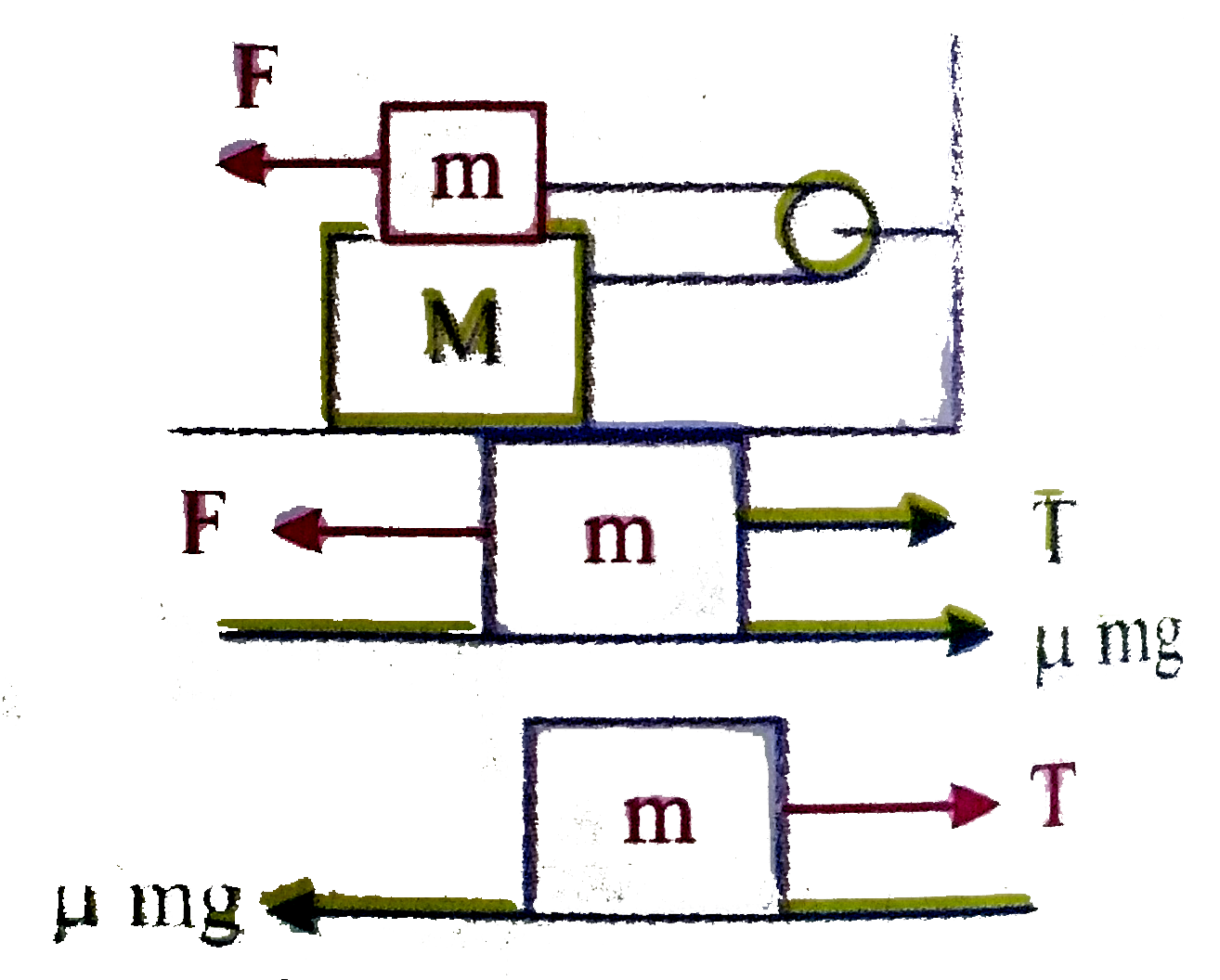
Two blocks of masses 'm' and and 'M' are arranged as shown in the The coefficient of friction between the two blocks is `'mu'`, where as between the lower block and the horizontal surface is zero. Find the force 'F' to be applied on the upper block for the system to be under equilibrium ? .

Text Solution

Verified by Experts

One the upper block
`F =T +f = T + mu N, F = T + mu mg……(1)`
One the lower block `T =mu mg……(2)`
from (1) and (2) we get, `F =2 mu mg`
Promotional Banner

Topper's Solved these Questions

  • NEWTONS LAWS OF MOTION

    NARAYNA|Exercise C.U.Q|73 Videos
  • NEWTONS LAWS OF MOTION

    NARAYNA|Exercise LEVEL -I (C.W)|47 Videos
  • MOTION IN A STRAIGHT LINE

    NARAYNA|Exercise Level 2 H.W|29 Videos
  • OSCILLATIONS

    NARAYNA|Exercise EXERCISE - IV|41 Videos

Similar Questions

Explore conceptually related problems

The block of mass M and are arrenged as the situation in fig is shown.The coefficient of friction between two block is mu and that between the bigger block and the ground is mu find the acceleration of the block

Consider the arrangement shown in the figure. The coefficient of friction between the two blocks is 0.5 and between the 4 kg block and the horizontal surface is 0.4. If a horizontal force of 12 N is applied on the 4 kg block, the acceleration of the 2 kg block would be

In the arrangement shown in figure, coefficient of friction between the two blocks is mu=1//2 . The force of friction acting between

A block of mass m is kept over another block of mass 2m. Coefficient of friction between two blocks is mu and that of between lower blood from the horizontal surface is zero. A horizontal force F=4/3 mu mg is applied on the block of mass 2m . Acceleration of lower block is

For the arrangement shown in the figure the coefficient of friction between the two blocks is mu . If both the blocks are identical and moving ,then the acceleration of each block is

The friction coefficient between the blocks is mu . If force F is applied on the lower block , analyse motion of two blocks.

The coefficient of static and kinetic friction between the two blocks and also between the lower block and the ground are mu_(s)=0.6 and mu_(k)=0.4 Find the value of tension T applied on the lower block at which the upper block begins to slip relative to lower block.

A block of mass m is placed on another block of mass M which itself is lying on a horizontal surface .The coefficient of friction between two blocks is mu_(1) and that between the block of mass M and horizontal surfece is mu_(2) What maximum horizontal force can be applied to the lower block move without separation?

The coefficient of static friction between the two blocks shown in figure is mu and the table is smooth. What maximum horizontal forced F can be applied to he block of mass M so that the block move together?
