Home
Class 11
PHYSICS
Block A weighs 4 N and block weigh 8 N T...

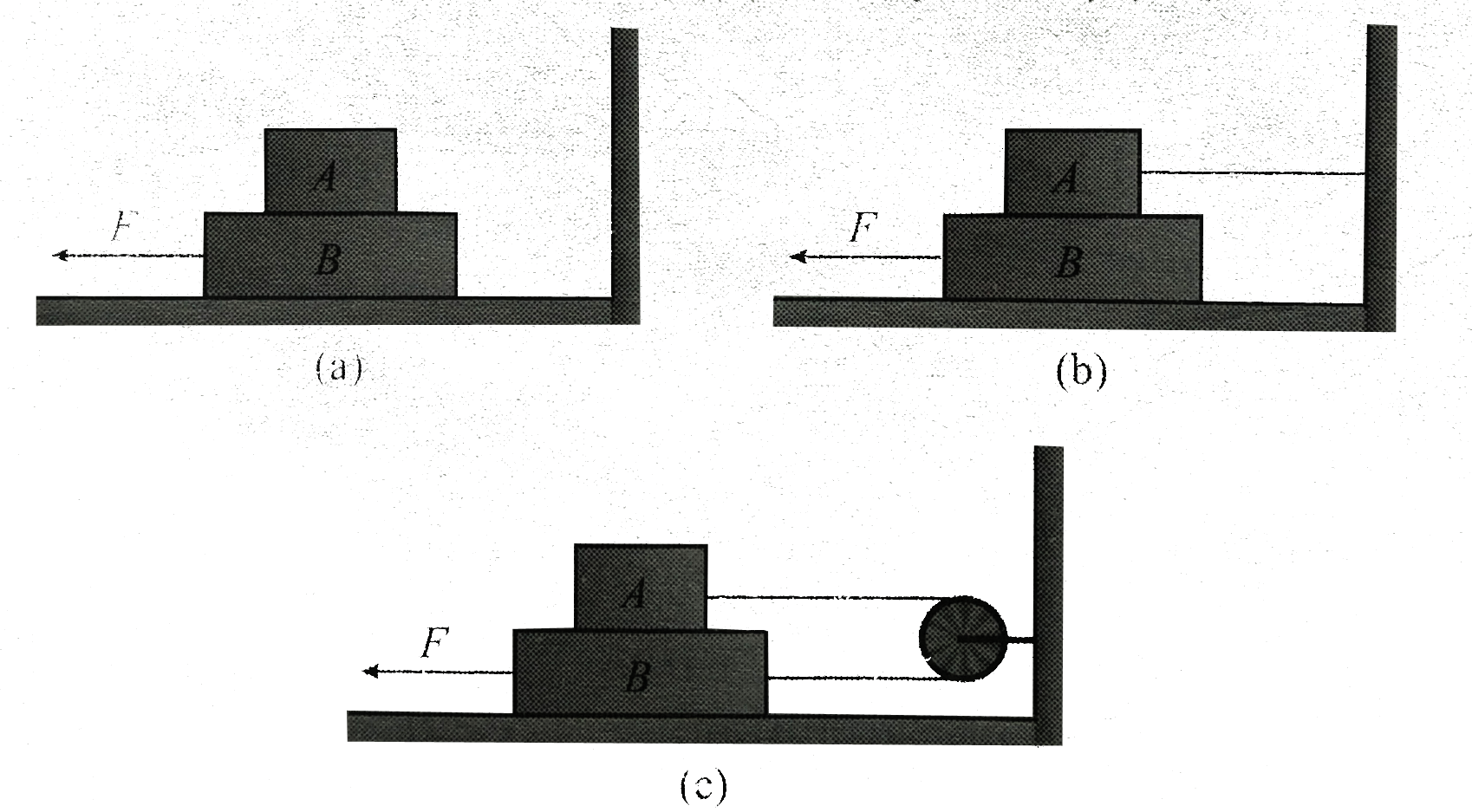
Block A weighs `4 N` and block weigh `8 N` The coefficient of kinetic friction is `0.25` for all surface find the force `F` to slide `B` at a constant speed when (a)`A` rest on `B` and moves with it (b) `A` is held at rest and (c )`A and B` are connected by a light cord passing over a smooth putting as shown in fig 7.31 (a - c) restively.

Text Solution

Verified by Experts

When A moves with `B` the force opposing the motion is the only force of friction between `B` and `S` the horizontal and as velocity of system is contant,
`F =f_(1) =muR_(1) =0.2 (4 +8) =3N`
(b) When A is held stationary the friction opposing the motion is between `A` and `B`. So
`F -muR_(1) +muR_(2) =3 + 0.25 (4) =4N`
(c ) In this situation for dyamic equilibrium of `B`
`F =muR_(1) +muR_(2)+T.....(i)`
While for the uniform motion of `A`
`T =muR_(2)......(ii)`
Substituting `T` from eqn (ii) in (i) we
get `F =muR_(1) + 2muR_(2) =3+2 xx 1 =5N` .
Promotional Banner

Topper's Solved these Questions

  • NEWTONS LAWS OF MOTION

    NARAYNA|Exercise C.U.Q|73 Videos
  • NEWTONS LAWS OF MOTION

    NARAYNA|Exercise LEVEL -I (C.W)|47 Videos
  • MOTION IN A STRAIGHT LINE

    NARAYNA|Exercise Level 2 H.W|29 Videos
  • OSCILLATIONS

    NARAYNA|Exercise EXERCISE - IV|41 Videos

Similar Questions

Explore conceptually related problems

Block A weights 4 N and block B weights 8 N. The coefficient of kinetic friction is 0.25 for all surfaces. The force F to slide B at a constant speed, when A rests on B and moves with it, is

Block A as shown in Fig weighs 2.0 N and block B weighs 6.0 N The coefficient of ikinetic friction between all surface is 0.25 Find the magnitude of the horizontal force necessary to drag block B to the left at constant speed if A and B are connected by a light , flxeible cord passing around a fixed, frictionless pulley

Block A in figure-2.207 weights 2.7N and block B weighs 5.4 N the coefficient of kinetic friction between all surfaces is 0.25. Find the magnitude of the horizontal force F necessary to drag blocks to the left at constant speed if A and B are connected by a light, flexible cord passing around a fixed frictionless pulley

Block A as shown in figure weight 1.40 N and block B weight 4.20 N The coefficient of kinetic friction between all surface is 0.30 Find the magnitude of the horizontal force necessary to drag block B to the left at constant speed if A and B are connected by a light , fiexible cort passing around a fixed , frictionless pulled.

Two blocks A and B , each of mass 10 kg , are connected by a light string passing over a smooth pulley as shown in the figure. Block A will remain at rest if the friction on it is

In the diagram shown, the blocks A, B and C weight, 3kg, 4kg and 5kg respectively. The coefficient of sliding friction between any two surface is 0.25. A is held at rest by a massless rigid rod fixed to the wall while B and C are connected by a light flexible cord passing around a frictionless pulley. Find the force F necessary to drag C along the horizontal surface to the left at constant speed. Assume that the arrangement shown in the diagram, B on C and A on B, is maintained all through. (g=9.8m//s^2)

Block B rests on a smooth surface .The coefficient of static friction between A and B is mu = 0.4 where F = 30 N then Acceleration of upper block is

Block B rests on a smooth surface .The coefficient of static friction between A and B is mu = 0.4 where F = 30 N then Acceleration of lower block is

Two blocks are connected over massless pulley as shown in figure. The mass of block Ais 10 kg and the coefficient of kinetic friction is 0.2 .Block A sliders down the incline at constant speed. The mass of block B in kg is
