Home
Class 11
PHYSICS
A point P moves in counter-clockwise dir...

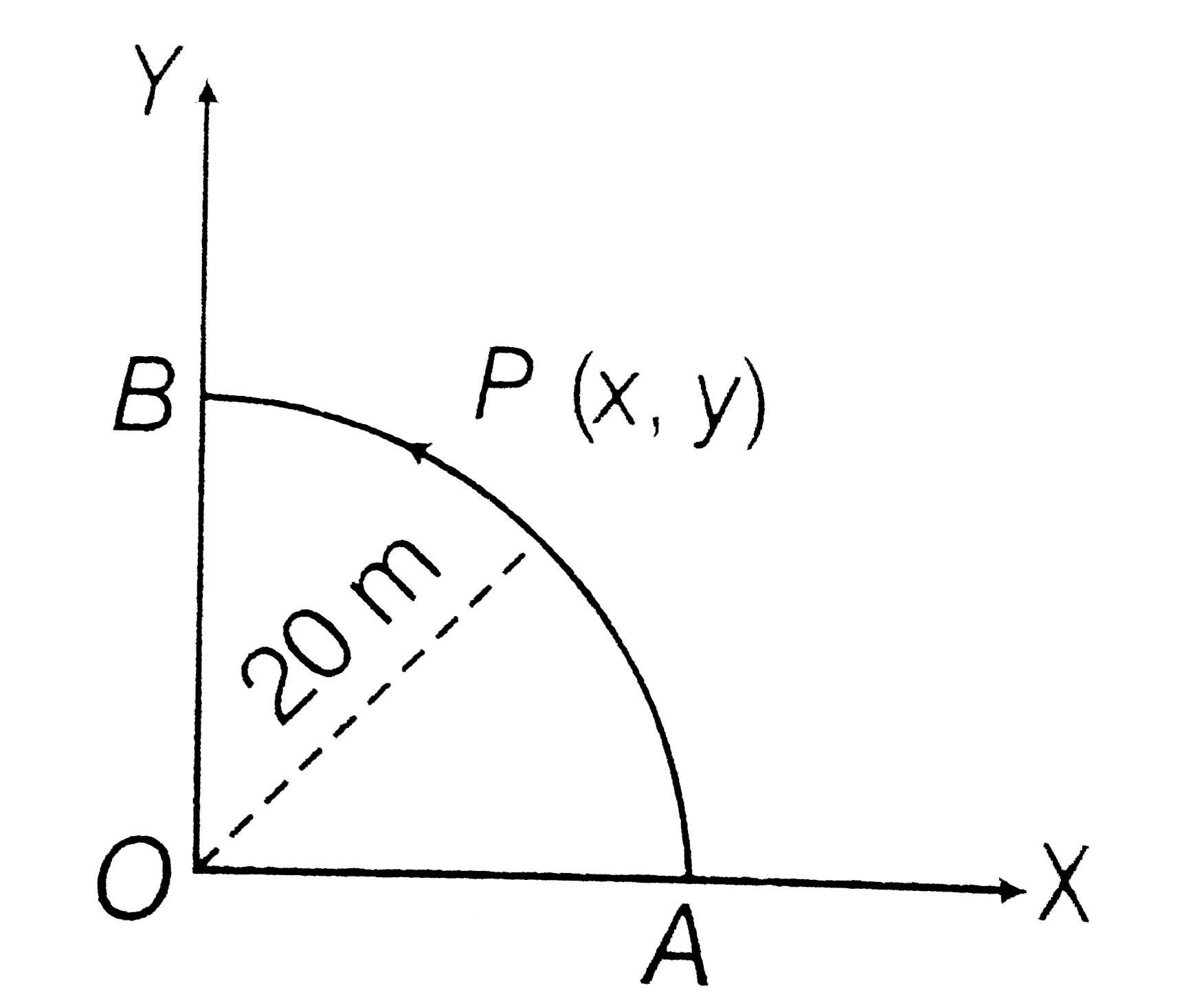
A point P moves in counter-clockwise direction on figure. The movement of P is such that it sweeps out a length `s=t^(3)+5`, where s is in metre and t is in second. The radius of the pathh is 20 m. the acceleration of P when t=2s is nearly

Text Solution

Verified by Experts

`S =t^(3) + 5 rArr v = (dS)/(dt) =3t^(2)`
For `t =2s, v =3xx 4 =12ms^(-1)`
Tangential acceleration, `a_(t) = (dv)/(dt) = 6t`
For `t =2s, a_(t) =12ms^(-2)`
Centripetal acceleraton
`a_(c) =(v^(2))/(R) =(144)/(20) = 7.2ms^(-2)`
net acceleration `=sqrt(a_(t)^(2) +a_(c)^(2))~~ 14ms^(-2)` .
Promotional Banner

Topper's Solved these Questions

  • NEWTONS LAWS OF MOTION

    NARAYNA|Exercise C.U.Q|73 Videos
  • NEWTONS LAWS OF MOTION

    NARAYNA|Exercise LEVEL -I (C.W)|47 Videos
  • MOTION IN A STRAIGHT LINE

    NARAYNA|Exercise Level 2 H.W|29 Videos
  • OSCILLATIONS

    NARAYNA|Exercise EXERCISE - IV|41 Videos

Similar Questions

Explore conceptually related problems

A point P moves in counter-clockwise direction on a circular path as shown in the figure. The movement of P is such that it sweeps out a length s=t^3+5 , where s is in metres and t is in seconds. The radius of the path is 20 m. The acceleration of P when t = 2 s is nearly

A point P moves in counter-clockwise direction on a circular path as shown in the figure. The movement of P is such that it sweeps out a length s=t^(3)+5 , where s is in meters and t is in seconds. The radius of the path is 20 m. The acceleration of P when t = 2 s is nearly

A point p moves in counter - clockwise direction on a circular path as shown in the figure . The movement of 'p' is such that it sweeps out in the figure . The movement of 'p' is such that it sweeps out a length s = t^(3) + 5 , where s is in metres and t is in seconds . The radius of the path is 20 m . The acceleration of 'P' when t = 2 s is nearly .

A point P moves in counter clockwise direction on a circular path as shown in the figure. The movement of 'P' is such that it sweeps out a length s=t^(2)+5 , wheres is in metres and t is in seconds. The radius of the path is 20m. The acceleration of 'P' when t=5sqrt((3)/(10)) seconds is nearly:

A point P moves in a counter-clockwise direction on a circular path as shown in the figure. The movement of P is such that it sweeps out a length s= t^(3) +5 where s is in the metre and t is in seconds. The radius of the path is 27 m. The acceleration of P when t= 3 s is _________ m//s^(2) . (Take sqrt(13) = 3.6 )

The displacement of a particle moving in a straight line, is given by s = 2t^2 + 2t + 4 where s is in metres and t in seconds. The acceleration of the particle is.

The displacement of a particle is represented by the equation, s=3 t^3 =7 t^2 +4 t+8 where (s) is in metres and (t) in seconds . The acceleration of the particle at t=1 s is.

The displacment of a particle is represented by the following equation : s=3t^(3)+7t^(2)+5t+8 where s is in metre and t in second. The acceleration of the particle at t=1:-
