Home
Class 11
PHYSICS
In a figure shown mass of A and B is equ...

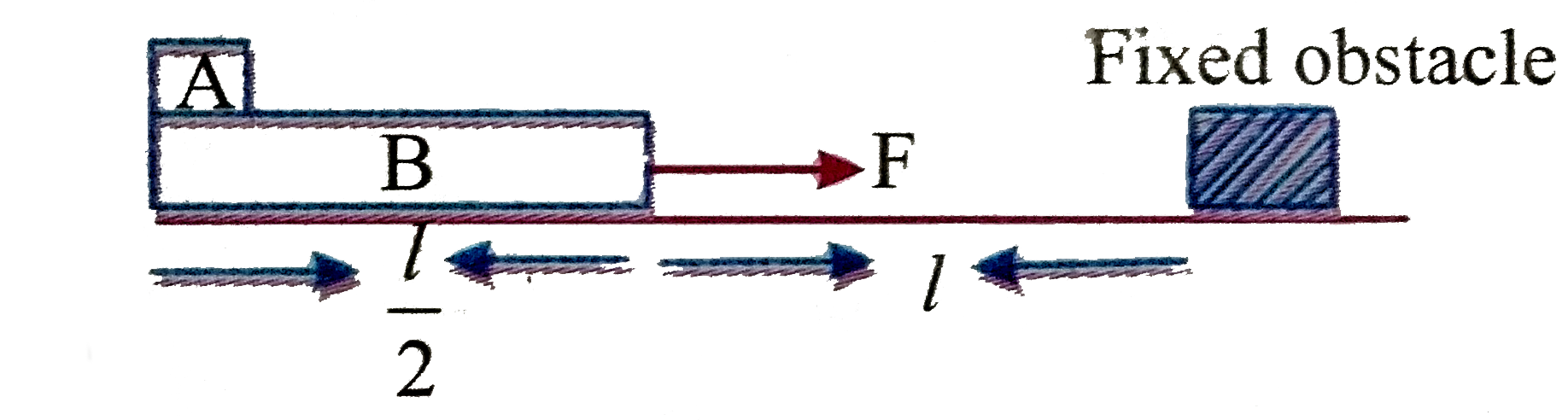
In a figure shown mass of `A` and `B` is equal to `M` each. Friction between `B` and lowermost surface is negligible. Initially both the blocks are at rest. The dimensions of the block `A` are very small. A constant horizontal force `F` is applied on the blocks `B` and both the blocks start moving together without any relative motion. Suddenly, the block `B` encounters a fixed obstacle and comes to rest. The block `A` continues to slide on the block `B`. The block `A` just manages to reach the opposite end of the bolck `B`. What is the coefficient of friction between the two blocks? (Required length are shown in figure)

A

`F//Mg`

B

`2F//Mg`

C

`F//2Mg`

D

none

Text Solution

Verified by Experts

The correct Answer is:

A

Velocity of upper block when lower bolck hits a obstacle,
`v=sqrt(2a)=sqrt(2.(F)/(2M))1=sqrt(F_(1)/(M))`
now after collision retardation of upper block w.r.t earth, `a=(muMg)/(M)=mug therefore v^(2)=u^(2)+2as`
`O=(Fl)/(M)-2mug"(1)/(2), rArrmu=(F)/(Mg)`
Promotional Banner

Topper's Solved these Questions

  • FRICTION

    NARAYNA|Exercise Multiple answer question|20 Videos
  • FRICTION

    NARAYNA|Exercise Passage type of questions|6 Videos
  • COLLISION

    NARAYNA|Exercise Level-II (H.W)|54 Videos
  • GRAVITATION

    NARAYNA|Exercise EXERCISE -IV|40 Videos

Similar Questions

Explore conceptually related problems

A force F is applied on block A and B and between the blocks B and C respectively are (Assume frictionless surface)

The coefficient of static friction between the two blocks shown in figure is mu and the table is smooth. What maximum horizontal forced F can be applied to he block of mass M so that the block move together?

A small block B is placed on another block A of mass 5 kg and length 20 cm. Initially, the block B is near the right end of block A. A constant horizontal force of 10 N is applied to the block A. All the surfaces are assumed frictionless. Find the time elapsed before the block B separates from A.

Two blocks A and B are as shown in figure. The minimum horizontal force F applied to the block B for which slipping behins between B and ground is :

A block of unknown mass is at rest on a rough, horizontal surface. A horizontal force F is applied to the block. The graph in the figure shows the acceleration of the block with respect to the applied force. The mass of the block is

Initially, both the blocks are at rest on horizontal surface as shown in the figure. Find the minimum value of force F in (N) so that sliding starts between the blocks (g=10ms^(-2))

Two block A and B are as shown in figure. The minimum horizantal force F applied to the block B for which slipping begins between B and ground is :

Block 'A' is placed ober the block 'B' as shown in the figure. Wedge is fixed and there is no friction. Between block 'B' and fixed inclined. Force of friction on the block 'A' is

On a smooth horizontal surface a block A of mass 10kg is kept. On this block a second block B of mass 5kg is kept. The coefficient of friction between the two blocks is 0.4 .A horizontal force of 30N is applied on the lower block as shown. The force of friction between the blocks is
