Home
Class 11
PHYSICS
Two blocks A and B of mass 2 kg and 4 kg...

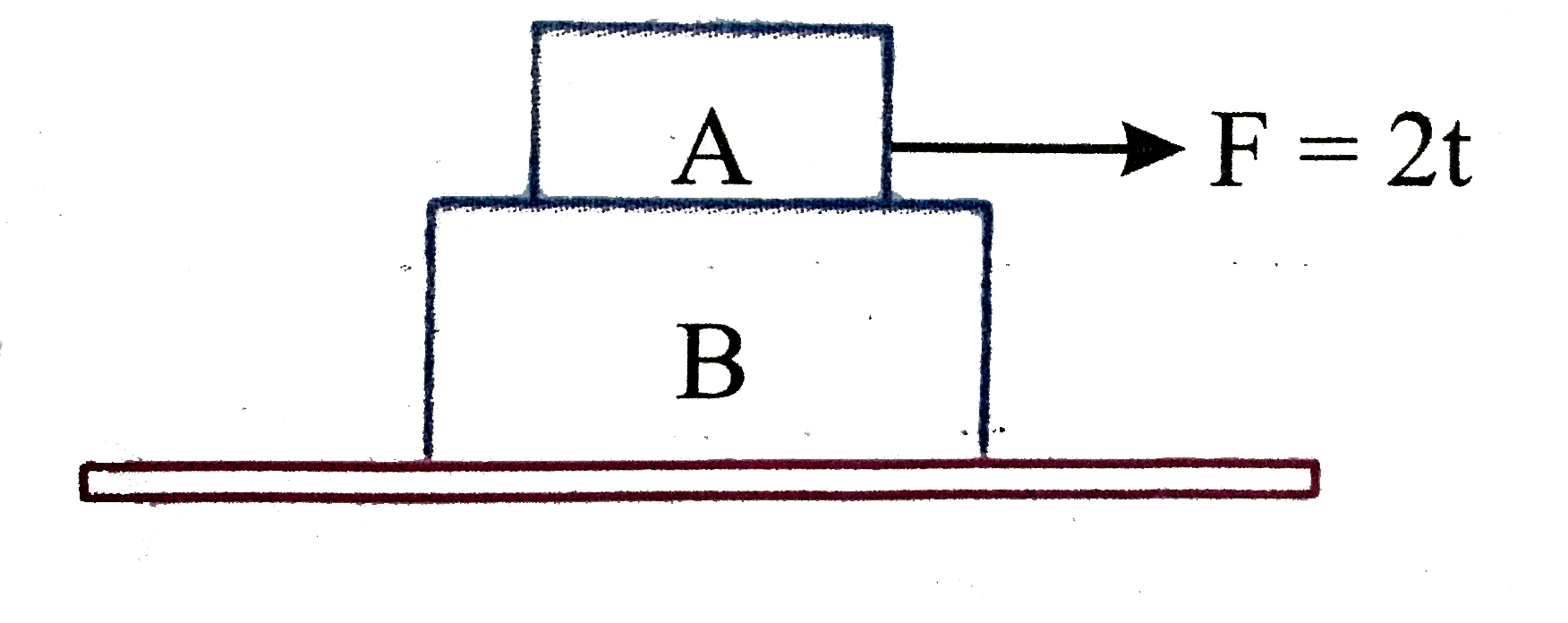
Two blocks `A` and `B` of mass `2 kg` and `4 kg` are placed one over the others as shown in figure. A time vaying horizontal force `F=2t` is applied on the upper blocks as shown in figure. Here `t` is in second and `F` is in newton. Coefficient of friction between `A` and `B` is `mu=(1)/(2)` and the horizontal surface over which `B` is placed is smmoth. `(g=10 m//s^(2))`. If acceleration of blocks `A` as a function of time is given by `a_(A)=t//c` then find value of `c`. `(t le7.5s)`

Text Solution

Verified by Experts

The correct Answer is:

3

Limiting friction between `A` and `B` is
`f_(L)=mum_(A)g=((1)/(2))(2)(10)=10N`
Block `B` moves due to friction only. Therefore, maximum acceleration of `B` can be
`a_(max)=(f_(L))/(m_(B))=(10)/(4)=2.5m//s^(2)`

`F=10N`
Thus, both the blocks move together with same acceleration till the common acceleration becomes `2.5 m//s^(2)`, after that acceleration of `B` will become constant while that of `A` will go on increasing. To find the time when the acceleration of both the blocks becomes. `2.5 m//s^(2)` ( or when slipping will start between `A` and `B`) we will write
` 2.5=(F)/((m_(A)+m_(B)))=(2t)/(6)` Therefore `t=7.5 s`
Hence, for `tle7.5s`
`a_(A)=a_(B)=(F)/(m_(A)+m_(B))=(2t)/(6)=(t)/(3)`
Promotional Banner

Topper's Solved these Questions

  • FRICTION

    NARAYNA|Exercise Passage type of questions I|6 Videos
  • FRICTION

    NARAYNA|Exercise Passage type of questions|6 Videos
  • COLLISION

    NARAYNA|Exercise Level-II (H.W)|54 Videos
  • GRAVITATION

    NARAYNA|Exercise EXERCISE -IV|40 Videos

Similar Questions

Explore conceptually related problems

Two blocks A and B of masses 2kg and 4kg are placed one over the other as shown in figure. A time varying horizontal force F =2t is applied on the upper block as shown in figure. Here t is in second and F is in newton. Drow a graph showing acceleration of A and B on y-axis and time on x-axis.Coefficient of friction between A and B is mu =(1)/(2) and the horizontal surface over which B is placed smooth. (g =10m//s^(2))

Two blocks of masses 1 kg and 2 kg are placed in contact on a smooth horizontal surface as shown in fig. A horizontal force of 6N is applied d(a) on a 1-kg block. Find the force of interaction of the blocks. .

Two blocks of masses 4kg and 2kg are placed side on a smooth horizontal surface as shown in the figure. A horizontal force of 20N is applied on 4kg block. Find (a) the acceleration of each block. (b) the normal reaction between two blocks.

Two block A and B of mass 50 kg and 300 kg respectively are placed as shown in figure. Coefficient of friction between all surface is (1)/(2) Then (take g = 10 m//s )

Two blocks 'A' and 'B' each of mass 'm' are placed on a smooth horizontal surface . Two horizontal force F and 2F are applied on the blocks A and B , respectively , as shown in figure . The block A does not slide on block B . The normal reaction acting between the two blocks is

Two blocks of masses m and 2 m are placed one over the other as shown in figure.The coefficient of friction between m and 2m is mu and between 2m and ground is (mu)/(3) . If a horizontal force F is applied on upper block and T is tension developed in string, then choose the incorrect alternative.

Two blocks of masses 10 kg and 20 kg are connected by a massless string and are placed on a smooth horizontal surface as shown in the figure. If a force F=600 N is applied to 10 kg block, then the tension in the string is

