Home
Class 11
PHYSICS
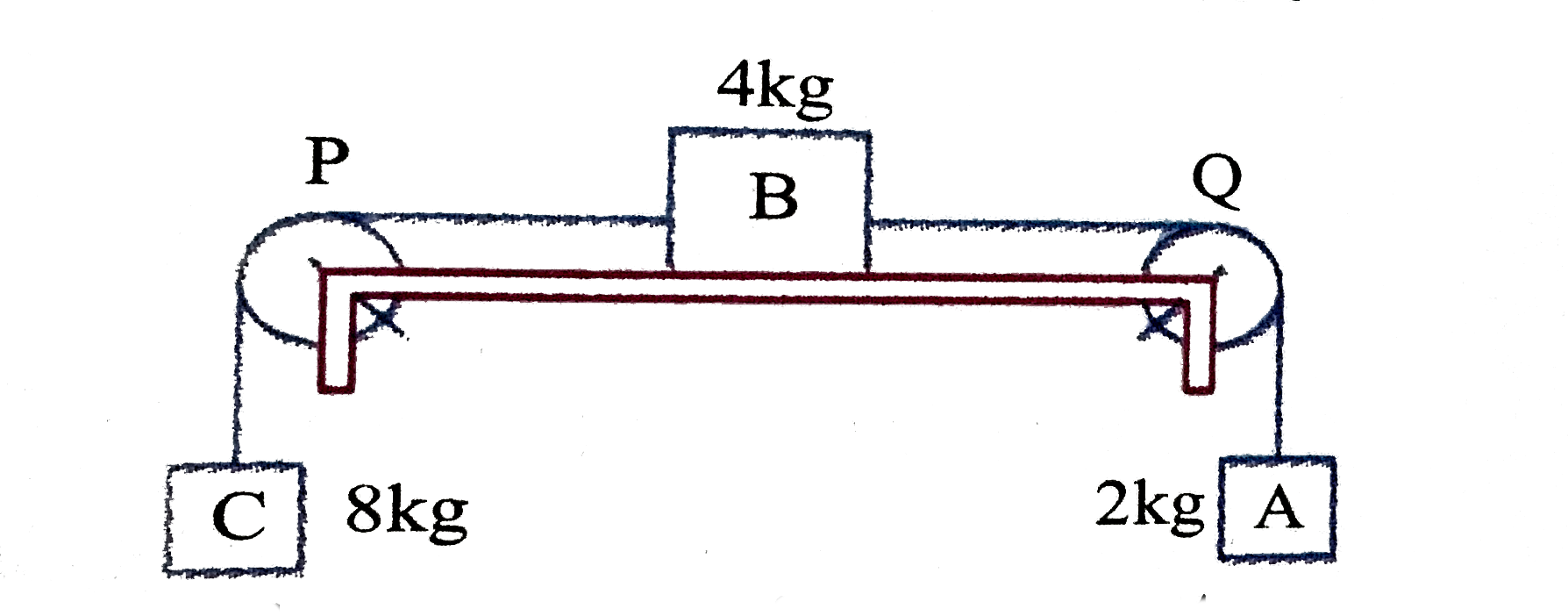
In the figure, the distance BQ=3m, BP=14...

In the figure, the distance `BQ=3m, BP=14m` at time `t=0`. The system of blocks is released from rest at time `t=0`. The string connecting `B` and `C` is suddenly cut at time `t=2s`. Calculate the velocity of `B` at the instant when it hits the pulley `Q`. The coefficient of friction between `B` and the horizontal surface is `mu_(s)=mu_(k)=0.25`. Take `g=9.8 m//s^(2)`

Text Solution

Verified by Experts

The correct Answer is:

7

initialy `8g-T = 8a`
`T-T'-(1)/(4) xx 4g = 4a , T'-2g = 2a`
solving we get a `a_(B) = (5g)/(14)` leftward.
Now `T = 0` at `t = 2s , v_(B) = (5g)/(7), s_(B) = (5g)/(7)`
`2g-T_(0) = 2a' , g + T_(0) = 4a'`
`2g = 6a rArr a' = (g)/(2) , v = (5g)/(7)-(g)/(2)t = 0`
`(t)/(2) = (5)/(7) rArr t = (10)/(7)s 0- ((5g)/(7))^(2) = 2 xx (g)/(2)t = 0 , S = (25 g)/(49) m`
Now `f` gets reserved. `2g - T_(0) = 2a`
`T_(0) = T_(k) = 4a , g = 6a rArr a = (g)/(6)`
`v^(2) -0^(2) = 2 xx (g)/(6)((25g)/(49)+(5g)/(7)+3)`
`v^(2) = (g)/(3) xx 15 rArr v^(2)-5 xx 9.8`
` = 49.0 rArr v = 7 ms^(-1)`
Promotional Banner

Topper's Solved these Questions

  • FRICTION

    NARAYNA|Exercise Passage type of questions I|6 Videos
  • FRICTION

    NARAYNA|Exercise Passage type of questions|6 Videos
  • COLLISION

    NARAYNA|Exercise Level-II (H.W)|54 Videos
  • GRAVITATION

    NARAYNA|Exercise EXERCISE -IV|40 Videos

Similar Questions

Explore conceptually related problems

A block of mass 50 kg slides over a horizontal distance of 1m. If the coefficient of friction between their surface is 0.2, then work done against friction is (take g = 9.8 m//s^(2) ) :

A car starts from rest at time t = 0 and it a-t graph is shown in figure. A coin is initially at rest on the floor of the car. At t = 1 s the coin begins to slip and it stops slipping at t = 3 s. The coefficient of static friction between the floor and the coin is (g = 10 m/ s^2 )

Block A has a mass 3kg and is sliding on a rough horizontal surface with a velocity u_A=2m//s when it makes a direct collision with block B, which has a mass of 2kg and is originally at rest. The collision is perfectly elastic. Determine the velocity of each block just after collision and the distance between the blocks when they stop sliding. The coefficient of kinetic friction between the blocks and the plane is mu_k=0.3 ( Take g=10m//s^2 )

Block B rests on surface . If the coefficient of static friction between A and B is mu = 0.4 . Determine the acceleration of each , if (a) F = 30 N and (b) F = 250 N (g = 10 m//s^(2))

In the given figure, Find mass of the block A, if it remains at rest, when the system is released from rest. Pulleys and strings are massless. [g=10m//s^(2)]

A block A of mass 2 kg rests on a horizontal surface. Another block B of mass 1 kg moving at a speed of m/s when at a distance of 16 cm from A. collides elastically with A. The coefficeint of friction between the horizontal surface and earth of the blocks is 0.2. Then (g = 10 m//s^(2))

Three blocks A , B and C , whose masses are 9kg , 9kg and 18kg respectively as shown in the figure, are released from rest. The co-efficient of friction between block A and the horizontal surface is 0.5 & the co-efficient of friction between block B and the horizontal surface is 0.5 . Find the acceleration of block C just release [Take g=10m//s^(2) ]. All strings and pulleys are ideal

A is a 100kg block, and B is a 200kg block. As shown in figure the block A is attached to a string tied to a wall. The coefficient of friction between A and B is 0.2 and the coefficient of fricition between B and floor is 0.3. Then calculate the minimum force required to move the block B. (take g=10m//s^(2) ).

Two blocks A and B of masses 2kg and 4kg are placed one over the other as shown in figure. A time varying horizontal force F =2t is applied on the upper block as shown in figure. Here t is in second and F is in newton. Drow a graph showing acceleration of A and B on y-axis and time on x-axis.Coefficient of friction between A and B is mu =(1)/(2) and the horizontal surface over which B is placed smooth. (g =10m//s^(2))

In the given arrangement,the pulleys and strings are ideal.The blocks are released from rest and it is found that block A has speed 0.3m/s after it has descended through a distance of 1m .The coefficient of friction (mu) is? (g=10m/s^(2))
