Home
Class 11
PHYSICS
Identical blocks each of mass M and leng...

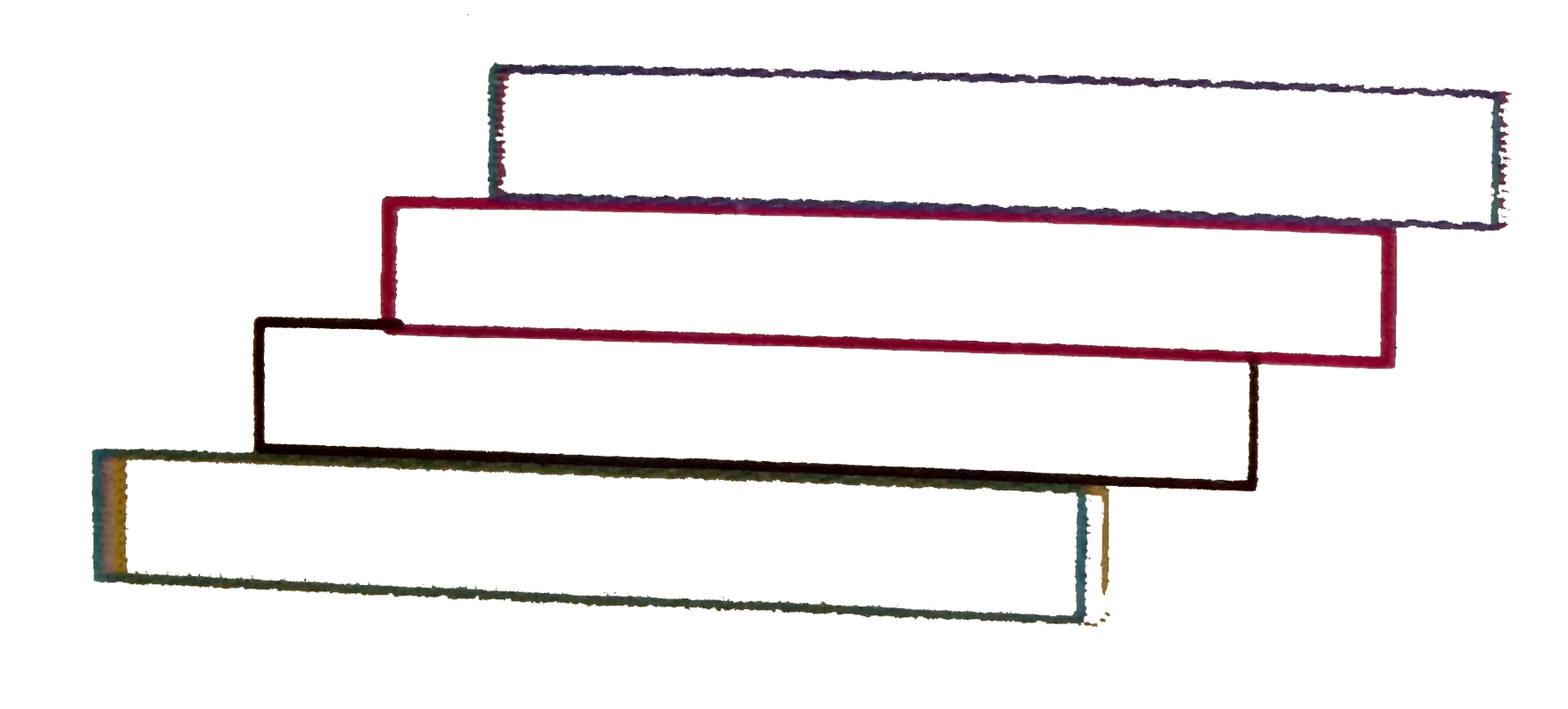
Identical blocks each of mass `M` and length `L` are placed one above the other such that each extends out by a maximum length as shown in figure. Find the maximum extension of the `n^(th)` block from the top, so that the blocks will not fall.

Text Solution

Verified by Experts
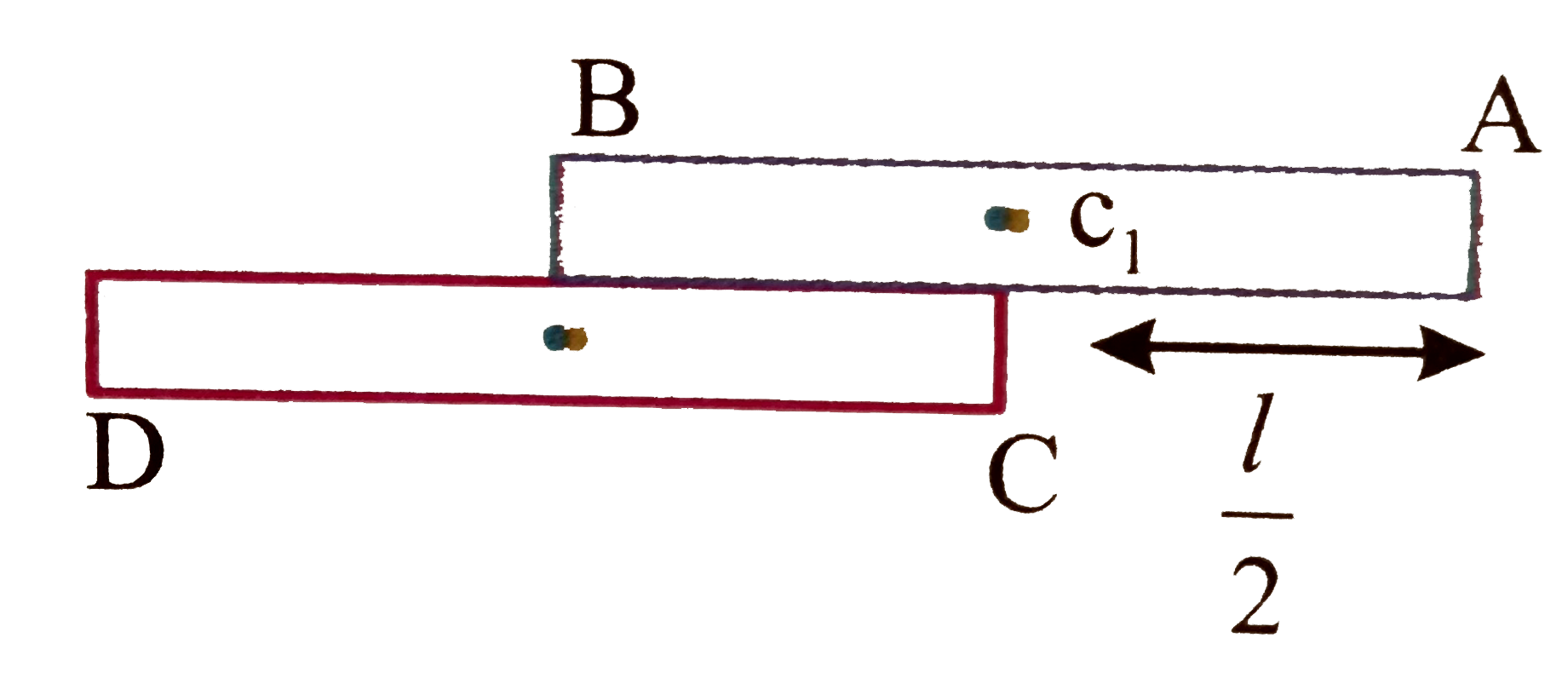
For a two block system, the centre of mass `(C_(1))` of upper block should be at the edge of lower block i.e., at `l/2` distance. But if centre of mass of upper block is not resting on the lower block then, the upper block falls down because of unbalanced torque created by gravitational force.

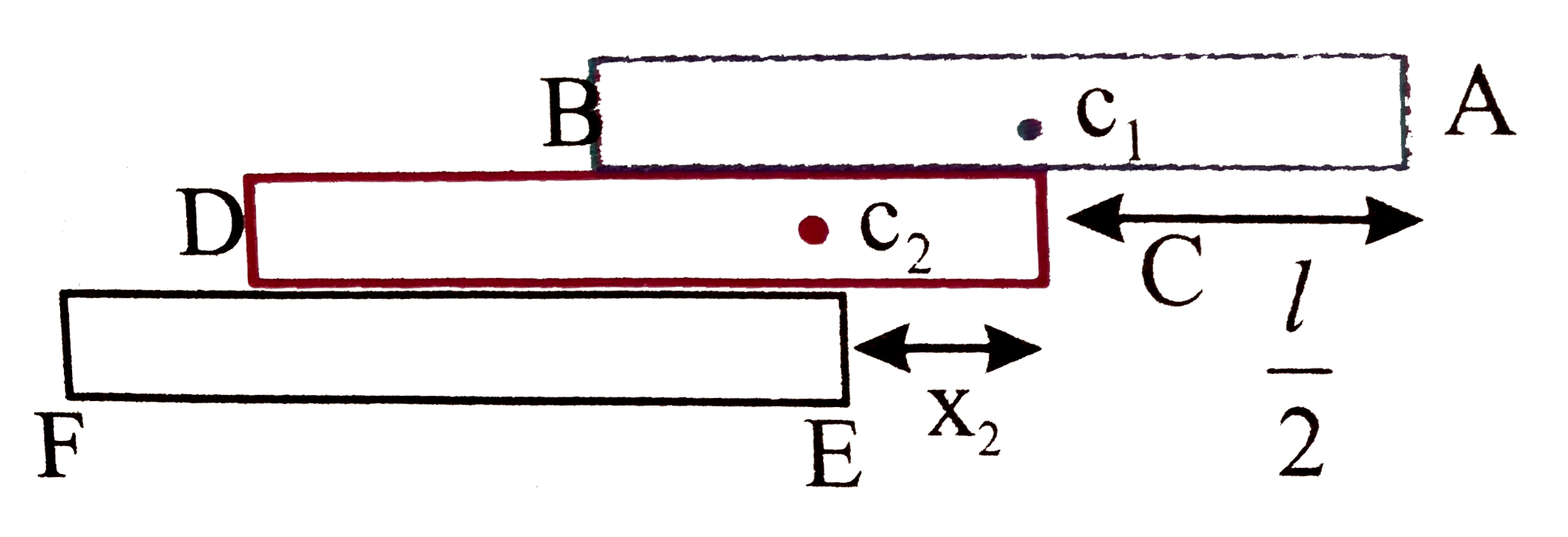
If a third block `(EF)` is arranged below the two blocks then

The centre of mass `(C_(2))` of `(AB)` and `(CD)` block system lie on the edge `E` of third block. to find `x_(2)` consider `C` as origin. then
`x_(2)=(M(0)+M(l/2))/(2M)=l/4`
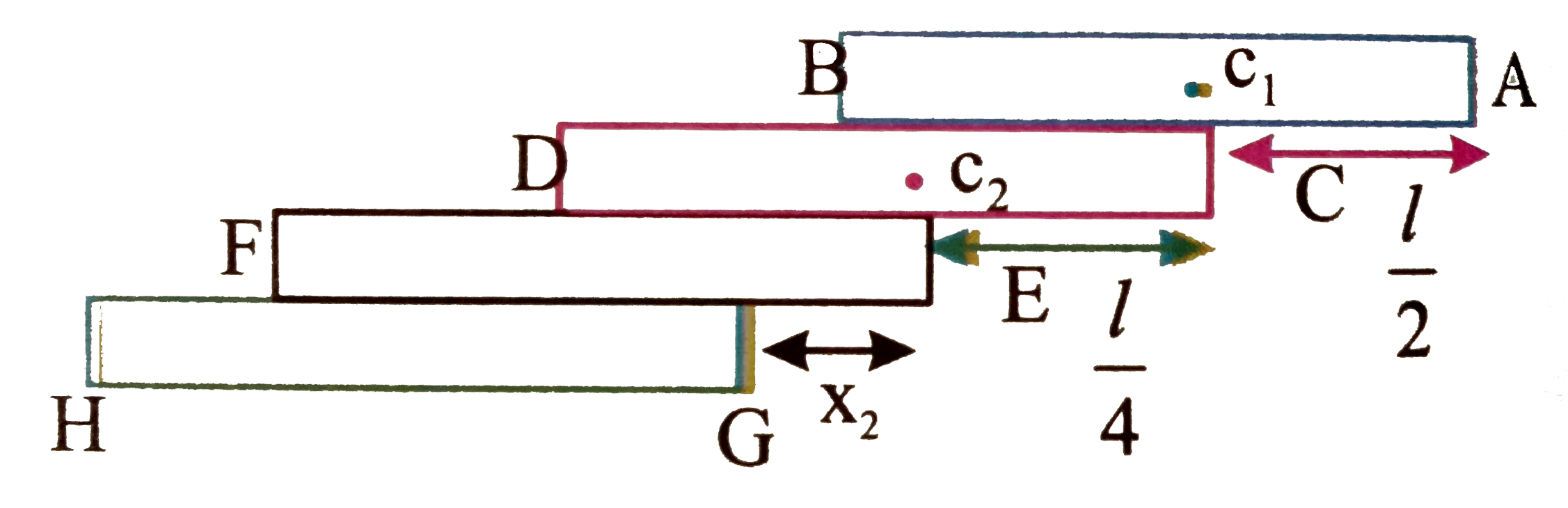
`x_(2)=l/4` So, centre of mass of upper two blocks is at `l/4` distance from edge of lower block. also, if another block `(GH)` is placed below the three blocks in equilibrium, then

The centre of mass `(C_(3))` of the upper three blocks must lie on the edge of the lower fourth block i.e., at `G`. to find `x_(3)` consider `E` as origin.
`x_(3)=(2M(0)+M(l/2))/(3M)=l/6 :. x_(3)=l/6`
Similarly `x_(4)=l/8, x_(5)=l/10,.......`
for `n^(th)` block `x_(n)=l/(2n)`
Promotional Banner

Similar Questions

Explore conceptually related problems

Four identical rods of mass M and length L are placed on one another on the table so as to produce the maximum overhang as shown in figure. The maximum total overhang will be :

A block of mass 1 kg is placed on a wedge shown in figure. Find out minimum coefficient of friction between wedge and block to stop the block on it.

Two blocks each having a mass M are placed as shown in the figure. The accleration of the system is:-

Find the maximum value of force F such that the block shown in the figure does not move

Three blocks A,B and C of equal mass m are placed one over the other on a smooth horizontal ground as shown in figure. Coefficient of friction between any two blocks of A,B and C is 1/2. the maximum value of mass of block D so that the blocks A,B and C move without slippping over each other is

There block A B ,and C of equal mass m are placed one over the other on a frictionless surface (table) as shown in figure The coefficient of friction between any blocks A ,B and C is mu The maximum value of mass of block D so that the blocks A,B and C move without slipping over each other is

Two identical ladders, each of mass M and length L are resting on the rough horizontal surface as shown in the figure. A block of mass m hangs from P. if the system is in equilibrium, find the magnitude and the direction of frictional force at A and B.