Home
Class 11
PHYSICS
Two particles A and B of masses 1kg and ...

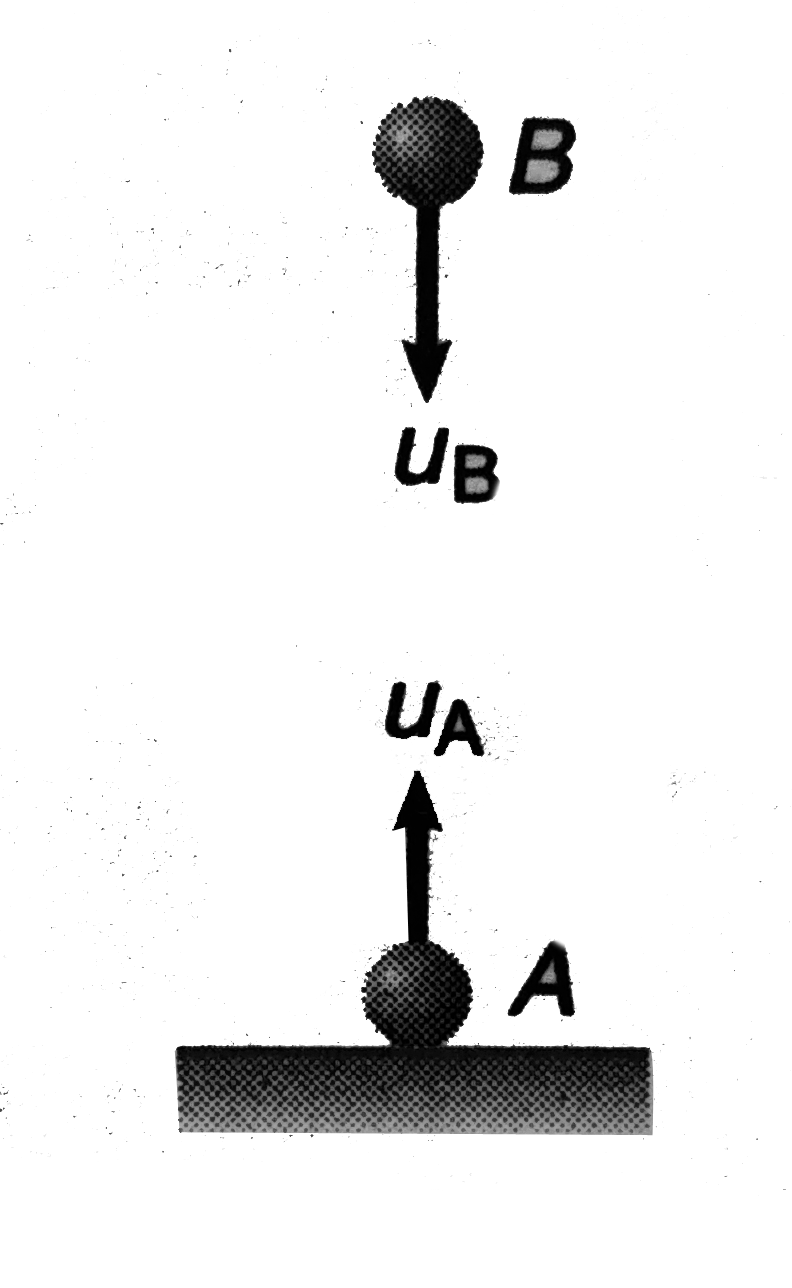
Two particles A and B of masses 1kg and 2kg respectively are projected in the directions shown in figure with speeds `u_A=200m//s` and `u_B=50m//s`. Initially they were `90m` apart. They collide in mid air and stick with each other. Find the maximum height attained by the centre of mass of the particles. Assume acceleration due to gravity to be constant.
`(g=10m//s^2)`

A

`115.55m`

B

`145.55m`

C

`4.55 m`

D

`34.55 m`

Text Solution

Verified by Experts

The correct Answer is:

A

Maximum height attained by `C.M`
=Initial heigh of `C.M. +(u_(cm)^(2))/(2g)`
Promotional Banner

Topper's Solved these Questions

  • SYSTEM OF PARTICLES

    NARAYNA|Exercise NCERT based questions|15 Videos
  • SYSTEM OF PARTICLES

    NARAYNA|Exercise Level -I(H.W)|58 Videos
  • SYSTEM OF PARTICLES

    NARAYNA|Exercise Level-II(C.W.)|64 Videos
  • PHYSICAL WORLD

    NARAYNA|Exercise C.U.Q|10 Videos
  • SYSTEM OF PARTICLES AND ROTATIONAL MOTION

    NARAYNA|Exercise EXERCISE - IV|39 Videos

Similar Questions

Explore conceptually related problems

Two particles A and B of mass 1 kg and 2 kg respectively are projected in the direction shown in figure with speeds u_(A) = 200 ms^(-1) and u_(B) = 50 ms^(-1) . Initially they were 90 m apart. Find the maximum height attained by the center of mass of the particles. Assume acceleration due to gravity to be constant. (Take, g=10 ms^(-2) .

Two particles A and B masses 1 kg and 2 kg respectivelty are projected in the same vertical line as shown in figure with speeds u_(A) = 200 m//s and u_(B) = 85m//s respectively. Initially they were 90 m apart. Find the maximum height attained by the centre of mass of the system of particles A and B, from the initial position of centre of mass of the system. Assume that none of these particles collides with the ground in that duration Take g = 10 m//s^(2)

Two particles A and B are projected simultaneously in the direction shown in the figure with velocities V_(A)=20m//s and V_(B)=10m//s respectively. If they collide in air after 1/2 sec. then

Two particles P and Q have mass 1 kg and 2 kg respectively. They are projected along a vertical line with velocity u_(p) = 20 m/s and u_(Q) = 5 m/s when separation between them was 60 m. P was projected vertically up while Q was projected vertically down. Calculate the maximum height attained by the centre of mass of the system of two particles, measured from the initial position of P. Assume that the particles do not collide and that the ground is far below their point of projection [g = 10 m//s^(2)]

Two particles A and B are projected simultaneously in the directins shown in figure with velocities v_(A) = 20 m//s and v_(B) = 10 m//s respectively. They collide in air after 1/2 s. Find (a) the angle theta (b) the distance x. .

Two particles of masses 1kg and 2kg respectively are initially 10m aprt. At time t=0 , they start moving towards each other with uniform speeds 2m//s and 1m//s respectively. Find the displacement of their centre of mass at t=1s .

Two particles A and B of masses 2kg and 3kg moving on a smooth horizontal surface with speed 1m//s and 2m//s collides perfectly inelastically, then

Two particles of equal mass are projected simultaneously with speeds 20 m//s end 10sqrt(3)m//s as shown in figure. Find the maximum height reached by the centre of mass of the particles

Two particles, one of mass m and the other of mass 2m, are projected horizontally towards each other from the same level above the ground with velocities 10 m/s and 5 m/s, respectively. They collide in air and stick to each other. The distance of the combined mass from point A is

Two particles of masses 2kg and 3kg are projected horizontally in opposite directions from the top of a tower of height 39.2m with velocities 5m//s and 10m//s respectively. The horizontal range of the centre of mass of two particles is

NARAYNA-SYSTEM OF PARTICLES-Level-III
  1. A rope thrown over a pulley has a ladder with a man of mass m on one o...

    Text Solution

    |

  2. Two particles of masses 2kg and 3kg are projected horizontally in oppo...

    Text Solution

    |

  3. Two particles A and B of masses 1kg and 2kg respectively are projected...

    Text Solution

    |

  4. At a given instant of time the position vector of a particle moving in...

    Text Solution

    |

  5. Two point P and Q. diametrically opposite on a disc of radius R have l...

    Text Solution

    |

  6. Point A of rod AB(l=2m) is moved upwards against a wall with velocity ...

    Text Solution

    |

  7. A uniform circular disc of radius R lies in the XY plane with its cent...

    Text Solution

    |

  8. A wheel rotating with uniform angular acceleration covers 50 revolutio...

    Text Solution

    |

  9. A square is made by joining four rods each of mass M and length L. Its...

    Text Solution

    |

  10. A shaft is turning at 65rad//s at time zero. Thereafter, angular accel...

    Text Solution

    |

  11. In figure wheel A of radius rA = 10 cm is coupled by belt B to wheel C...

    Text Solution

    |

  12. An equilateral prism of mass m rests on a rough horizontal surface wit...

    Text Solution

    |

  13. The mass of a metallic beam of uniform thickness and of length 6m is 6...

    Text Solution

    |

  14. Two persons P and Q of same height are carrying a uniform beam of leng...

    Text Solution

    |

  15. A uniform meter scale of mass 1kg is placed on table such that a part ...

    Text Solution

    |

  16. A metallic cube of side length 1.5m and of mass 3.2 metric ton is on h...

    Text Solution

    |

  17. A cubical block of side L rests on a rough horizontal surface with coe...

    Text Solution

    |

  18. O is the centre of an equilateral triangle ABC. F(1), F(2) and F(3) ar...

    Text Solution

    |

  19. A square plate of mass M and edge L is shown in the figure. The moment...

    Text Solution

    |

  20. A thin rod of length L of mass M is bent at the middle point O at an a...

    Text Solution

    |
