Home
Class 11
PHYSICS
Angular acceleration of the cylinder C s...

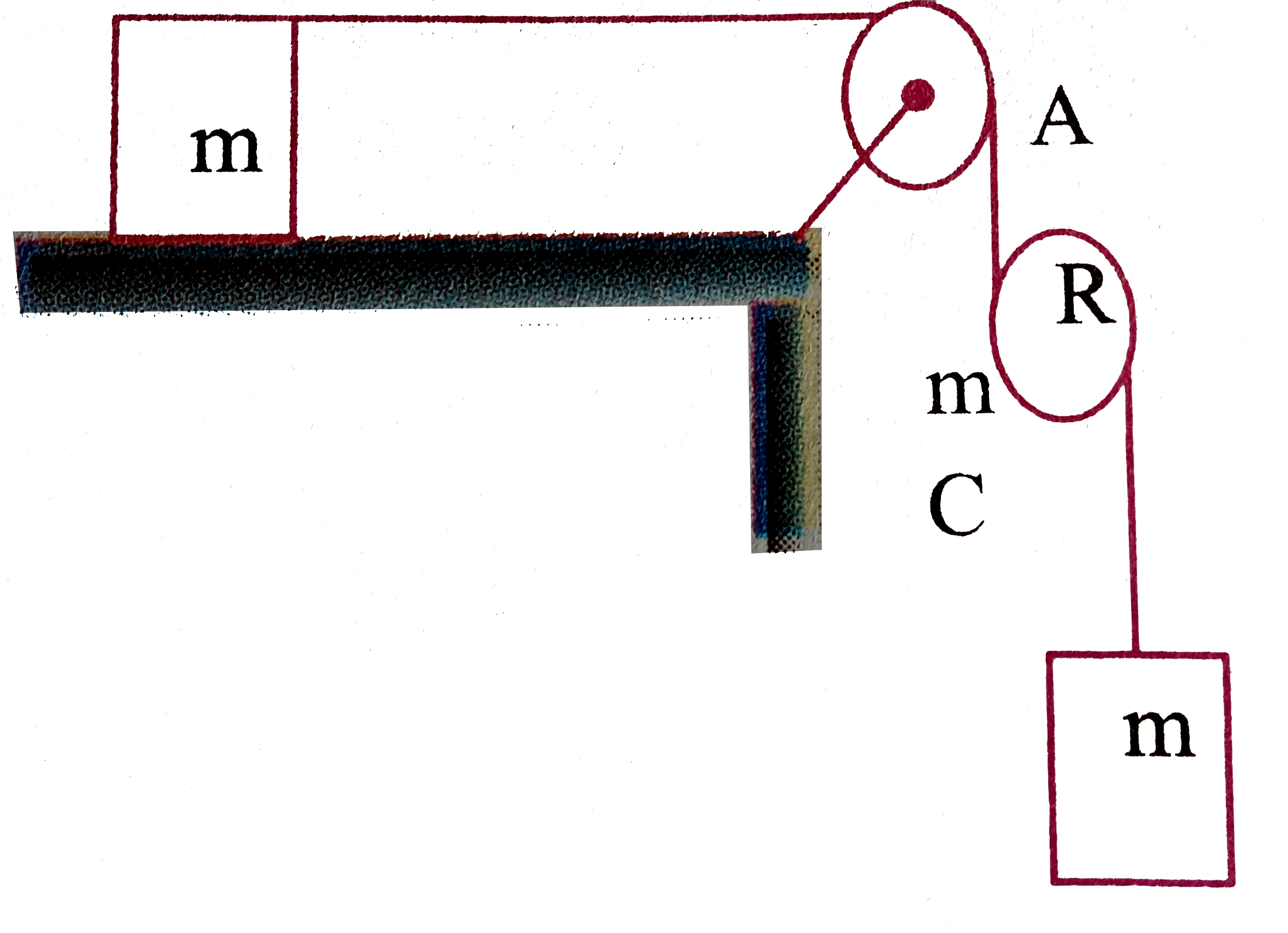
Angular acceleration of the cylinder `C` shows in the figure is (all strings and the pulley are ideal)

A

`(2g)/(3R)`

B

`(2g)/(5R)`

C

`(2g)/R`

D

`g/(2R)`

Text Solution

Verified by Experts

The correct Answer is:
B


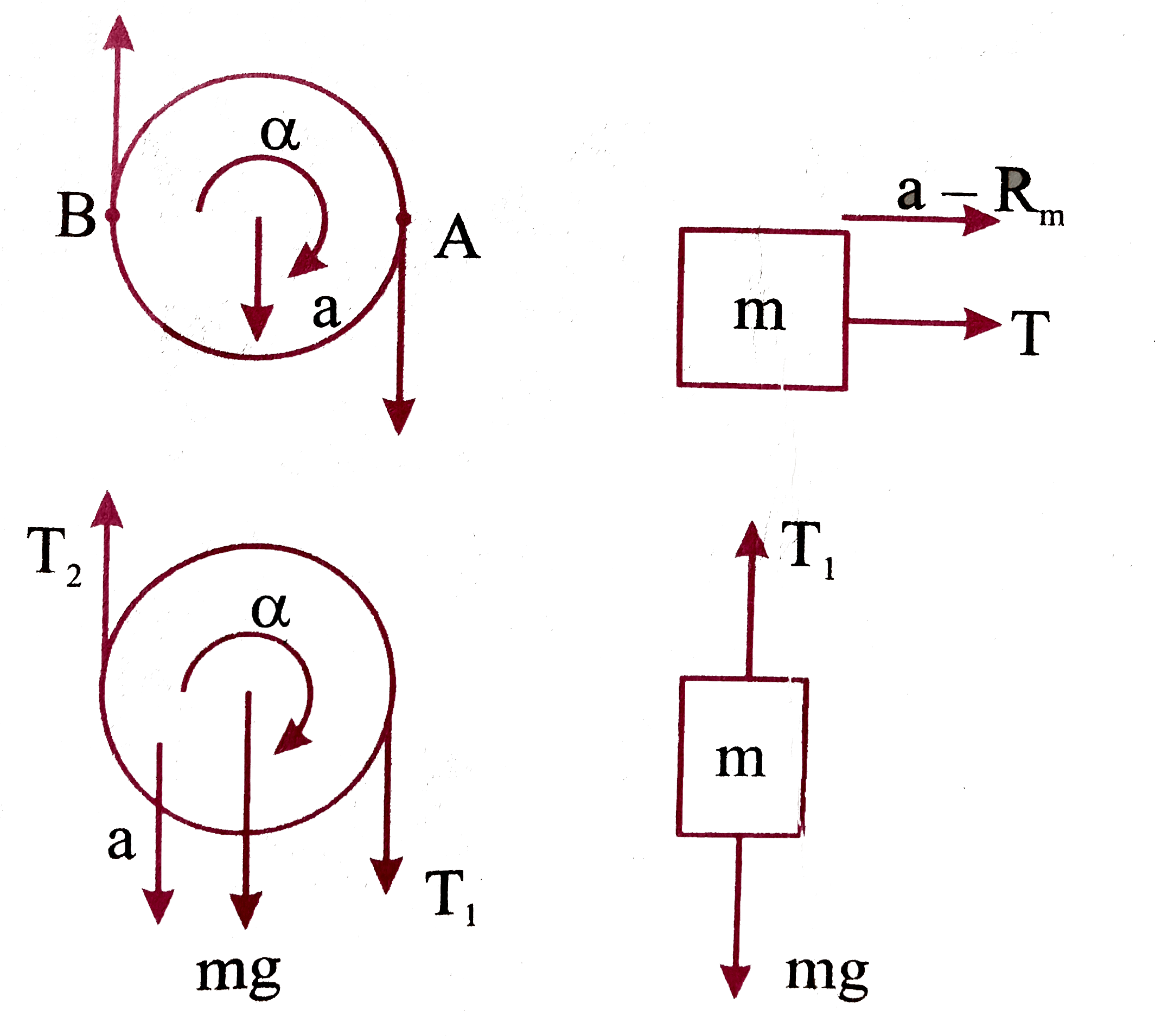
`|vec(a)_(A)|=a+Ralpha`
`|vec(a)_(B)|=a-Ralpha`
`mg-T_(1)=m(a+Ralpha)......(1)`
`T_(1)+mg-T_(2)=ma......(2)`
`T_(2)=m(a-Ralpha)......(3)`
`T_(1)R+T_(2)R=(mR^(2))/2 alpha`
On solving these eqn. we get
`a=(2g)/3, alpha=(2g)/(5R)`
Promotional Banner

Topper's Solved these Questions

  • SYSTEM OF PARTICLES

    NARAYNA|Exercise Level-V|72 Videos
  • PHYSICAL WORLD

    NARAYNA|Exercise C.U.Q|10 Videos
  • SYSTEM OF PARTICLES AND ROTATIONAL MOTION

    NARAYNA|Exercise EXERCISE - IV|39 Videos

Similar Questions

Explore conceptually related problems

Find the acceleration of the 6 kg block in the figure. All the surfaces and pulleys are smooth. Also the strings are inextensible and light. [Take g = 10 m//s^(2) ] .

Acceleration of pulleys and blocks are as shown in the figure. All pulleys & strings are massless & frictionless magnitude of a_(A) and a_(B) are : .

Consider the situation shown in the figure. The surface is smooth and the string and the pulley are light. Find the acceleration of each block and tension in the string.

A belt moves over two pulleys A and B as shown in the figure. The pulleys are mounted on two fixed horizontal axles. Radii of the pulleys A and B are 50 cm and 80 cm respectively. Pulley A is driven at constant angular acceleration of 0.8 "rad/s"^2 unitl pulley B acquries an angular velocity of 10 rad/s. The belt does not slide on either of the pulleys. (a)Find the acceleration of a point C on the belt and angular acceleration of the pulley B. (b) How long does it take for the pulley B to acquire an angular velocity of 10 rad/s ?

The acceleration of the block (A) and (B) respectively in situation shown in the figure is: (pulleys and string are massless).

Figure shows a pulley of mass m and radius r with two blocks of masses m_(1) and m_(2) attached with a light and unstretchable string. Find the acceleration of the blocks, tensions in the string and the force exerted by the pulley on the celling from which it is hanging. Assume no slipping between the string and the wheel.

Consider the situation shown in figure. All the surfaces are frictions and the string and the pulley are light. Find the magnitude of the acceleration of the two blocks.

NARAYNA-SYSTEM OF PARTICLES-Level-VI
  1. Two identical rings A and B are acted upon by torques tau(A) and tau(B...

    Text Solution

    |

  2. A uniform solid sphere of radius r is rolling on a smooth horizontal s...

    Text Solution

    |

  3. Angular acceleration of the cylinder C shows in the figure is (all str...

    Text Solution

    |

  4. A particle of mass m is released from rest at point A in the figure fa...

    Text Solution

    |

  5. The end B of the rod AB which makes angle theta with the floor is bein...

    Text Solution

    |

  6. A block having equilateral triangular cross-section of side a and mass...

    Text Solution

    |

  7. A thin horizontal uniform rod AB of mass m and length l can rotate fre...

    Text Solution

    |

  8. A block mass m moves on a horizontal circle against the wall of a cyli...

    Text Solution

    |

  9. A uniform rod of length l is released from the position shown in the f...

    Text Solution

    |

  10. Consider an arrangement shown in the figure. The pulley P is frictionl...

    Text Solution

    |

  11. Find the moment of inertia of a hemisphere of mass M and radius R show...

    Text Solution

    |

  12. A wheel rolls purely between a rough horizontal surface below it and a...

    Text Solution

    |

  13. A small block of mass m is released from rest from position A inside a...

    Text Solution

    |

  14. Three particles, each of mass m are placed an the points (x(1),y(1),z(...

    Text Solution

    |

  15. A massless spool of inner radius r outer radius R is placed against a ...

    Text Solution

    |

  16. Two particles of masses m(1) and m(2) are connected with a rigid rod o...

    Text Solution

    |

  17. A uniform solid of mass m is placed on a sheet of paper on a horizont...

    Text Solution

    |

  18. A rigid body is in pure rotation, that is, undergoing fixed axis rotat...

    Text Solution

    |

  19. A rough disc of mass m rotates freely with an angular velocity omega. ...

    Text Solution

    |

  20. In the figure, the disc D does not slip on the surface S, the pulley P...

    Text Solution

    |

