Home
Class 11
PHYSICS
Consider a cylinder of mass M=1 kg and r...

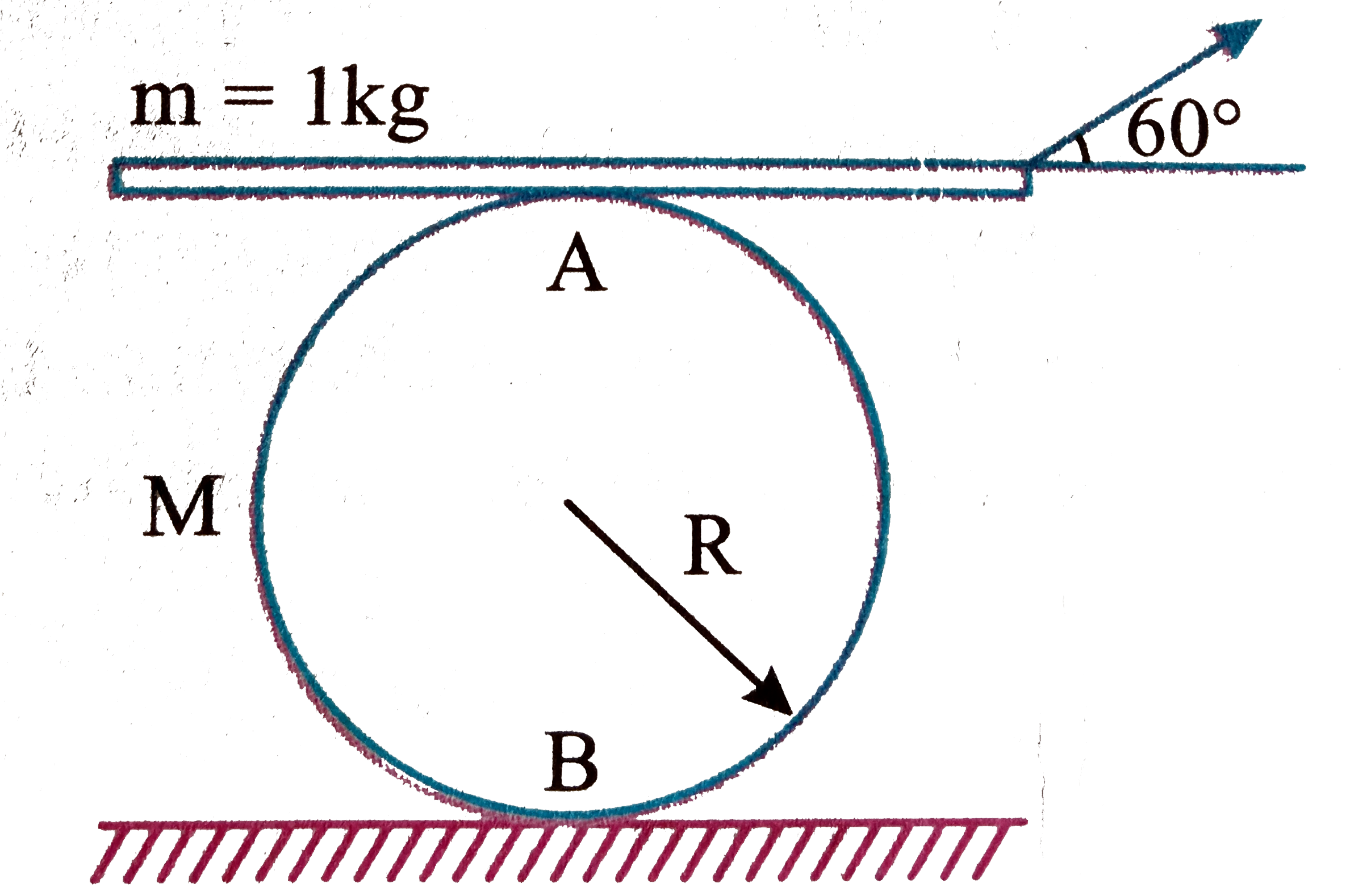
Consider a cylinder of mass `M=1 kg` and radius `R=1 m`lying on a rough horizontal plane. It has a plank lying on its stop as shown in the figure.

A force `F=55N` is applied on the plank moves and causes the cylinder to roll. The plank always remains horizontal. there is no slipping at any point of contact.
The value of frictional force at `A` is

A

`7.5N`

B

`5.0 N`

C

`2.5N`

D

`1.5N`

Text Solution

Verified by Experts

The correct Answer is:
A

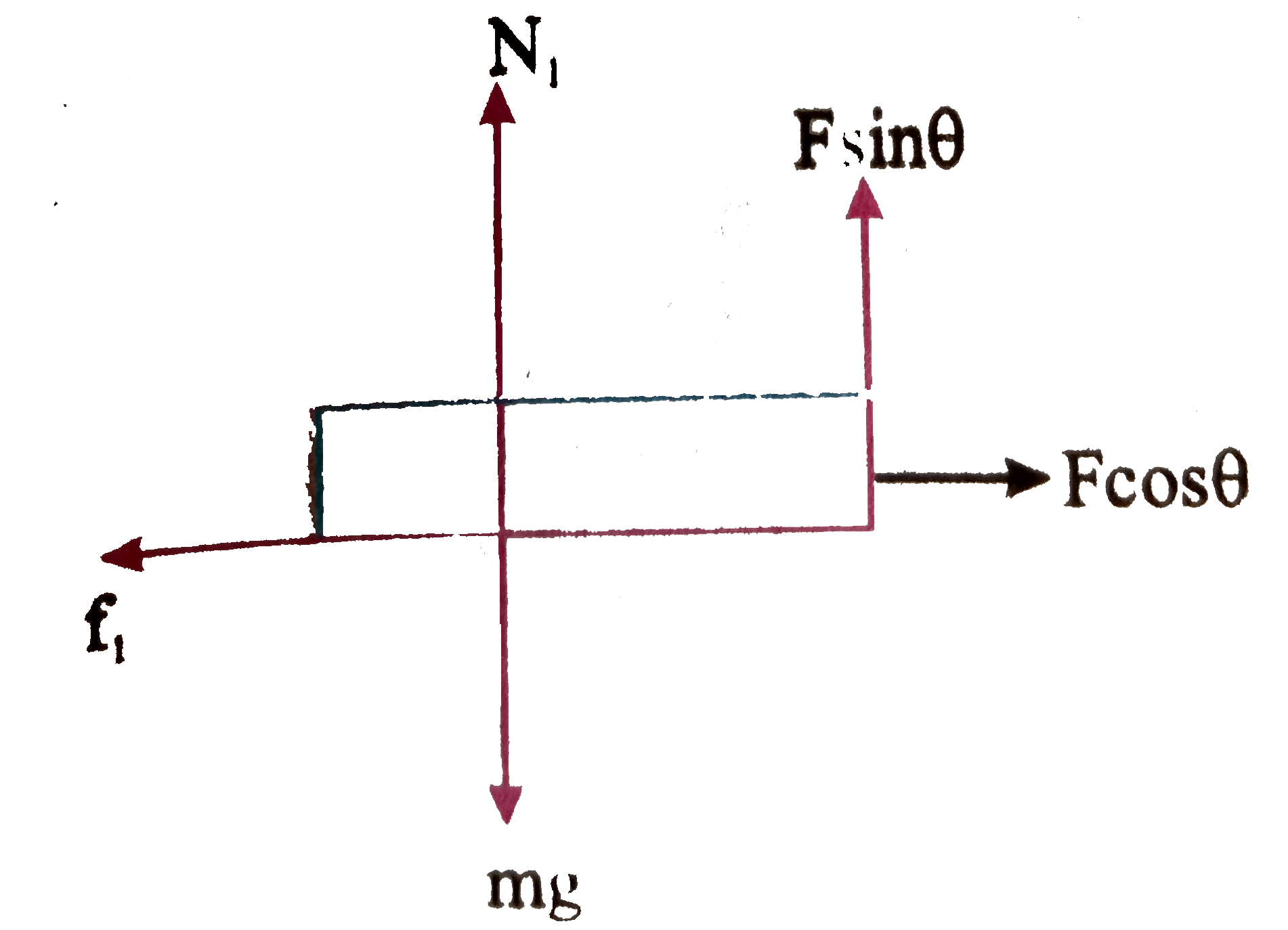
Drawing the `F.B.D.` of the plank and the cylinder

Equations of motion are
`F cos theta-f_(1)=ma.....(1)`
`F sin theta+N_(1)=mg.....(2)`
`f_(1)+f_(2)=MA......(3)`
`f_(1)R-f_(2)R=Ialpha......(4)`
`A=Ralpha.....(5)`
`a=(4Fcos theta)/(3M+8m)=(4xx55xx1/2)/([(3xx1)+(8xx1)])=10 m//s^(2)`
`f_(1)=(3MFcos theta)/(3M+8m)=(3xx1+55xx1/2)/(3xx1+8xx1)=7.5 N`
and `f_(2)=(MF cos theta)/(3M+8m)=(1+55xx1/2)/(3xx1+8xx1)=2.5 N`
Promotional Banner

Topper's Solved these Questions

  • SYSTEM OF PARTICLES

    NARAYNA|Exercise Level-V|72 Videos
  • PHYSICAL WORLD

    NARAYNA|Exercise C.U.Q|10 Videos
  • SYSTEM OF PARTICLES AND ROTATIONAL MOTION

    NARAYNA|Exercise EXERCISE - IV|39 Videos

Similar Questions

Explore conceptually related problems

Consider a cylinder of mass M=1 kg and radius R=1 m lying on a rough horizontal plane. It has a plank lying on its stop as shown in the figure. A force F=55N is applied on the plank moves and causes the cylinder to roll. The plank always remains horizontal. there is no slipping at any point of contact. The acceleration of cylinder is

Consider a cylinder of mass M and radius R lying on a rough horizontal plane. It has a plank lying on its top as shown in the figure. A force F is applied on the plank such that the plank moves and causes the cylinder to roll. The plank always remains horizontal. There is no slipping at any point to contact. (a) what are the directions of the fricition forces acting at A and B on the plank and the cylinder ? (b) Calculate the acceleration of the cylinder. (c ) Find the value of frictional force at A & B .

Consider a cylinder of mass M and radius R lying on a rough horizontal plane. It has a plank lying on its top as shown in figure. A force F is applied on the plank such that the plank moves and causes the cylinder to roll the plank always remains horizontal. there is no slipping at any point of contact. Calculate the acceleration of the cylinder and the frictional forces at the two contact.

A solid cylinder of mass M and radius 2R is rolled up on an incline with the help of a plank of mass 2M as shown in the figure. A constant force F is acting on the plank parallel to the incline. There is no slipping at any of the contact. The friction force between the plank and cylinder is given by:

A uniform solid cylinder of mass m and radius R is placed on a rough horizontal surface. A horizontal constant force F is applied at the top point P of the cylinder so that it start pure rolling. The acceleration of the cylinder is

A sphere of mass m and radius r is placed on a rough plank of mass M . The system is placed on a smooth horizontal surface. A constant force F is applied on the plank such that the sphere rolls purely on the plank. Find the acceleration of the sphere.

A force F is applied at the top of a ring of mass M and radius R placed on a rough horizontal surface as shown in figure. Friction is sufficient to prevent slipping. The friction force acting on the ring is:

A homogeneous cylinder of mass Mand radius r is pulled on a horizontal plane by a horizontal force F acting through its centre of mass. Assuming rolling without slipping, find the angular acceleration of the cylinder,

A plank of mass m is placed on a smooth surface. Now, a uniform solid sphere of equal mass m and radius R is placed on the plank as shown in the figure. A force F is applied at topmost point of the sphere at an angle of 45^(@) to the horizontal. Surface between the plank and the sphere is extremely rough so that there is no slip between the plank and the sphere. The force of firction acting between the plank and the sphere is (F)/(ksqrt(2)) . Find the value of k .

A cylinder of mass 2kg and radius 10cm is held between two planks as shown in Fig. Calculate KE of the cylinder when there is no slipping at any point.

NARAYNA-SYSTEM OF PARTICLES-Level-VI
  1. A wheel of radius R, mass m with an axle of radius r is placed on a ho...

    Text Solution

    |

  2. Consider a cylinder of mass M=1 kg and radius R=1 mlying on a rough ho...

    Text Solution

    |

  3. Consider a cylinder of mass M=1 kg and radius R=1 mlying on a rough ho...

    Text Solution

    |

  4. Consider a cylinder of mass M=1 kg and radius R=1 mlying on a rough ho...

    Text Solution

    |

  5. A uniform rod is fixed to a rotating turntable so that its lower end i...

    Text Solution

    |

  6. A uniform rod is fixed to a rotating turntable so that its lower end i...

    Text Solution

    |

  7. A disc of a mass M and radius R can rotate freely in vertical plane ab...

    Text Solution

    |

  8. A disc of mass M and radius R can rotate freely in a vertical plane ab...

    Text Solution

    |

  9. A disc of mass M and radius R can rotate freely in a vertical plane ab...

    Text Solution

    |

  10. A plank of mass m(1) with a uniform solid sphere of mass m(2) placed o...

    Text Solution

    |

  11. A uniform cylinder of radius R is spinned about it axis to the angular...

    Text Solution

    |

  12. The pulley shown in figure has a radius 10 cm and moment of inertia 0....

    Text Solution

    |

  13. Two solid semi-circular disks fo equal masses m=10 kg collide and stic...

    Text Solution

    |

  14. A ball of radius R=20 cm has mass m=0.75 kg and moment of inertia (abo...

    Text Solution

    |

  15. A uniform square plate of mass 'm'is supported as shown. If the cable ...

    Text Solution

    |

  16. In the figure shown there is a fixed wedge 'W' of inclination theta. A...

    Text Solution

    |

  17. In the figure shown a uniform ringh of mass m placed on arough horizon...

    Text Solution

    |

  18. A thin rod of mass m and length 2l is placed horizontally and perpendi...

    Text Solution

    |

  19. Figure shows an arrangements of masses hanging from a ceilling. In equ...

    Text Solution

    |

  20. A right triangular plate ABC of mas m is free to rotate in the vertica...

    Text Solution

    |

