Home
Class 11
PHYSICS
Two rods of different metals having the ...

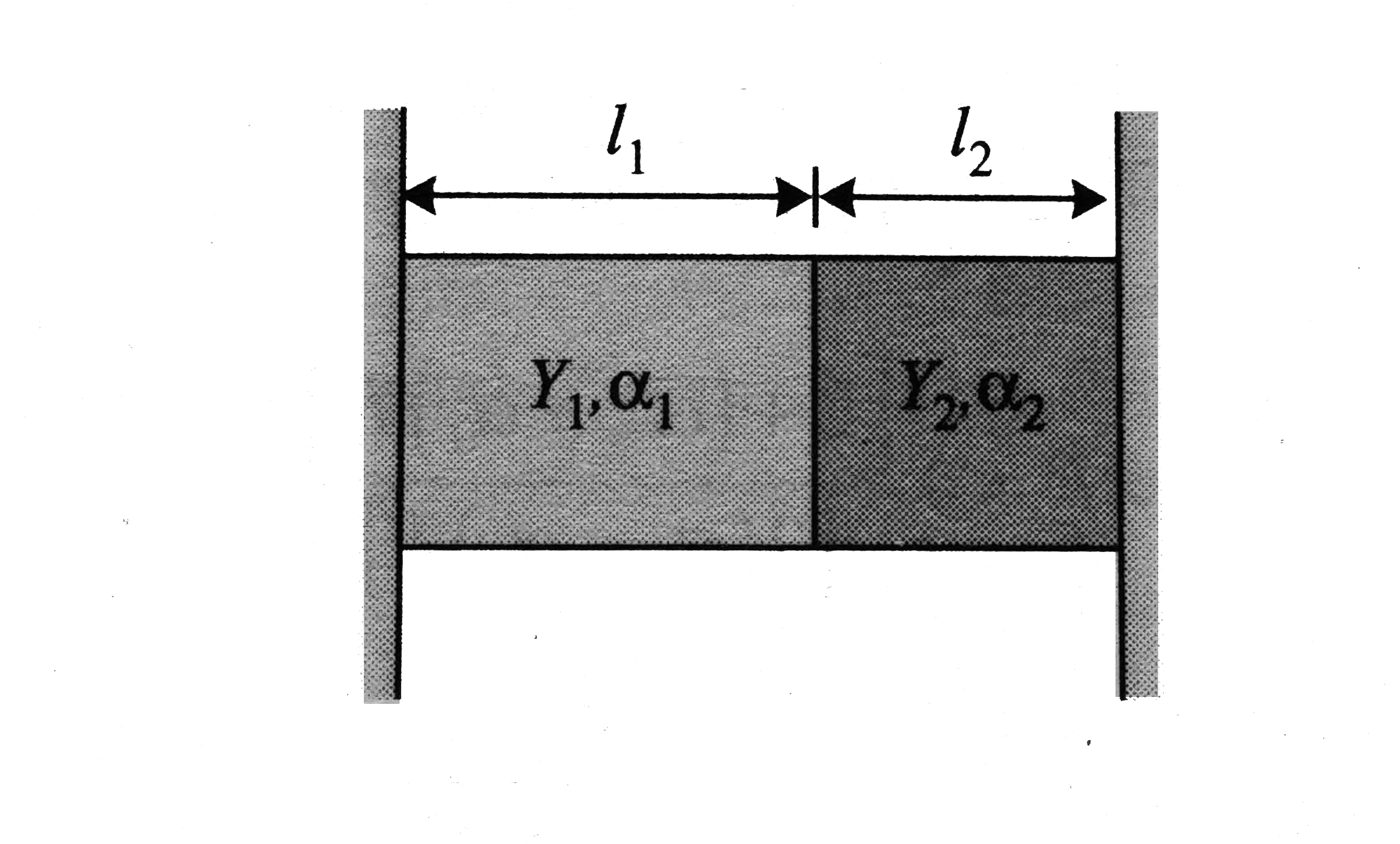
Two rods of different metals having the same area of cross section A are placed between the two massive walls as shown is Fig. The first rod has a length `l_1`, coefficient of linear expansion `alpha_1` and Young's modulus `Y_1`. The correcsponding quantities for second rod are `l_2,alpha_2` and `Y_2`. The temperature of both the rods is now raised by `t^@C`.
i. Find the force with which the rods act on each other (at higher temperature) in terms of given quantities.
ii. Also find the length of the rods at higher temperature.

A

`L_(2)^(1) = L_(2) [1 + alpha_(2)T - (F)/(AY_(2))]`
`L_(1)^(1) = L_(1) (1 + alpha_(1)T - (F)/(AY_(1)))`

B

`L_(2)^(1) = L_(1) [1 - alpha_(2)T + (F)/(AY_(2))]`
`L_(1)^(1) = L_(1) (1 - alpha_(1)T - (F)/(AY_(1)))`

C

`L_(2)^(1) = L_(1) [1 + alpha_(2)T + (F)/(AY_(2))]`

D

`L_(2)^(1) = L_(1) [1 - alpha_(2)T - (F)/(AY_(2))]`

Text Solution

Verified by Experts

The correct Answer is:

A

Consider the rod of length `L_(1)` Due to heating itg increases by `(Delta L_(1))_(H) = (alpha_(1) L_(1) T)` while due to compression it decreases by `(Delta L_(1))_(C) = (FL_(1)//AY_(1)),` so its final length
`L_(1) = L_(1) + (Delta L_(1))_(H) - (Delta L_(1))_(C) = L_(1) [1 + alpha_(1)T - (F//AY_(1))]`
`L_(2) = L_(2) + (Delta L_(2))_(H) - (Delta L_(2))_(C) = L_(2) [1 + alpha_(2)T - (F//AY_(2))]`
Promotional Banner

Topper's Solved these Questions

  • MECHANICAL PROPERTIES OF SOLIDS

    NARAYNA|Exercise SINGLE ANSWER TYPE QUESTIONS|13 Videos
  • MECHANICAL PROPERTIES OF SOLIDS

    NARAYNA|Exercise Comprehension-1:|2 Videos
  • MECHANICAL PROPERTIES OF SOLIDS

    NARAYNA|Exercise MULTIPLE ANSWER TYPE|10 Videos
  • MECHANICAL PROPERTIES OF FLUIDS

    NARAYNA|Exercise EXERCISE - III|30 Videos
  • MOTION IN A PLANE

    NARAYNA|Exercise Level-II(H.W)|31 Videos

Similar Questions

Explore conceptually related problems

A rod has length L_(0) at a reference temperature T_(0) , coefficient of linear expansion alpha , Young's modulus Y, area of cross section A. Rod lie unconstrained on a smooth surface temperature of rod is increased bby Delta T . Mark the correct statement

A metal rod having coefficient of linear expansion (alpha) and Young's modulus (Y) is heated to raise the temperature by Delta theta . The stress exerted by the rod

A metal rof having coefficient of linear expansion alpha and Young's modulus Y is heated to raise its temperature by Delta theta . The stress exerted by the rod is

Two metal rods of the same length and area of cross-section are fixed end to end between rigid supports. The materials of the rods have Young module Y_(1) and Y_(2) , and coefficient of linear expansion alpha_(1) and alpha_(2) . The junction between the rod does not shift and the rods are cooled

Two rods AB and BC of equal cross-sectional area are joined together and clamped between two fixed supports as shown in the figure. For the rod AB and road BC lengths are l_(1) and l_(2) coefficient of linear expansion are alpha_(1) and alpha_(2) , young's modulus are Y_(1) and Y_(2) , densities are rho_(1) and rho_(2) respectively. Now the temperature of the compound rod is increased by theta . Assume of that there is no significant change in the lengths of rod due to heating. then the time taken by transverse wave pulse to travel from end A to other end C of the compound rod is directly proportional to

There are two rods of length l_1 l_2 and coefficient of linear expansions are alpha_1 and alpha_2 respectively. Find equivalent coefficient of thermal expansion for their combination in series.

The coefficient of linear expansion of a rod is alpha and its length is L. The increase in temperature required to increase its legnth by 1% is

Two rods of different materials are placed between massive walls as shown in figure. The cross section of the rods is A, their moduil of elastricity are E_(1) and E_(2) respectively. If rods are heated by t degrees, then (coefficients of liner expansion of material of rods are alpha_(1) and alpha_(2) respectively)

Two rods of length L_(1) and L_(2) are made of materials of coefficients of linear expansions alpha_(1) an alpha_(2) respectively such that L_(1)alpha_(1)=L_(2)alpha_(2) . The temperature of the rods is increased by DeltaT and correspondingly the change in their respective lengths be DeltaL_(1) and DeltaL_(2)

A steel rod of length L_0 . has a cross sectional area A. The force required to stretch this rod by the same amount as the expansion produced by heating it through DeltaT is (coefficient of linear expansion of steel is alpha and young's modulus for steel is Y ).
