Home
Class 11
PHYSICS
Two walls of thicknes l(1) and l(2) and ...

Two walls of thicknes `l_(1)` and `l_(2)` and ther-mal condctivities `K_(1)` and `K_(2)` are in contact In the steady state, if the temperature at the outer faces are `T_(1)` and `T_(2)` find the temperature at the common wall .

Text Solution

Verified by Experts
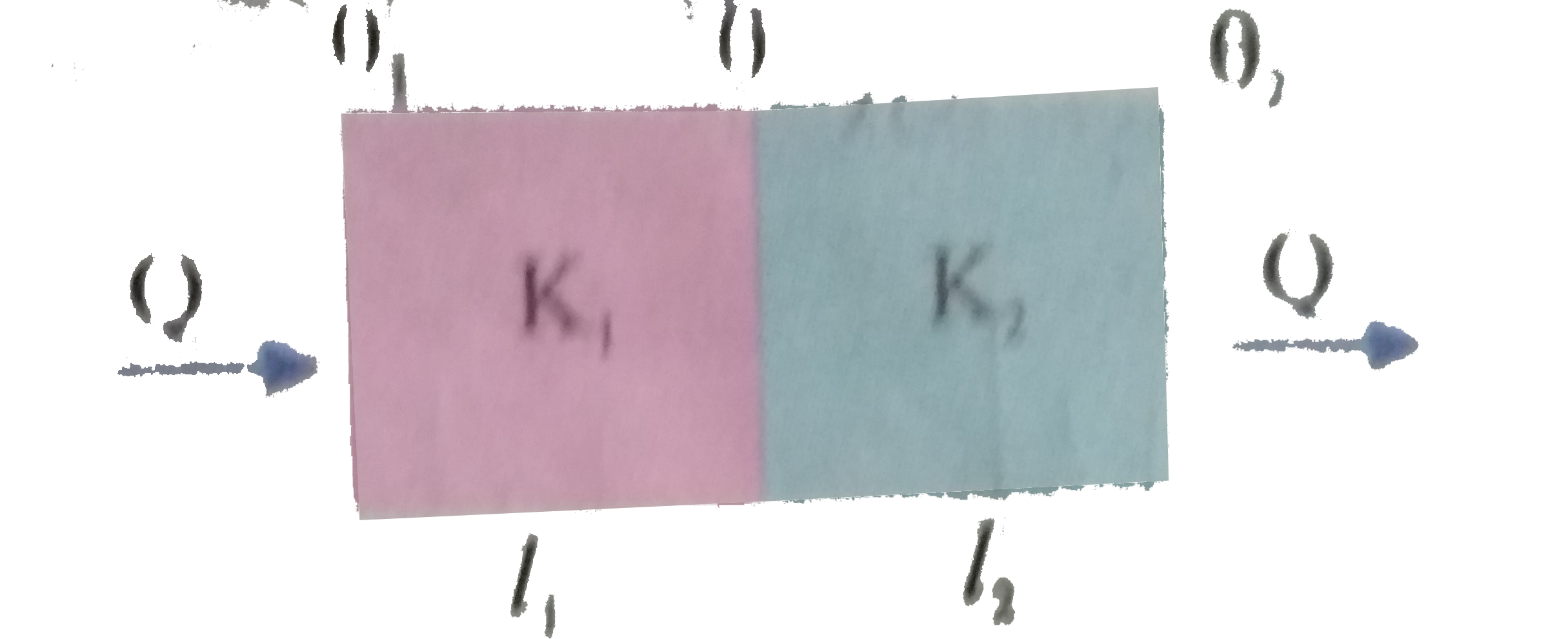
Let `theta` be the temperature of the junction or interface In steady state`(Q)/(t)` = constant
`:.(K_(1)A(theta_(1)-theta))/(l_(1)) = (K_(2)A(theta-theta))/(l_(2))`
`((K_(1)theta_(1))/(l_(1))+(K_(2)theta_(2))/(l_(2)))/(K_(1)/(l_(1))+K_(2)/(l_(2)))=(K_(1)theta_(1)l_(2)+K_(2)theta_(2)l_(1))/(K_(1)l_(2)+K_(2)l_(1))`
.
Promotional Banner

Topper's Solved these Questions

  • TRANSMISSION OF HEAT

    NARAYNA|Exercise C .U .Q|89 Videos
  • TRANSMISSION OF HEAT

    NARAYNA|Exercise LEVEL -1 (C.W)|1 Videos
  • THERMODYNAMICS

    NARAYNA|Exercise Exercise|187 Videos
  • UNITS AND MEASUREMENTS

    NARAYNA|Exercise STATEMENT TYPE QUESTION|23 Videos

Similar Questions

Explore conceptually related problems

Two walls of thickness d and d and thermal conductivities k and k are in contact. In the steady state, if the temperature at the outer T_(1) and T_(2) , the temperature at the common wall is

If two conducting slabs of thickness d_1 and d_2 , and thermal conductivity K_1 and K_2 are placed together face to face as shown in figure in the steady state temperature of outer surfaces are theta_1 and theta_2 . The temperature of common surface is-

Two plates each of area A thickness L_(1) and L_(2) thermal conductivities K_(1) and K_(2) respectively are joined to from a single plate of thickness (L_(1)+L_(2)) If the temperatures of the free surfaces are theta_(1) and theta_(2) Calculate (a) Rate of flow of heat (b) Temperature of interface .

Consider two rods of equal cross - sectionai area A, one of Aluminium and other of iron joined end to end as shown in figure -4.8. Length of the two rods and their thermal coductivities are l_(1) , k_(1) and l_(2),k_(2) respectively . If the ends of the rods are maintained at temperature T_(1) and T_(2),(T_(1)gt T_(2)) find the temperature of the junction in steady state .

Two cylindrical rods of lengths l_(1) and l_(2) , radii r_(1) and r_(2) have thermal conductivities k_(1) and k_(2) respectively. The ends of the rods are maintained at the same temperature difference. If l_(1) =2l_(2) and r_(1) =r_(2)//2 , the rates of heat flow in them will be the same if k_(1)//k_(2) is:

Two bars of same length and same cross-sectional area but of different thermal conductivites K_(1) and K_(2) are joined end to end as shown in the figure. One end of the compound bar it is at temperature T_(1) and the opposite end at temperature T_(2) (where T_(1) gt T_(2) ). The temperature of the junction is

A composite cylinder is made of two materials having thermal conductivities K_(1) and K_(2) as shown. Temperature of the two flat faces of cylinder are maintained at T_(1) and T_(2) . For what ratio K_(1)//K_(2) the heat current throught the two materials will be same. Assume steady state and the rod is lagged (insulated from the curved surface).

Two bodies of masses m_(1) and m_(2) and specific heat capacities S_(1) and S_(2) are connected by a rod of length l, cross-ssection area A, thermal conductivity K and negligible heat capacity. The whole system is thermally insulated. At time t=0 , the temperature of the fisrt body is T_(1) and the temperature of the second body is T_(2)(T_(2)gtT_(1)) . Find the temperature difference between the two bodies at time t.

The figure shows the cross-section of the outer wall of a house buit in a hill-resort to keep the house insulated from the freezing temperature of outside. The wall consists of teak wood of thickness L_(1) and brick of thickness (L_(2) = 5L_(1)) , sandwitching two layers of an unknown material with identical thermal conductivites and thickness. The thermal conductivity of teak wood is K_(1) and that of brick is (K_(2) = 5K) . Heat conducion through the wall has reached a steady state with the temperature of three surfaces being known. (T_(1) = 25^(@)C, T_(2) = 20^(@)C and T_(5) = - 20^(@)C) . Find the interface temperature T_(4) and T_(3) .

NARAYNA-TRANSMISSION OF HEAT-LEVEL-II(C.W)
  1. Two walls of thicknes l(1) and l(2) and ther-mal condctivities K(1) an...

    Text Solution

    |

  2. Three metal rods of coefficient of thermal conductivities K,2K,3K cond...

    Text Solution

    |

  3. Two rods one is semi circular of thermal conductivity K(1) and otheir ...

    Text Solution

    |

  4. Two identical rods of same metal are first waleded in series and then ...

    Text Solution

    |

  5. Two slabs A and B of equal surface area are placed one over the other ...

    Text Solution

    |

  6. Three metal rods of same lenghs and same area of cross sections having...

    Text Solution

    |

  7. Two hollow supheres of thickness are filled with ice The ratio of thei...

    Text Solution

    |

  8. Three rods of same dimensions have thermal condutivity 3K,2K and K The...

    Text Solution

    |

  9. Three rods of lengths L,21 and 3L having thermal conductivities 3K,2K ...

    Text Solution

    |

  10. Three rods of identical cross-sectional area and made from the same me...

    Text Solution

    |

  11. hollow metal with side 0.5m and wall thickess 5 xx 10^(-3)m is filled ...

    Text Solution

    |

  12. One end of thermally insulated rod is kept at a temperature T(1) and t...

    Text Solution

    |

  13. The temperature of a furnace is 2227^(@)C and the intensity is maximum...

    Text Solution

    |

  14. Black body at a temperature of 1640K has the wavelength corresponding ...

    Text Solution

    |

  15. A particular star (assuming it as a black body) has a surface temperat...

    Text Solution

    |

  16. The power radiated by a black body is 'P' and it radiates maximum ener...

    Text Solution

    |

  17. There is a temperature difference of 1K between two black patches of s...

    Text Solution

    |

  18. A black body radiates energy at the rate of E "watt"//m^(2) at a high ...

    Text Solution

    |

  19. The radiant energy from the Sun incident normally at the surface of ea...

    Text Solution

    |

  20. A star behaves like perfeact Black body emitting radiant energy The ra...

    Text Solution

    |

  21. Two spherical bodies have radii R,2R and emissivities e,2e If the temp...

    Text Solution

    |

