Home
Class 11
PHYSICS
A rod of length L with sides fully insul...

A rod of length `L` with sides fully insulated is made of a material whose thermal conductivity `K` varies with temperature as `K=(alpha)/(T)` where `alpha` is constant. The ends of rod are at temperature `T_(1)` and `T_(2)(T_(2)gtT_(1))` Find the rate of heat flow per unit area of rod .

Text Solution

Verified by Experts
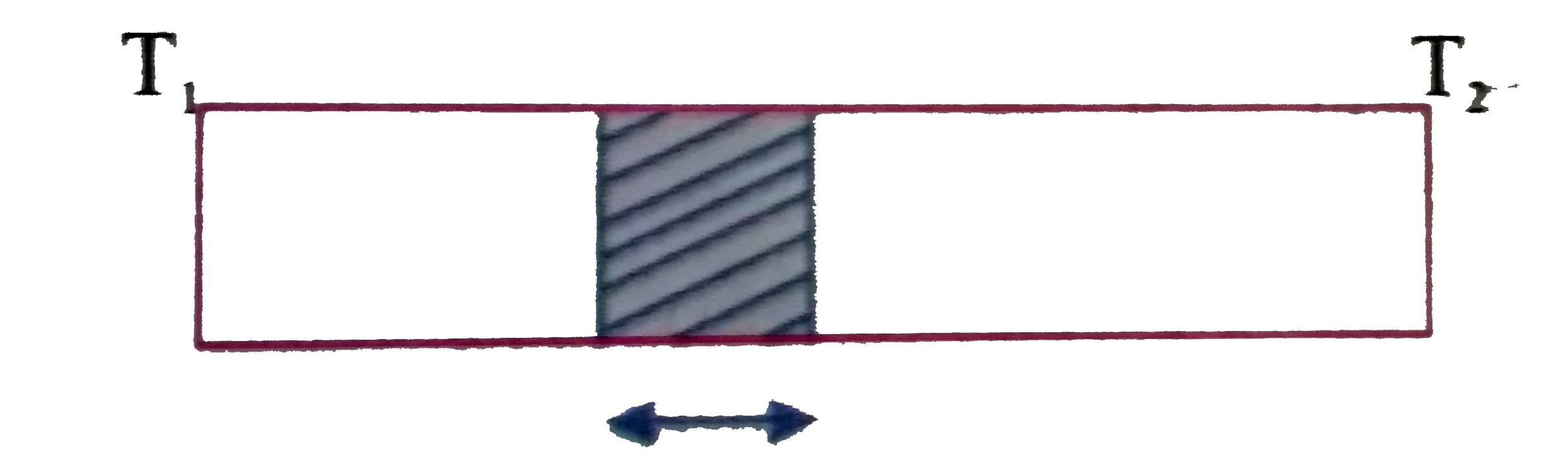

`(dQ)/(dt) =q = - KA(dT)/(dx)`
Heat transfer across each differential element is same
`q = - ((alpha)/(T))A (dT)/(dx)`
`underset(0)overset(L)intqdx= -alphaAunderset(T_(1))overset(T_(2))int(dT)/(T)rArrq =-(alphaA)/(L)ln((T_(2))/(T_(1)))`
` q=(alphaA)/(L)ln((T_(2))/(T_(1)))` .
Promotional Banner

Topper's Solved these Questions

  • TRANSMISSION OF HEAT

    NARAYNA|Exercise C .U .Q|89 Videos
  • TRANSMISSION OF HEAT

    NARAYNA|Exercise LEVEL -1 (C.W)|1 Videos
  • THERMODYNAMICS

    NARAYNA|Exercise Exercise|187 Videos
  • UNITS AND MEASUREMENTS

    NARAYNA|Exercise STATEMENT TYPE QUESTION|23 Videos

Similar Questions

Explore conceptually related problems

A rof of length l with thermally insulated lateral surface consists of material whose heat conductivity coefficient varies with temperature as x = alpha//T , where alpha is a constant. The ends of the rod are kept at temperatures T_1 and T_2 . Find the function T (x) , where x is the distance from the end whose temperature is T_1 , and the heat flow density.

A rod of length l with thermally insulated lateral surface consists of material whose heat conductivity coefficient varies with temperature as k= a//T , where a is a constant. The ends of the rod are kept at temperatures T_1 and T_2 . Find the function T(x), where x is the distance from the end whose temperature is T_1 .

A rod of length l with thermally insulated lateral surface is made of a material whose thermal conductivity varies as K=sc//T where c is a constant. The ends are kept at temperatures T_(1) and T_(2) . Find the temperature at a distance x from te first end where the temperature is T_(1) and the heat flow density.

A rod of length l with thermally insulated lateral surface is made of a matrical whose thermal conductivity varies as K =C//T where C is a constant The ends are kept at temperature T_(1) and T_(2) The temperature at a distance x from the first end where the temperature is T_(1), T =T_(1)((T_(2))/(T_(1)))^(nx//2l) Find the value of n? .

A rod of length l (laterally thermally insulated) of the uniform cross sectional area A consists of a material whose thermal conductivity varies with temperature as K=(K_(0))/(a+bT') where K_(0) , a and b are constants. T_(1) and T_(2)(lt T_(1)) are the temperatures of the ends of the rod. Then, the rate of flow of heat across the rod is

A rod of length l and cross-section area A has a variable thermal conductivity given by K = alpha T, where alpha is a positive constant and T is temperature in kelvin. Two ends of the rod are maintained at temperature T_(1) and T_(2) (T_(1)gtT_(2)) . Heat current flowing through the rod will be

A rod of length l and cross sectional area A has a variable conductivity given by K=alphaT , where alpha is a positive constant T is temperatures in Kelvin. Two ends of the rod are maintained at temperatures T_1 and T_2(T_1gtT_2) . Heat current flowing through the rod will be

A hollow tube has a length l, inner radius R_(1) and outer radius R_(2) . The material has a thermal conductivity K. Find the heat flowing through the walls of the tube if (a) the flat ends are maintained at temperature T_(1) and T_(2) (T_(2)gtT_(1) (b) the inside of the tube is maintained at temperature T_(1) and the outside is maintained at T_(2) .

Three rods of same cross-section but different length and conductivity are joined in series . If the temperature of the two extreme ends are T_(1) and T_(2) (T_(1)gtT_(2)) find the rate of heat transfer H.

Two identical rods are made of different materials whose thermal conductivities are K_(1) and K_(2) . They are placed end to end between two heat reservoirs at temperatures theta_(1) and theta_(2) . The temperature of the junction of the rod is

NARAYNA-TRANSMISSION OF HEAT-LEVEL-II(C.W)
  1. A rod of length L with sides fully insulated is made of a material who...

    Text Solution

    |

  2. Three metal rods of coefficient of thermal conductivities K,2K,3K cond...

    Text Solution

    |

  3. Two rods one is semi circular of thermal conductivity K(1) and otheir ...

    Text Solution

    |

  4. Two identical rods of same metal are first waleded in series and then ...

    Text Solution

    |

  5. Two slabs A and B of equal surface area are placed one over the other ...

    Text Solution

    |

  6. Three metal rods of same lenghs and same area of cross sections having...

    Text Solution

    |

  7. Two hollow supheres of thickness are filled with ice The ratio of thei...

    Text Solution

    |

  8. Three rods of same dimensions have thermal condutivity 3K,2K and K The...

    Text Solution

    |

  9. Three rods of lengths L,21 and 3L having thermal conductivities 3K,2K ...

    Text Solution

    |

  10. Three rods of identical cross-sectional area and made from the same me...

    Text Solution

    |

  11. hollow metal with side 0.5m and wall thickess 5 xx 10^(-3)m is filled ...

    Text Solution

    |

  12. One end of thermally insulated rod is kept at a temperature T(1) and t...

    Text Solution

    |

  13. The temperature of a furnace is 2227^(@)C and the intensity is maximum...

    Text Solution

    |

  14. Black body at a temperature of 1640K has the wavelength corresponding ...

    Text Solution

    |

  15. A particular star (assuming it as a black body) has a surface temperat...

    Text Solution

    |

  16. The power radiated by a black body is 'P' and it radiates maximum ener...

    Text Solution

    |

  17. There is a temperature difference of 1K between two black patches of s...

    Text Solution

    |

  18. A black body radiates energy at the rate of E "watt"//m^(2) at a high ...

    Text Solution

    |

  19. The radiant energy from the Sun incident normally at the surface of ea...

    Text Solution

    |

  20. A star behaves like perfeact Black body emitting radiant energy The ra...

    Text Solution

    |

  21. Two spherical bodies have radii R,2R and emissivities e,2e If the temp...

    Text Solution

    |

