Home
Class 11
PHYSICS
A cylinder of radius R made of a materia...

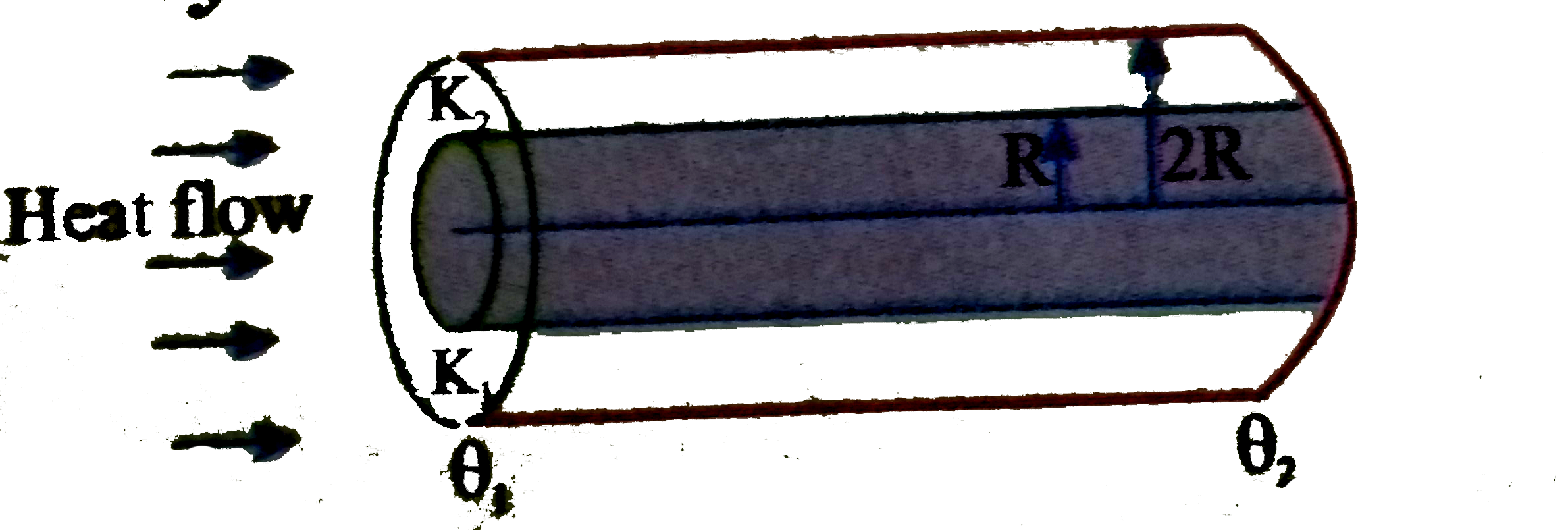
A cylinder of radius `R` made of a material of thermal conductivity `K_(1)` is surrounded by cylindrical shell of inner radius `R` and outer radius `2R` made of a material of thermal con-ductivity `K_(2)` The two ends of the combined system are maintained at two differnet tem-peratures There is no loss of heat across the cylindrical surface and system is in steady state What is the effective thermal conductivity of the system
.

A

`K_(1)+K_(2)`

B

`(K_(1)K_(2))/(K_(1)+K_(2))`

C

`(K_(1)+3K_(2))/(4)`

D

`(K_(1)+8K_(2))/(9)`

Text Solution

Verified by Experts

The correct Answer is:

D

Two rods are in parallel
`K_(eff) (A_(1)+A_(2))=K_(1)A_(1)+K_(2)A_(2)`
`A_(1)=piR^(2)` and `A_(2)= pi (9R^(2)-R^(2))` .
Promotional Banner

Topper's Solved these Questions

  • TRANSMISSION OF HEAT

    NARAYNA|Exercise NCERT BASED QUESTIONS|5 Videos
  • TRANSMISSION OF HEAT

    NARAYNA|Exercise SINGLE ANSWER QUESTIONS Passage|1 Videos
  • TRANSMISSION OF HEAT

    NARAYNA|Exercise LEVEL-III (C.W)|1 Videos
  • THERMODYNAMICS

    NARAYNA|Exercise Exercise|187 Videos
  • UNITS AND MEASUREMENTS

    NARAYNA|Exercise STATEMENT TYPE QUESTION|23 Videos

Similar Questions

Explore conceptually related problems

A cylinder of radius R made of a material of thermal conductivity K_1 is surrounded by a cylinderical shell of inner radius R and outer radius 2R made of a material of thermal conductivity K_2 . The two ends of the combined system are maintained at two different temperatures. There is no loss of heat across the cylindrical surface and the system is in steady state. The effictive thermal conductivity of the system is

A cylinder of radius R made of a material of thermal conductivity K_1 is surrounded by a cylindrical shell of inner radius R and outer radius 2R made of a material of thermal conductivity K_2 . The two ends of the combined system are maintained at two different temperatures. There is no loss of heat across the cylindrical surface and the system is in steady state. The effective thermal conductivity of the system is (a) K_1 + K_2 (b) K_1K_2//(K_1+K_2) (c ) (K_1 + 3K_2)//4 (d) (3K_1 + K_2)//4 .

A cylinder of radius R made of material of thermal conductivity K_(1) is surrounded by a cylindrical shell of inner radius R and outer radius 3R made of a material of thermal conductivity K_(2) . The two ends of the combined system are maintained at two different temperatures. What is the effective thermal conductivity of the system ?

A cylinder A of a material of thermal conductivity K_(1) is surrounded by a cylindrical shell of inner radius equal to the cylinder. The shell is made of a material of thermal conductivity K_(2) . The two ends of the combined system are maintained at two different temperature. if the effective thermal conductivity of the system is (4K_(1) + 5K_(2))/(9) , find the rate of outer radius of the shell to the radius of the cylinder.

A cylinder of radius R is surrounded by a cylindrical shell of inner radius R and oputer radius 2R. The thermal conductivity of the material of the inner cylinder si k_(1) and that of the outer cylinder is K_(2) ,Assumming no loss of heat , the effective thermal conductivity of the system for heat flowing along the length of the cylionder is :

What is the volume of the material in a spherical shell with inner radius ‘r' and outer radius 'R' ?

Calculated thermal conductance for radial flow of a spherical sheel of inner and outer radius r_(1) and r_(2) . Assume that thermal conductivity of the material is K

A cylinder of radius R and length l is made uo of a substnace whose thermal conductivity K varies with the distance x from the axis as K=K_(1)x+K_(2) Detemine the effective thermal conductivity between the flat faces of the cylinder .

A metallic cylindrical shell of length 50 cm has inner radius of 3 cm and outer radius of 6 cm. If the inner and outer surfaces of the cylinder are maintained at 0^@C and 80^@C , respectively, then find the rate of flow of heat from the outer surface to the inner surface. Take, thermal conductivity of metal = 69.3 Wm^(-1) k^(-1)

NARAYNA-TRANSMISSION OF HEAT-LEVEL- (C.W)
  1. Three rods of material 'x' and three rods of materialy are connected a...

    Text Solution

    |

  2. A cylinder of radius R made of a material of thermal conductivity K(1)...

    Text Solution

    |

  3. Water is being boiled in a flat bottomed kettle placed on a stove The ...

    Text Solution

    |

  4. A point source of heat of power P is placed at the centre of a spheric...

    Text Solution

    |

  5. The temperature of the two outer surfaces of a composite slab, consist...

    Text Solution

    |

  6. A and B are two points on uniform metal ring whose centre is O The ang...

    Text Solution

    |

  7. Two ends of a conducting rod of varying cross-section are maintained a...

    Text Solution

    |

  8. Three rods of same dimensions are arranged as shown in Fig. They have ...

    Text Solution

    |

  9. A boiler is made of a copper plate 2.4mm thick with an inside coating ...

    Text Solution

    |

  10. Ice starts forming in lake with water at 0^(@)C and when the atmospher...

    Text Solution

    |

  11. A long metallic bar is carrying heat from one of its ends to the other...

    Text Solution

    |

  12. The temperature drop through each layer of a two layer furnace wall is...

    Text Solution

    |

  13. The wall with a cavity consists of two layers of brick separated by a ...

    Text Solution

    |

  14. A ring consisting of two parts ADB and ACB of same conductivity k carr...

    Text Solution

    |

  15. Two metallic spheres S1 and S2 are made of the same material and have ...

    Text Solution

    |

  16. The temperature of an spherical isolated black body falls from T(1) an...

    Text Solution

    |

  17. A star behaves like a perfectly black body emitting radiant energy The...

    Text Solution

    |

  18. A sphere of density 'd' specific heat capacity 'c' and radius 'r' is h...

    Text Solution

    |

  19. Assuming the Sun to be a spherical body of radius R at a temperature o...

    Text Solution

    |

  20. The spectral emissive power E(lambda) for a body at temperature T(1) i...

    Text Solution

    |
