Home
Class 11
PHYSICS
Two ends of a conducting rod of varying ...

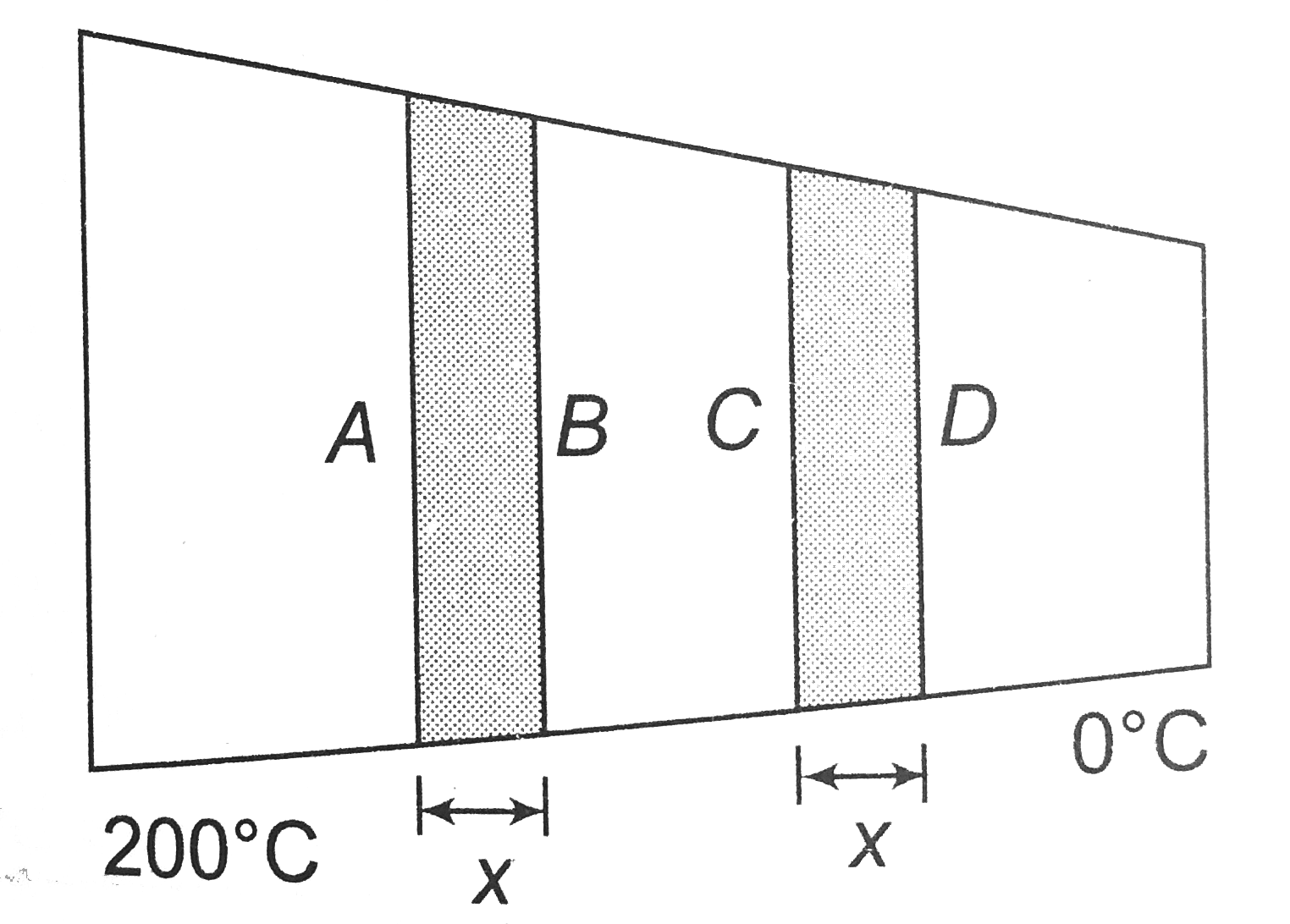
Two ends of a conducting rod of varying cross-section are maintained at `200^(@)C` and `0^(@)C` respectively. In steady state:

A

temperature difference across `AB` and `CD` are equal

B

temperature difference across `AB` and `CD`

C

temperature difference across `AB` and `CD`

D

temperature difference may be equal or differnet depeding on the thermal conductivity of the rod .

Text Solution

Verified by Experts

The correct Answer is:

C

`Deltatheta=(Q)/(t)xx` thermal resistance
`Delta theta prop` thermal resistance `(R )` where `R =(l)/(KA)`
`Delta theta prop (1)/(A)` Area across `CD` is less Therefore temperature difference across `CD` will be more .
Promotional Banner

Topper's Solved these Questions

  • TRANSMISSION OF HEAT

    NARAYNA|Exercise NCERT BASED QUESTIONS|5 Videos
  • TRANSMISSION OF HEAT

    NARAYNA|Exercise SINGLE ANSWER QUESTIONS Passage|1 Videos
  • TRANSMISSION OF HEAT

    NARAYNA|Exercise LEVEL-III (C.W)|1 Videos
  • THERMODYNAMICS

    NARAYNA|Exercise Exercise|187 Videos
  • UNITS AND MEASUREMENTS

    NARAYNA|Exercise STATEMENT TYPE QUESTION|23 Videos

Similar Questions

Explore conceptually related problems

The temperature of the two ends A and B of a rod of length 25cm and circular cross section are 100^(@)C and 0^(@)C respectively In the steady state, find the temperature at a point 10cm from the end B (ifnore loss of heat from curved surface of the body) ?

A rod of length L and uniform cross-sectional area has varying thermal conductivity which changes linearly from 2K at end A to K at the other end B . The ends A and B of the rod are maintained at constant temperture 100^(@)C and 0^(@)C , respectively. At steady state, the graph of temperture : T=T(x) where x= distance from end A will be

The ends of copper rod of length 1m and area of cross section 1cm^(2) are maintained at 0^(@)C and 100^(@)C . At the centre of rod, there is a source of heat of 32W . The thermal conductivity of copper is 400W//mK

Two rods of similar area of cross section and length are joined as shown in the figure. The ratio of their thermal conductivity is 2:3. The free ends are maintained at 100^(@)C and 0^(@)C respectivley. THE temperature at junction in steady state is

The ends of a copper rod of length 1m and area of cross-section 1cm^2 are maintained at 0^@C and 100^@C . At the centre of the rod there is a source of heat of power 25 W. Calculate the temperature gradient in the two halves of the rod in steady state. Thermal conductivity of copper is 400 Wm^-1 K^-1 .

Cylinder copper rod of length 1m and a cylinder steel rod of length 1.5m are joined together end to end. The cross sectional area of eac rod is 3.14cm . The free ends of steel rod and copper rods are maintained at 0^(@)C and 100^(@)C respectively. The surfaces of rods are thermally insulated. Find the temperature of copper steel junction. (Given thermal conductivity of steel =46J//m-s.^(@)C and the thermal conductivity of copper =386J//m-s.^(@)C )

Assume that the thermal conductivity of copper is twice that of aluminium and four times that of brass. Three metal rods made of copper, aluminium and brass are each 15 cm long and 2 cm in diameter. These rods are placed end to end, with aluminium between the other two. The free ends of the copper and brass rods are maintained at 100^@C and 0^@C respectively. The system is allowed to reach the steady state condition. Assume there is no loss of heat anywhere. When steady state condition is reached everywhere, which of the following statement is true?

Assume that the thermal conductivity of copper is twice that of aluminium and four times that of brass. Three metal rods made of copper, aluminium and brass are each 15 cm long and 2 cm in diameter. These rods are placed end to end, with aluminium between the other two. The free ends of the copper and brass rods are maintained at 100^@C and 0^@C respectively. The system is allowed to reach the steady state condition. Assume there is no loss of heat anywhere. Under steady state condition the equilibrium temperature of the copper aluminium junction will be

In the figure ABC is a conducting rod whose lateral surfaces are insulated. The length of the section AB is one-half of that of BC, and the respective thermal conductivities of the two sections are as given in the figure. If the ends A and C are maintained at 0^(@)C and 70^(@)C respectively, the temperature of junction B in the steady state is

Five rods of same material and same cross-section are joined as shown. Lengths of rods ab, ad and bc are l, 2l and 3l respectively. Ends a and c are maintained at temperatures 200^(@)C and 0^(@)C respectivelly. If x has the value calculated in the above question. Then temperature of junction b or d is

NARAYNA-TRANSMISSION OF HEAT-LEVEL- (C.W)
  1. The temperature of the two outer surfaces of a composite slab, consist...

    Text Solution

    |

  2. A and B are two points on uniform metal ring whose centre is O The ang...

    Text Solution

    |

  3. Two ends of a conducting rod of varying cross-section are maintained a...

    Text Solution

    |

  4. Three rods of same dimensions are arranged as shown in Fig. They have ...

    Text Solution

    |

  5. A boiler is made of a copper plate 2.4mm thick with an inside coating ...

    Text Solution

    |

  6. Ice starts forming in lake with water at 0^(@)C and when the atmospher...

    Text Solution

    |

  7. A long metallic bar is carrying heat from one of its ends to the other...

    Text Solution

    |

  8. The temperature drop through each layer of a two layer furnace wall is...

    Text Solution

    |

  9. The wall with a cavity consists of two layers of brick separated by a ...

    Text Solution

    |

  10. A ring consisting of two parts ADB and ACB of same conductivity k carr...

    Text Solution

    |

  11. Two metallic spheres S1 and S2 are made of the same material and have ...

    Text Solution

    |

  12. The temperature of an spherical isolated black body falls from T(1) an...

    Text Solution

    |

  13. A star behaves like a perfectly black body emitting radiant energy The...

    Text Solution

    |

  14. A sphere of density 'd' specific heat capacity 'c' and radius 'r' is h...

    Text Solution

    |

  15. Assuming the Sun to be a spherical body of radius R at a temperature o...

    Text Solution

    |

  16. The spectral emissive power E(lambda) for a body at temperature T(1) i...

    Text Solution

    |

  17. A heated object (at time t=0 and temperature T=T(0)) is taken out of t...

    Text Solution

    |

  18. A system S receives heat continuously from an electric heater of power...

    Text Solution

    |

  19. According to Newton's law of cooling, the rate of cooling of a body is...

    Text Solution

    |

  20. A liquid in a beaker has temperature theta(t) at time t and theta0 is ...

    Text Solution

    |
