Home
Class 11
PHYSICS
An ideal gas expands isothermally from v...

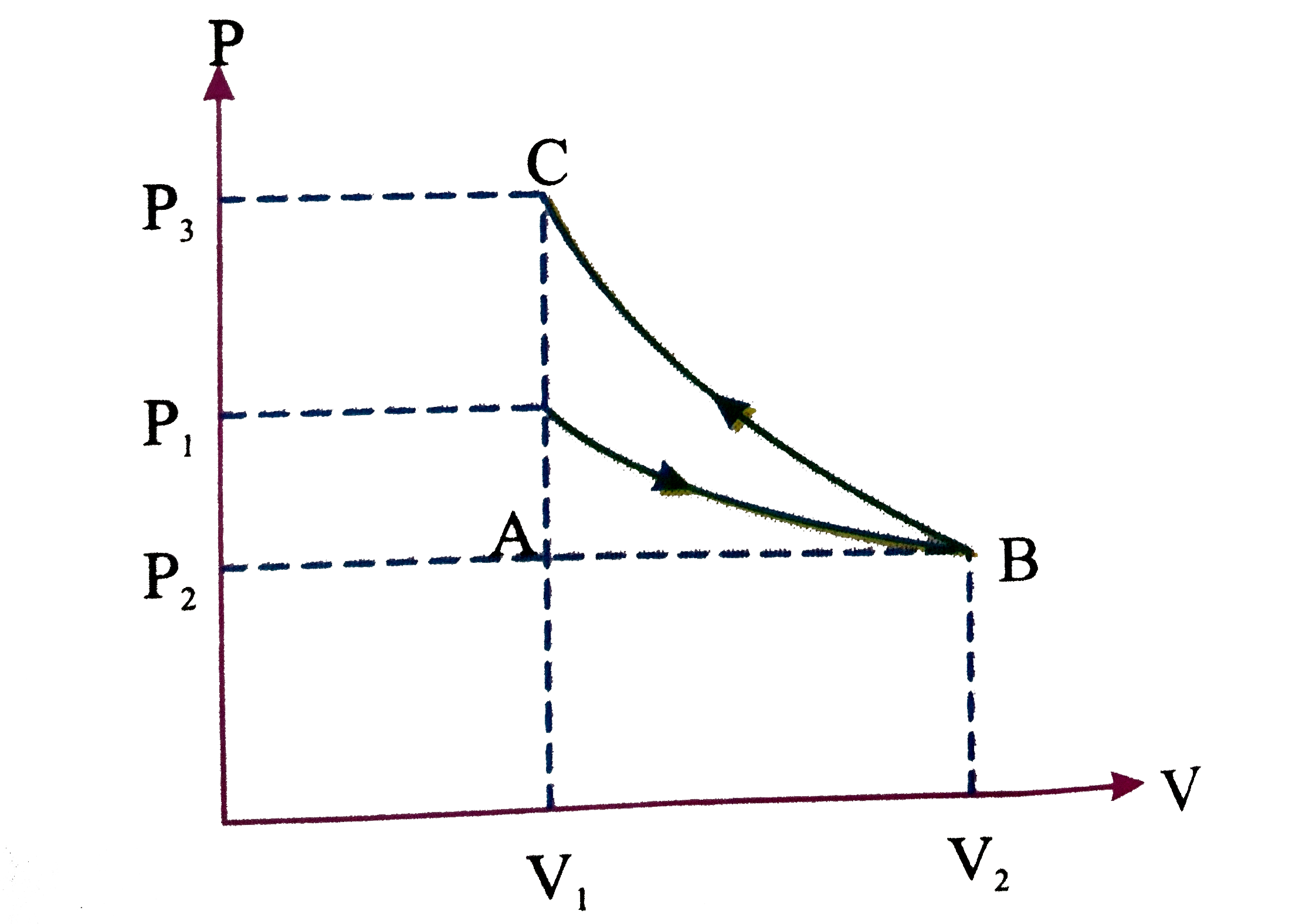
An ideal gas expands isothermally from volume `V_(1)` to `V_(2)` and is then compressed to original volume `V_(1)` adiabatically. Initialy pressure is `P_(1)` and final pressure is `P_(3)`. The total work done is `W`. Then

A

`P_(3) gt P_(1),W gt 0`

B

`P_(3) lt P_(1),W lt 0`

C

`P_(3) gt P_(1),W lt 0`

D

`P_(3)=P_(1),W=0`

Text Solution

Verified by Experts

The correct Answer is:
C

The slope of adiabatic process, at a given state `(P,V,T)` is greater than the slope of isothermal and `BC` is adiabatic Workdone in a process is given by area under the curve and V-axis.

The workdone `W` is positive if volume increases in the process and `W` is negative if volume decreases in the process. Hence `W_(AB)` is positive as volume increases from `V_(1) to V_(2)` , `W_(BC)` is negative as volume decrases from `V_(2) to V_(1)` .
Further `|W_(BC)|gt|W_(AB)|`
Net workdone `=W_(AB)+(-W_(BC))`
`W =A` negative value `( :.|W_(BC)|gt|W_(AB)|)or Wlt0` From the graph itself, `P_(3)gtP_(1)`
`:. Wlt0 and P_(3)gtP_(1)`
Hence option (c) repesents correct answer.
Promotional Banner

Topper's Solved these Questions

  • THERMAL PROPERTIES OF MATTER

    NARAYNA|Exercise LEVEL - II (H.W.)|19 Videos
  • TRANSMISSION OF HEAT

    NARAYNA|Exercise LEVEL-II(C.W)|27 Videos

Similar Questions

Explore conceptually related problems

An ideal gas of volume V and pressure P expands isothermally to volume 16 V and then compressed adiabatically to volume V . The final pressure of gas is [ gamma = 1.5]

A gas expands under constant pressure P from volume V_(1) to V_(2) The work done by the gas is

A sample of ideal gas undergoes isothermal expansion in a reversible manner from volume V_(1) to volume V_(2) . The initial pressure is P_(1) and the final pressure is P_(2) . The same sample is then allowed to undergoes reversible expansion under adiabatic conditions from volume V_(1) to V_(2) . The initial pressure being same but final pressure is P_(2) . The work of expansion in adiabatic process (w_(adi)) is related to work of expansion in isothermal process (w_(iso)) is

A sample of ideal gas undergoes isothermal expansion in a reversible manner from volume V_(1) to volume V_(2) . The initial pressure is P_(1) and the final pressure is P_(2) . The same sample is then allowed to undergoes reversible expansion under adiabatic conditions from volume V_(1) to V_(2) . The initial pressure being same but final pressure is P_(2) . If P_(3) and P_(2) are equal, then

A sample of ideal gas undergoes isothermal expansion in a reversible manner from volume V_(1) to volume V_(2) . The initial pressure is P_(1) and the final pressure is P_(2) . The same sample is then allowed to undergoes reversible expansion under adiabatic conditions from volume V_(1) to V_(2) . The initial pressure being same but final pressure is P_(2) . Which relation is correct (gamma = (C_(P))/(C_(V))) ?

A sample of ideal gas undergoes isothermal expansion in a reversible manner from volume V_(1) to volume V_(2) . The initial pressure is P_(1) and the final pressure is P_(2) . The same sample is then allowed to undergoes reversible expansion under adiabatic conditions from volume V_(1) to V_(2) . The initial pressure being same but final pressure is P_(2) . Which of the following is correct?

A sample of ideal gas undergoes isothermal expansion in a reversible manner from volume V_(1) to volume V_(2) . The initial pressure is P_(1) and the final pressure is P_(2) . The same sample is then allowed to undergoes reversible expansion under adiabatic conditions from volume V_(1) to V_(2) . The initial pressure being same but final pressure is P_(2) . Which graphic representation is correct a.

NARAYNA-THERMODYNAMICS-Exercise
  1. An ideal monoatomic gas undergoes a cyclic process ABCA as shown in th...

    Text Solution

    |

  2. A vessel of water eqivalent W kg contains m kg of water of specific he...

    Text Solution

    |

  3. An ideal gas expands isothermally from volume V(1) to V(2) and is then...

    Text Solution

    |

  4. The work done by a cretain material when temprature changes from T(0) ...

    Text Solution

    |

  5. An ideal gas is made to undergo a termodynamic process given by V prop...

    Text Solution

    |

  6. Determine the average molar heat capacity of an ideal gas under going ...

    Text Solution

    |

  7. An ideal gas goes through a cycle consisting of ischoric adiabatic and...

    Text Solution

    |

  8. A cycle is made of three process is iso barie, adiabatic and isotherma...

    Text Solution

    |

  9. A calorimeter contains 4.00 kg of water at 20.0^(@)C . What amount of ...

    Text Solution

    |

  10. A 0.50 kg ice cube at -10^(@)C is placed in 3.0 kg of coffce at 20^(@)...

    Text Solution

    |

  11. A thermal insulated vessel contains some water at 0^(@)C. The vessel i...

    Text Solution

    |

  12. If specific heat capacity of a substance in solid and liquid is propor...

    Text Solution

    |

  13. 450 g water at 40^(@)C was kept in a calorimeter of water equivalent 5...

    Text Solution

    |

  14. 5 moles of nitrogen gas are enclosed in an adiabatic cylindrical vesse...

    Text Solution

    |

  15. When water is boiled at 2 atm pressure the latent heat of vapourizatio...

    Text Solution

    |

  16. A vertical cylinder of cross-section area A contains one mole of an id...

    Text Solution

    |

  17. A gas is enclosed in a cylinder with a movable frictionless piston. It...

    Text Solution

    |

  18. One mole of an ideal monoatomaic gas is taken from A to C along the pa...

    Text Solution

    |

  19. Two cylinders are connected by a fixed diathermic partition A and a re...

    Text Solution

    |

  20. An ideal monoatomic gas is confined in a horizontal cylinder by a spri...

    Text Solution

    |

