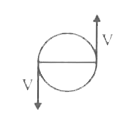
A particle is moving in a circular path with a constant speed. If `theta` Is the angular displacement, then starting from `theta=0` , the maximum and minimum change in the linear momentum will occur when value of `theta` is respectively
A
`0^(@) and 90^(@)`
B
`90^(@) and 180^(@)`
C
`180^(@) and 270^(@)`
D
`180^(@) and 360^(@)`
Text Solution
Verified by Experts
The correct Answer is:
D
When ` theta = 180^(@)` Change in monentum `=mv -(-mv ) = 2mv` This is maximum . When it will return to its intial position ` theta = 360^(@)` , and change in momentum `= mv - mv =0`. this is minimum
Topper's Solved these Questions
CIRCULAR MOTION
MARVEL PUBLICATION|Exercise TEST YOUR GRASP-1|1 Videos
CIRCULAR MOTION
MARVEL PUBLICATION|Exercise TEST YOUR GRASP-2|1 Videos
ATOMS, MOLECULES AND NUCLEI
MARVEL PUBLICATION|Exercise TEST YOUR GRASP|30 Videos
COMMUNICATION SYSTEMS
MARVEL PUBLICATION|Exercise TEST YOUR GRASP -20|10 Videos
Similar Questions
Explore conceptually related problems
A particle is moving in a circular path with a constant speed. If theta Is the angular displacement, then starting from theta=0 , the maximum and mimnimum change in the linear momentum will occur when nvalue of theta is respectively
Write the maximum and minimum values of sin theta
For a particle moving along a circular path with a constant speed, the accelerationis constant in
A particle is moving on a circular path with a constant speed 'v'. Its change of velocity as it moves from A to B is:
A particle is going around in a circular path with constant speed. Angular momentum of particle is conserved about
A particle moves in a circular path with decreasing speed. What happens to its angular momentum ?
Write the maximum and minimum values of cos theta
A particle moves in a circular path of radius 0.5 m with a linear speed of 2 ms^(-1) ,its angular speed is
A particle is revolving in a circular path of radius 2 m with constant angular speed 4 rad/s. The angular acceleration of particle is
MARVEL PUBLICATION-CIRCULAR MOTION-TEST YOUR GRASP-20