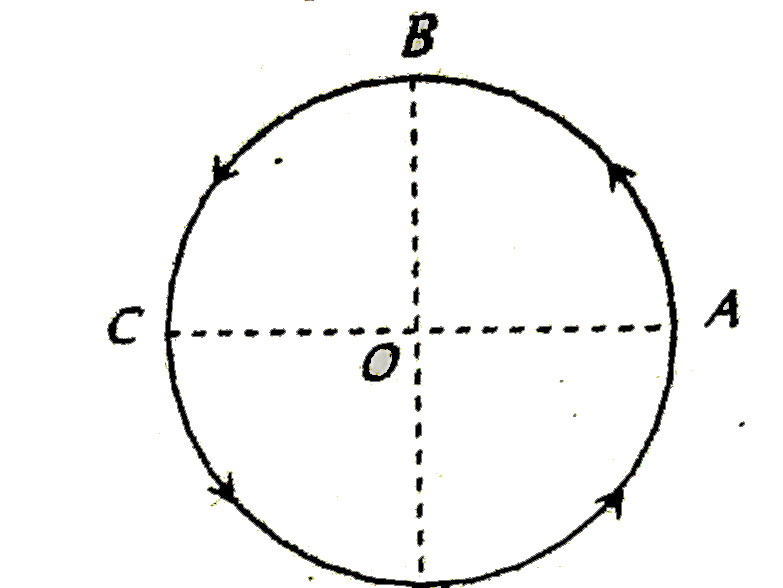
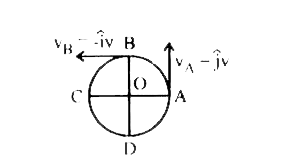
Figure shows a body of mass m moving with a uniform speed v along a circle of radius r . The change in velocity in going from A to B is
A
`(v )/(sqrt(2))`
B
`v`
C
zero
D
`vsqrt(2)`
Text Solution
Verified by Experts
The correct Answer is:
D
The body is moving with a uniform speed but the direction of its velocity changes from point and at any point it is directed along the tangent Its velocity at `A = V_(A ) = hatj v ` and its velocity at B is ` V_(B ) = - hatj v` ` therefore ` change in velocity `= vec V_(B) - vecv _(A) =- hati v - hatj v ` `therefore ` magnitude of change of velocity ` = | - hati v- hatj v| = sqrt( v^(2)+v^(2))= vsqrt(2)`
Topper's Solved these Questions
CIRCULAR MOTION
MARVEL PUBLICATION|Exercise TEST YOUR GRASP-1|1 Videos
CIRCULAR MOTION
MARVEL PUBLICATION|Exercise TEST YOUR GRASP-2|1 Videos
ATOMS, MOLECULES AND NUCLEI
MARVEL PUBLICATION|Exercise TEST YOUR GRASP|30 Videos
COMMUNICATION SYSTEMS
MARVEL PUBLICATION|Exercise TEST YOUR GRASP -20|10 Videos
Similar Questions
Explore conceptually related problems
Figure below shows a body of mass M moving with the uniform speed on a circular path of radius, R . What is the change in acceleration in going from P_(1) to P_(2)
The acceleration of an object moving with speed v in a circle of radius r is
If a body is moving with a uniform speed v in a circle of radius 'r', then the angular acceleration of the body will be
When a body moves with a constant speed along a circle
A body of mass 1kg is moving with a uniform speed of 1m//s in a circular path of radius 1m . The external force acting on the body is
Centripetal force (F) on a body of mass (m) moving with uniform speed (v) in a circle of radius (r ) depends upon m, v and r. The formula for the centripetal force using theory of dimensons.
A particle is moving with uniform speed 0.5 m//s along a circle of radius 1m then the angular velocity of particle is (in rad s^(-1) )
A particle is moving in a circle of radius r having centre at O with a constant speed v . The magnitude of change in velocity in moving from A to B is
A particle is moving at uniform speed 2 ms^(-1) along a circle of radius 0.5m .The centripetal acceleration of particle is
A particle is moving in a circle of radius r with speed v as shown in the figure. The magnitude of change in velocity in moving from P to Q is
MARVEL PUBLICATION-CIRCULAR MOTION-TEST YOUR GRASP-20