

Home
Class 11
PHYSICS
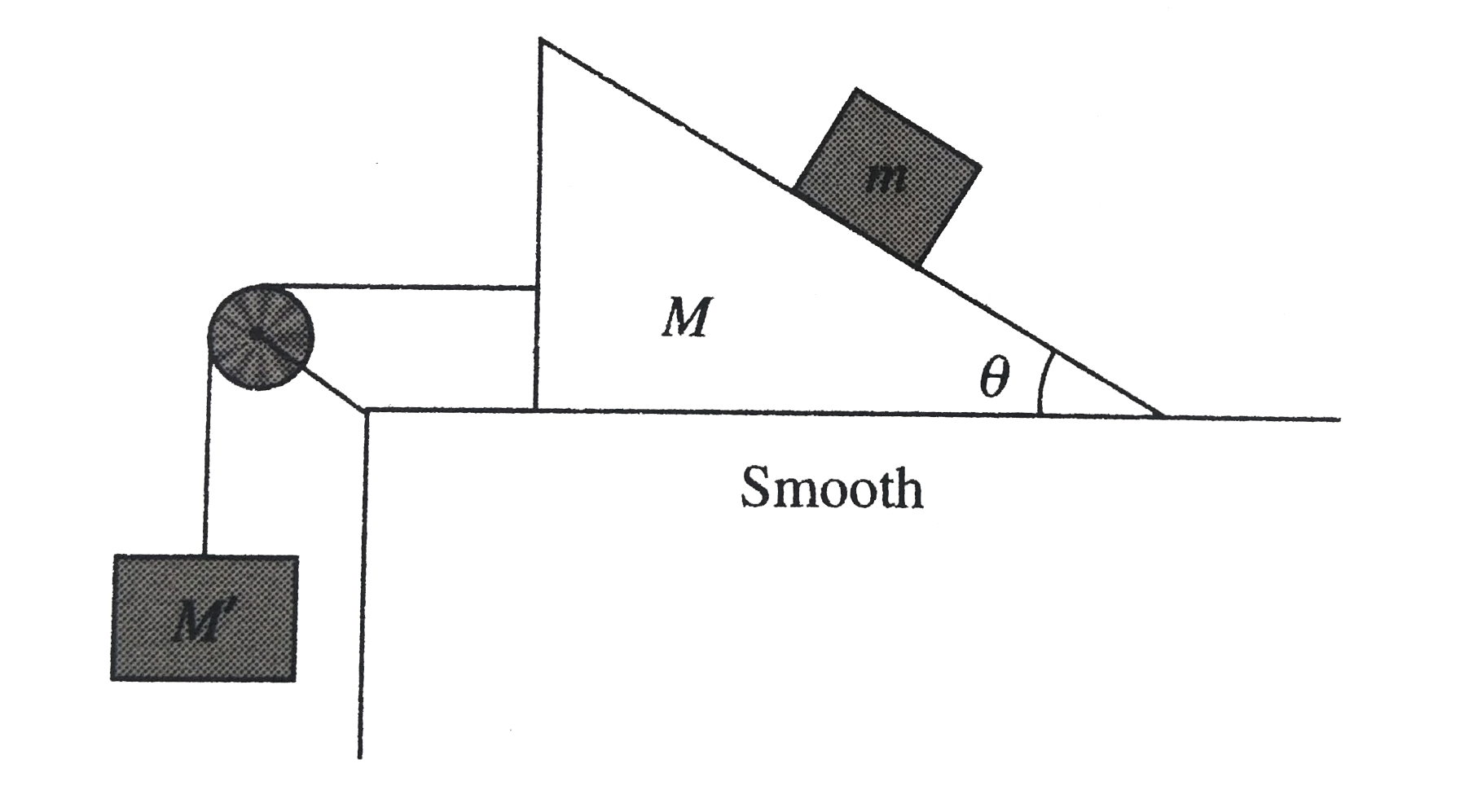
Figure shown a block of mass m placed on...

Figure shown a block of mass m placed on a smooth wedge of mass M. Calculate the minimum value of M' and tension in the string, so that the block of mass m will move vertically downwards with acceleration `10ms^(-2)`

Promotional Banner

Similar Questions

Explore conceptually related problems

Fig shows a block of mass 0.1 kg placed on a smooth wedge of mass 1/(5sqrt(3)) kg if the block of mass m will move vertically downward with acceleration 10m//s^(2) Then the value of tension (in newton) in the string is (theta=30^(@)) :

A block of mass m is placed on a smooth wedge of mass M, as shown in the figure . Just after placiing block m over wedge M.

A block of mass 'm' is placed on wedge of mass 'M'. If all the surfaces are smooth Accelaration of wedge 'A' is

Figure-2.54 shows a block of mass m is placed on an inclined wedge of mass M If the system is released from rest find the acceleration of m and M.

A block of mass 'm' is placed on wedge of mass 'M'. If all the surfaces are smooth Normal reaction between the wedge and block is

A block of mass m is placed at rest on a smooth wedge of mass M placed at rest on a smooth horizontal surface. As the system is released

A block of mass m is placed at rest on a smooth wedge of mass M placed at rest on a smooth horizontal surface. As the system is released

A block of mass 'm' is kept on a smooth moving wedge. If the acceleration of the wedge is 'a'

In the arrangement shown in figure, a block A of mass m has been placed on a smooth wedge B of mass M. The wedge lies on a horizontal smooth surface. Another block C of mass (M)/(4) has been placed in contact with the wedge B as shown. The coefficient of friction between the block C and the vertical wedge wall is mu= (3)/(4) . Find the ratio (m)/(M) for which the block C will not slide with respect to the wedge after the system is released?

A block of mass m is released from a wedge of mass m as shown in figure . Find the time taken by the block to reach the end of the wedge.