Home
Class 11
PHYSICS
Explain whether (i) T2gtT1 (ii) P2gtP1 a...


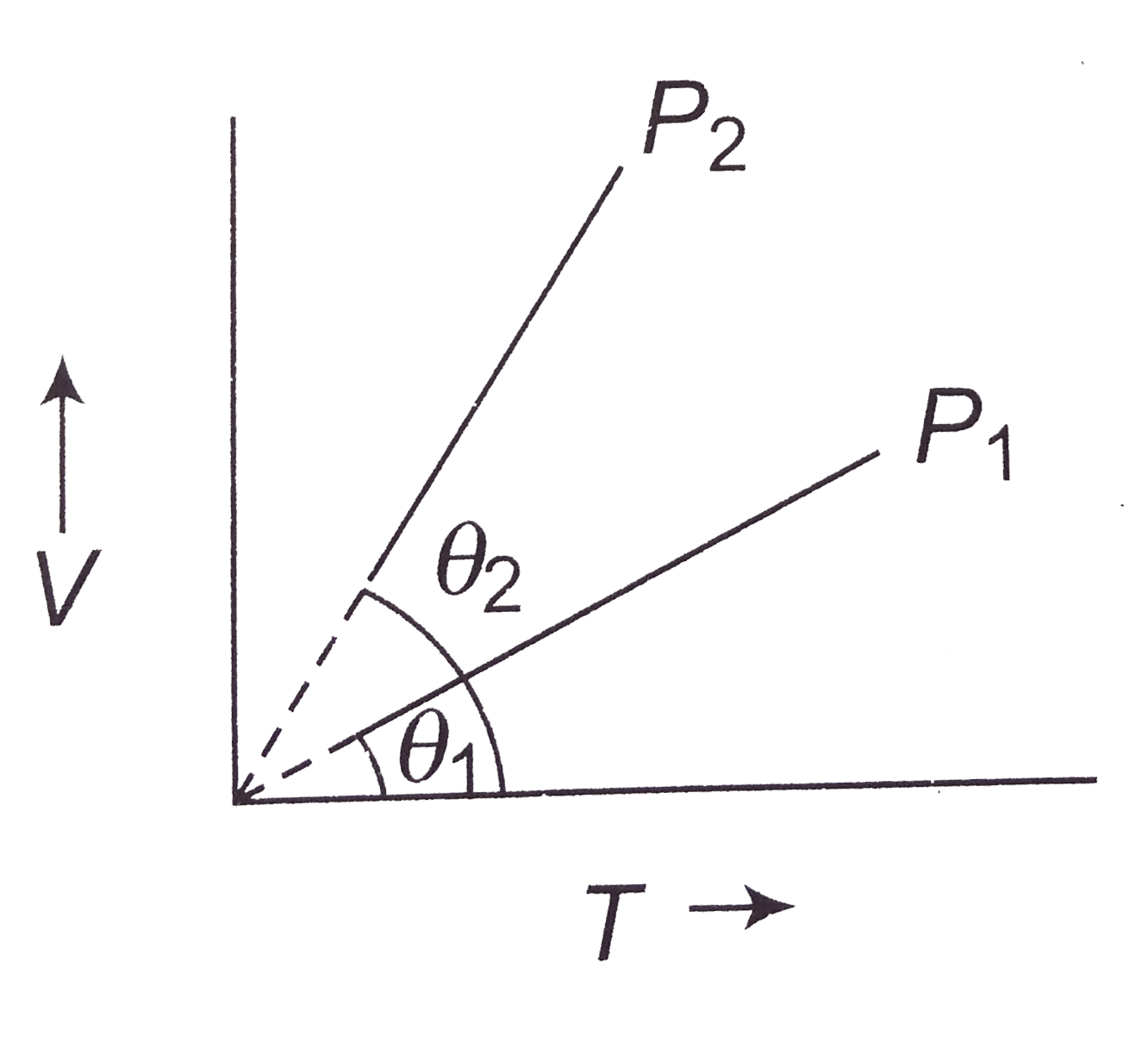
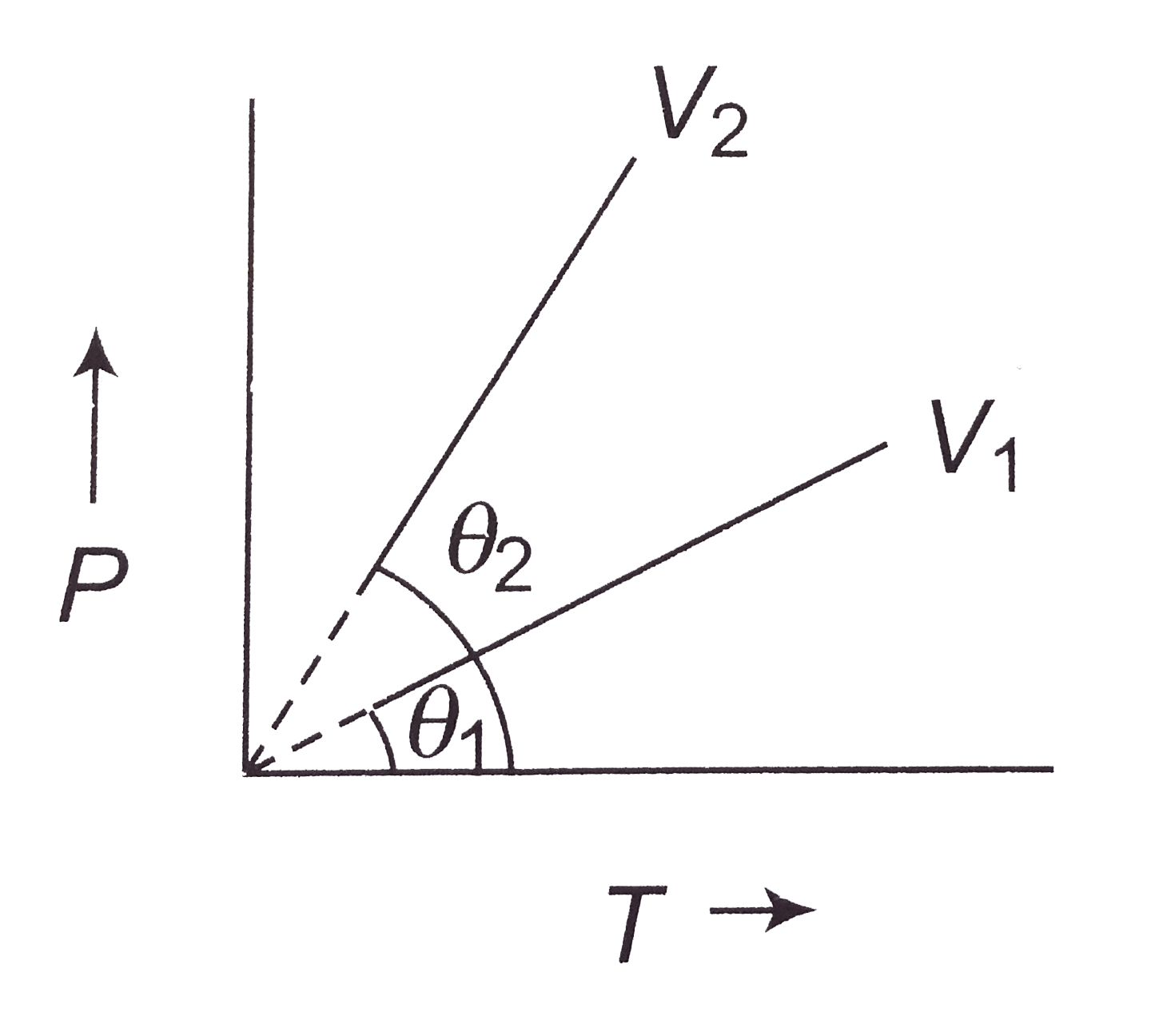
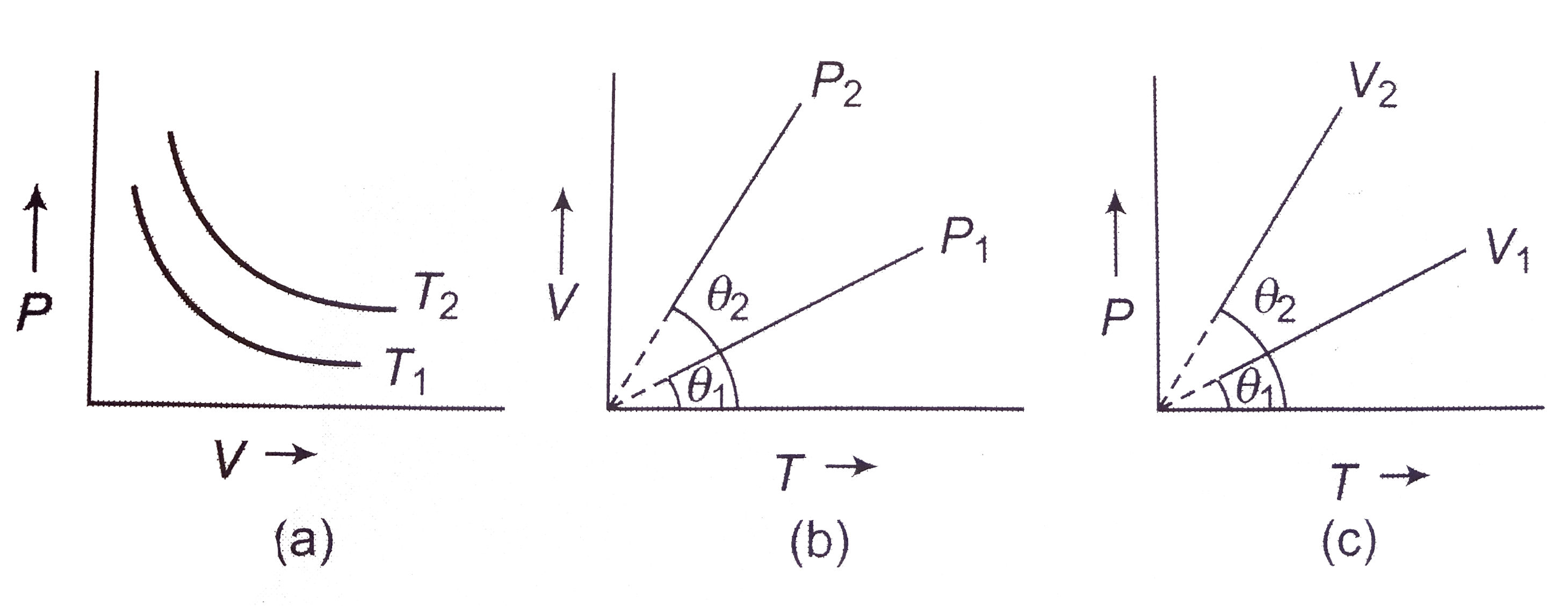
Explain whether (i) `T_2gtT_1` (ii) `P_2gtP_1` and (iii) `V_2gtV_1` for given mass of gas.

Text Solution

Verified by Experts
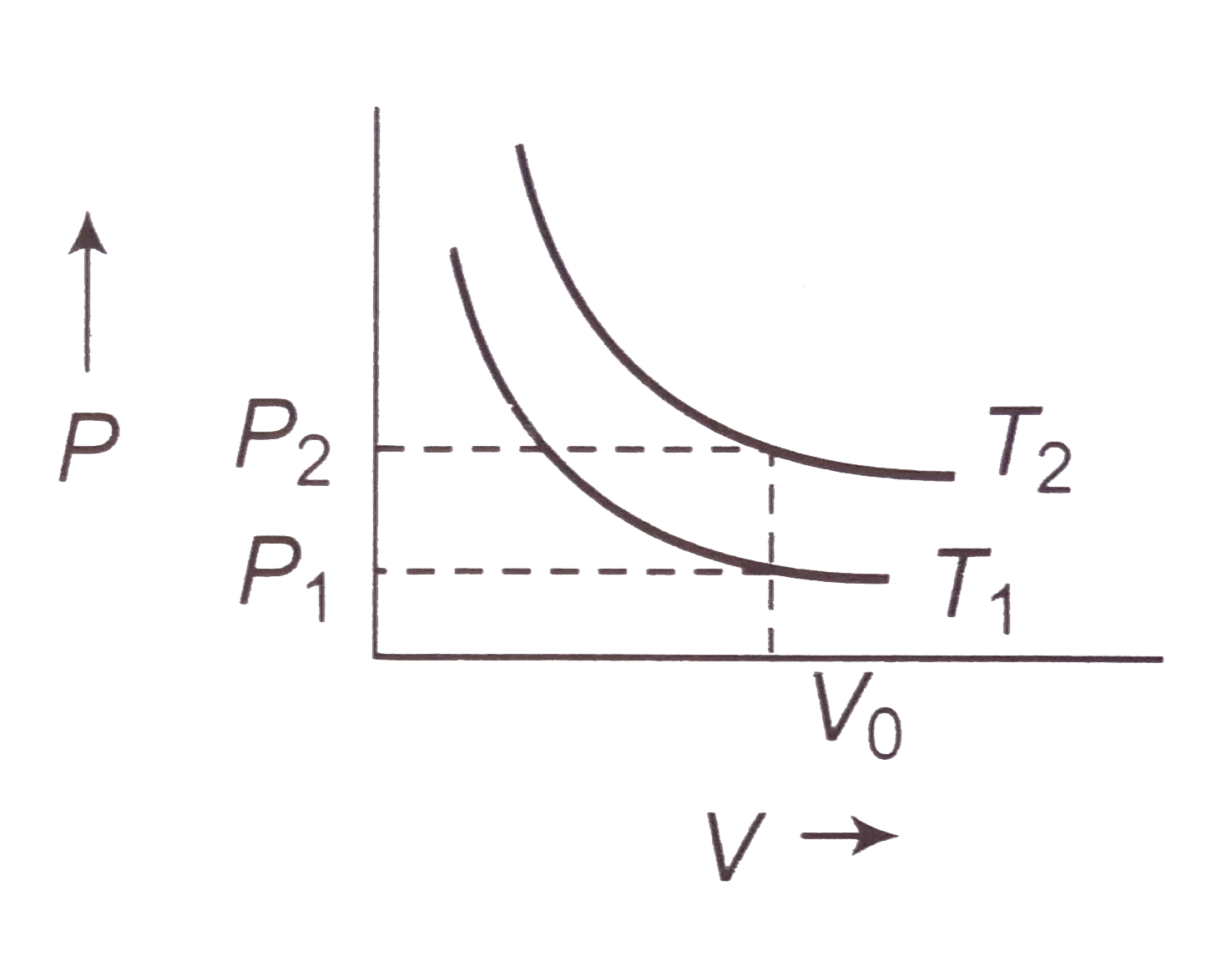


`P_1V_0=nRT` .(a)
`P_2V_0=nRT_2`
Dividing (b) by (a)
`(P_2)/(P_1)=(T_2)/(T_1)`
Since `P_2gtP_1`, hence `T_2gtT_1`
(b) Slope of inclined line `,(V)/(T)=tantheta=(nR)/(P)`
`theta_2gttheta_1`
`tantheta_2gttantheta_1`
`(nR)/(P_2)gt(nR)/(P_1)`
`P_1gtP_2`
(c) Slope of inclined line, `(P)/(T)=tantheta=(nR)/(V)`
`theta_2gttheta_1`
`tantheta_2gttantheta_1`
`(nR)/(V_2)gt(nR)/(V_1)`
`V_1gtV_2`
Promotional Banner

Topper's Solved these Questions

  • LAWS OF THERMODYNAMICS

    CP SINGH|Exercise EXERCISE|131 Videos
  • KINETIC THEORY OF GASES

    CP SINGH|Exercise Exercises|79 Videos
  • MOTION IN A PLANE

    CP SINGH|Exercise Exercises|69 Videos

Similar Questions

Explore conceptually related problems

Explain whether (a) T_(2) gt T_(1) , (b) P_(2) gt P_(1) and (c ) V_(2) gt V_(1) or otherwise in Fig., which represent in isothermal, isobaric, and isochoric processes for the same mass of an ideal gas, respedtively.

Examine the following plots and predict whether in (i) P_(1) lt P_(2) "and" T_(1) gt T_(2) , in (ii) T_(1) = T_(2)ltT_(3) , in (iii) V_(1) gt V_(2), "in" (iv) P_(1) gt P_(2) "or" P_(2) gt P_(1)

Select the graph that correctly describes the adsorption isotherms at two temperatures T_(1) and T_(2) (T_(1) gt T_(2)) for a gas : (x — mass of the gas adsorbed m-mass of adsorbent P - pressure)

A thermodynamic system goes from states (i) P_(1),V to 2P_(1),V (ii) P,V_(1) to P.2V_(1) . Then work done in the two cases is

In the circuit shown, i. V_A - V_B = …….. (ii) I_1 = ……. (iii) I_2 …….. iv. I = ……..

The activity of a sample of radioactive material A_(1) at time t_(1) and A_(2) at time t_(2)(t_(2)gtt_(1)) . Its mean life is T .

If p+iq=0 then p+q is (i) 1(ii)-1(iii)-2 (iv) 0

CP SINGH-LAWS OF THERMODYNAMICS-EXERCISE
  1. Explain whether (i) T2gtT1 (ii) P2gtP1 and (iii) V2gtV1 for given mass...

    Text Solution

    |

  2. The first law of thermodynamics incorporates are concept (i) conserv...

    Text Solution

    |

  3. The work done in the process AB is

    Text Solution

    |

  4. (i) DeltaW(AB)=5P0V0 (ii) DeltaW(BC)=0 (iii) DeltaW(CA)=-2P0V0 (...

    Text Solution

    |

  5. Consider the process on a system shown in figure. During the process, ...

    Text Solution

    |

  6. Consider two processes on a system as shown in figure. The volumes in...

    Text Solution

    |

  7. A system can be taken from the initial state p(1),V(1) to the final st...

    Text Solution

    |

  8. In the figure given two processes A and B are shown by which a thermod...

    Text Solution

    |

  9. Refer to figure in previous question, DeltaU(1) and DeltaU(2) be the c...

    Text Solution

    |

  10. Refer to figure DeltaU(1) and DeltaU(2) be the changes in internal ene...

    Text Solution

    |

  11. In a given process on an ideal gas, dW=0 and dQlt0. Then for the gas

    Text Solution

    |

  12. Consider the following two statements. (A) If heat is added to a syst...

    Text Solution

    |

  13. In a process on a system, the initial pressure and volume are equal to...

    Text Solution

    |

  14. The pressure p and volume V of an ideal gas both increase in a process...

    Text Solution

    |

  15. The state of a thermodynamic system is represented by

    Text Solution

    |

  16. Which of the following is not a thermodynamical function

    Text Solution

    |

  17. If Q, E and W denote respectively the heat added, change in internal e...

    Text Solution

    |

  18. For free expansion of the gas, which of the following is true?

    Text Solution

    |

  19. A system is given 300 calories of heat and it does 600 joules of work....

    Text Solution

    |

  20. In thermodynamic process, pressure of a fixed mass of a gas is changes...

    Text Solution

    |

  21. A perfect gas goes from a state A to another state B by absorbing 8 × ...

    Text Solution

    |