Home
Class 11
PHYSICS
Three moles of an ideal gas (Cp=7/2R) at...

Three moles of an ideal gas `(C_p=7/2R)` at pressure, `P_A` and temperature `T_A` is isothermally expanded to twice its initial volume. It is then compressed at constant pressure to its original volume. Finally gas is compressed at constant volume to its original pressure `P_A`.
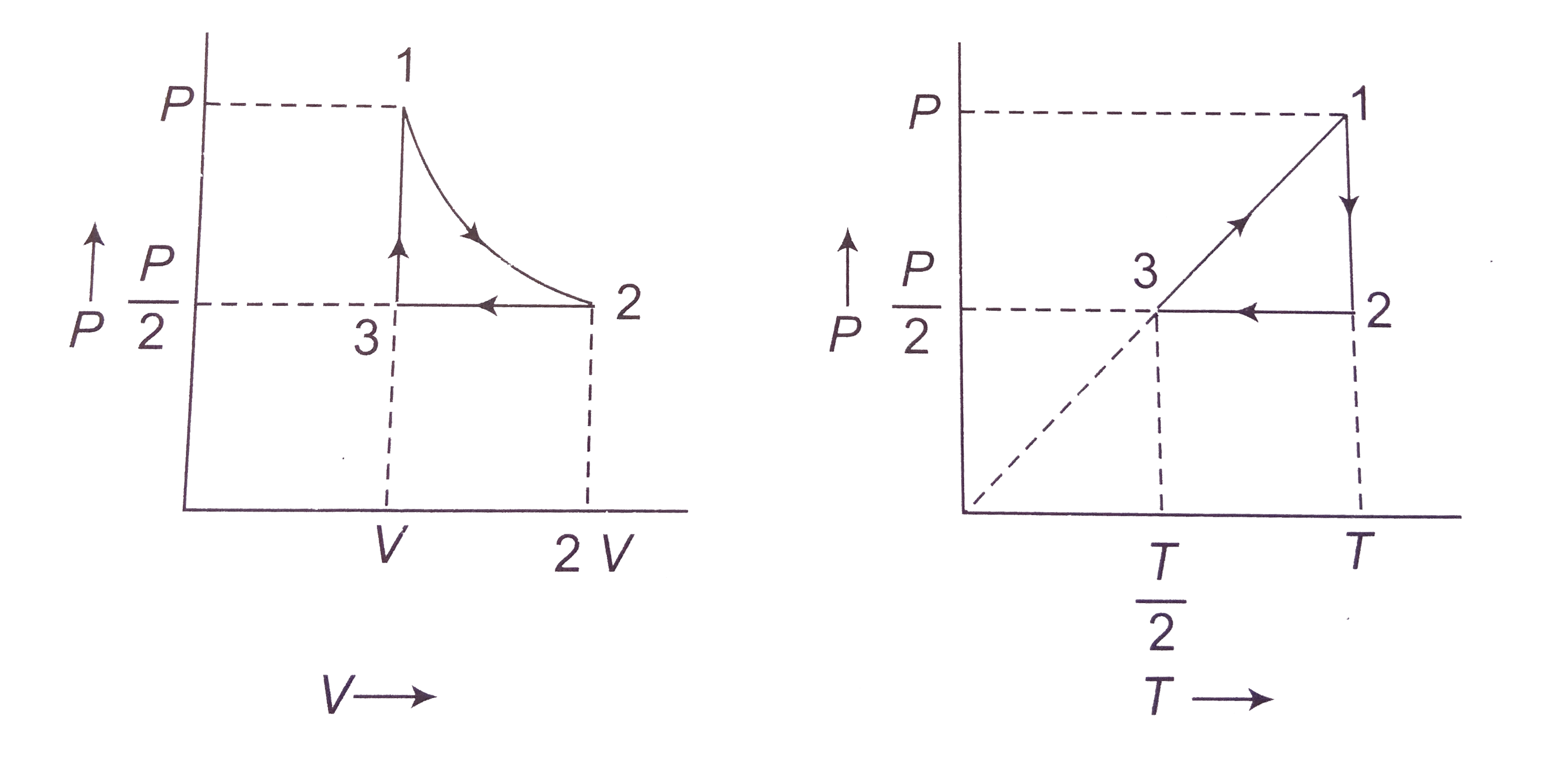
(a) Sketch P-V and P-T diagrams for the complete process.
(b) Calculate the net work done by the gas, and net heat supplied to the gas during the complete process.

Text Solution

Verified by Experts
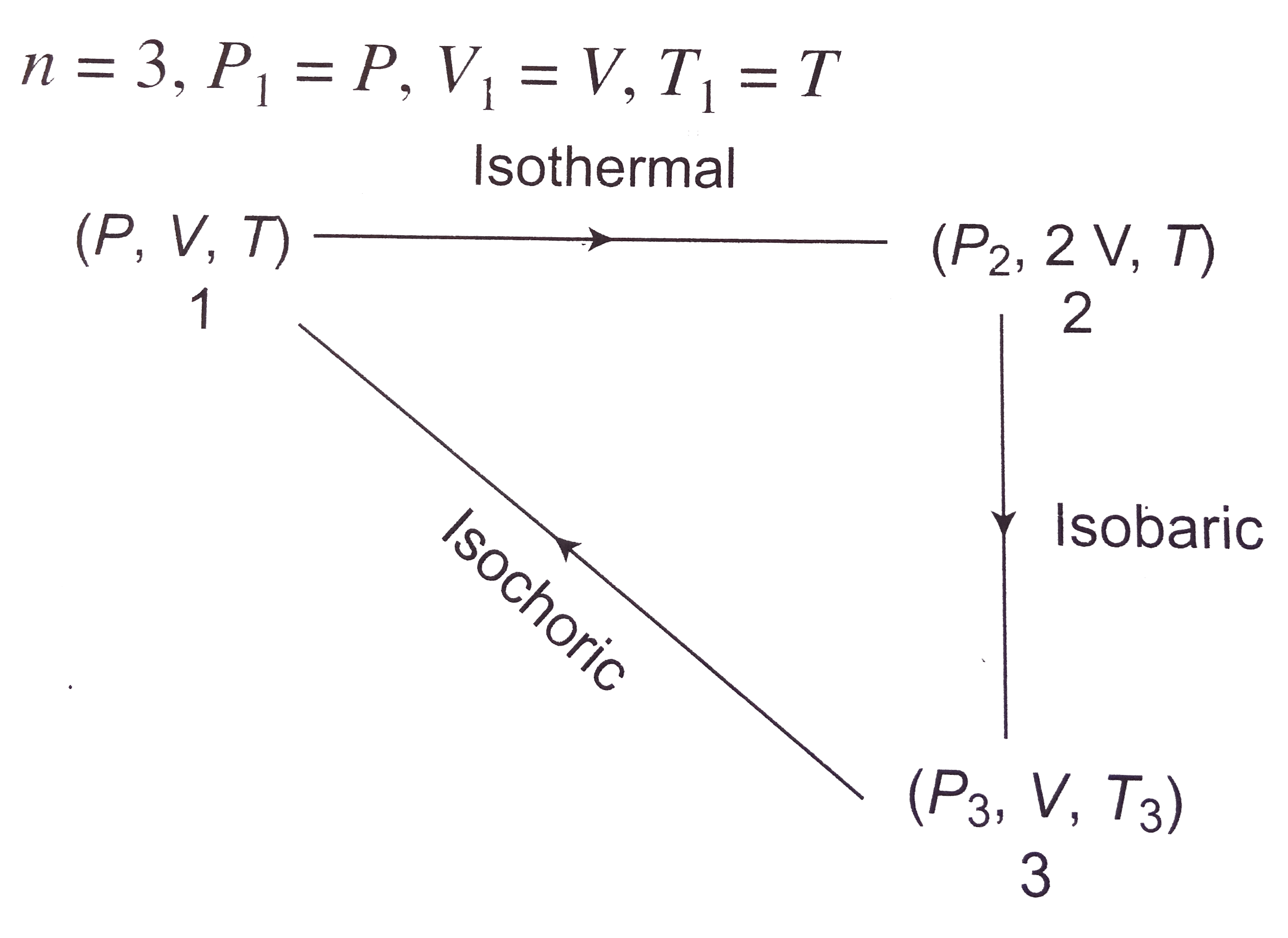

`n=3`,`P_1=P`,`V_1=V`,`T_1=T`
`1rarr2`:`PV=P_2.2VimpliesP_2=(P)/(2)`,`T_2=T`
`2rarr3`:`P_3=P_2=(P)/(2)`,`(2V)/(T)=(V)/(T_3)impliesT_3=(T)/(2)`
(a)
(b) `1rarr2` (Isothermal expansion),
`DeltaW_(1rarr2)=nRT1n((2V)/(V))=3RT1n2`
`2rarr3` (Isobaric compression)
`DeltaW_(2rarr3)=nRDeltaT=3R((T)/(2)-T)=-1.5RT`
`3rarr1` (Isochoric process)
`DeltaW_(3rarr1)=0`
`Delta_(cyclic)=DeltaW_(1rarr2)+DeltaW_(2rarr3)+DeltaW_(3rarr1)`
`=RT(3ln2-1.5)`
`=RT(3xx0.693-1.5)=0.58RT`
For cyclic process
`DeltaQ=DeltaW`
`=0.58RT`
Promotional Banner

Topper's Solved these Questions

  • LAWS OF THERMODYNAMICS

    CP SINGH|Exercise EXERCISE|131 Videos
  • KINETIC THEORY OF GASES

    CP SINGH|Exercise Exercises|79 Videos
  • MOTION IN A PLANE

    CP SINGH|Exercise Exercises|69 Videos

Similar Questions

Explore conceptually related problems

Three moles of an ideal gas (C_p=7/2R) at pressure p_0 and temperature T_0 is isothermally expanded to twice its initial volume. It is then compressed at a constant pressure to its original volume. (a) Sketch p-V and p-T diagram for complete process. (b) Calculate net work done by the gas. (c) Calculate net heat supplied to the gas during complete process. (Write your answer in terms of gas constant =R)

A sample of an ideal gas has pressure p_(0) , volume V_(0) and tempreture T_(0) . It is isothermally expanded to twice its oringinal volume.it is then compressed at constant pressure to have the original volume V_(0) . Finally, the gas is heated at constant volume to get the original tempreture.(a) show the process in a V-T diagram (b) calculate the heat absorbed in the process.

An ideal gas intially has pressure P volume V and temperature T . Its is isothermally expanded to four times of its original volume, then it is compressed at constant pressure to attain its original volume V . Finally, the gas is heated at constant volume to get the original temperature T . (a) Draw V-T curve (b) Calculate the total work done by the gas in the process.(given ln2 = 0.693)

If a gas is heated at constant pressure, its isothermal compressibility

One mole of an ideal gas at pressure P_(0) and temperature T_(0) is expanded isothermally to twice ist volume and then compressed at constant pressure to (V_(0) // 2) and the gas is brought bac to original state by a process in which P alpha V (pressure is direclty proportional to volume). The correct temperature of the process is

A gas is suddenly compressed to one fourth of its original volume. What will be its final pressure, if its initial pressure is p

A mass of ideal gas at pressure P is expanded isothermally to four times the original volume and then slowly compressed adiabatically to its original volume. Assuming gamma to be 1.5, the new pressure of the gas is

One gram mole of an ideal gas at N.T.P is first expanded isothermally to twice the origional volume. It is then compressed at constant volume, till its pressure is raised to the original value. Calculate the total amount of work done. Given R= 8.3 mol e^(_1)K^(-1) .

CP SINGH-LAWS OF THERMODYNAMICS-EXERCISE
  1. Three moles of an ideal gas (Cp=7/2R) at pressure, PA and temperature ...

    Text Solution

    |

  2. The first law of thermodynamics incorporates are concept (i) conserv...

    Text Solution

    |

  3. The work done in the process AB is

    Text Solution

    |

  4. (i) DeltaW(AB)=5P0V0 (ii) DeltaW(BC)=0 (iii) DeltaW(CA)=-2P0V0 (...

    Text Solution

    |

  5. Consider the process on a system shown in figure. During the process, ...

    Text Solution

    |

  6. Consider two processes on a system as shown in figure. The volumes in...

    Text Solution

    |

  7. A system can be taken from the initial state p(1),V(1) to the final st...

    Text Solution

    |

  8. In the figure given two processes A and B are shown by which a thermod...

    Text Solution

    |

  9. Refer to figure in previous question, DeltaU(1) and DeltaU(2) be the c...

    Text Solution

    |

  10. Refer to figure DeltaU(1) and DeltaU(2) be the changes in internal ene...

    Text Solution

    |

  11. In a given process on an ideal gas, dW=0 and dQlt0. Then for the gas

    Text Solution

    |

  12. Consider the following two statements. (A) If heat is added to a syst...

    Text Solution

    |

  13. In a process on a system, the initial pressure and volume are equal to...

    Text Solution

    |

  14. The pressure p and volume V of an ideal gas both increase in a process...

    Text Solution

    |

  15. The state of a thermodynamic system is represented by

    Text Solution

    |

  16. Which of the following is not a thermodynamical function

    Text Solution

    |

  17. If Q, E and W denote respectively the heat added, change in internal e...

    Text Solution

    |

  18. For free expansion of the gas, which of the following is true?

    Text Solution

    |

  19. A system is given 300 calories of heat and it does 600 joules of work....

    Text Solution

    |

  20. In thermodynamic process, pressure of a fixed mass of a gas is changes...

    Text Solution

    |

  21. A perfect gas goes from a state A to another state B by absorbing 8 × ...

    Text Solution

    |