Home
Class 11
PHYSICS
Figure shows a cylindrial tube of volume...

Figure shows a cylindrial tube of volume V with adiabatic walls containing an ideal gas. The internal energy of this ideal gas is given by `1.5nRT`. The tube is divided into two equal parts by a fixed diathermic wall. Initially, the pressure and the temperature are `p_(1), T_(1)` on the left and `p_(2), T_(2)` on the right. The system is left for sufficient time so that the temperature becomes equal on the two sides.
(a) How much work has been done by the gas on the left part ?
(b) Find the final pressures on the two sides.
(c ) Find the final equilibrium temperature.
(d) How much heat has flown from the gas on the right to the gas on the left ?

Text Solution

Verified by Experts
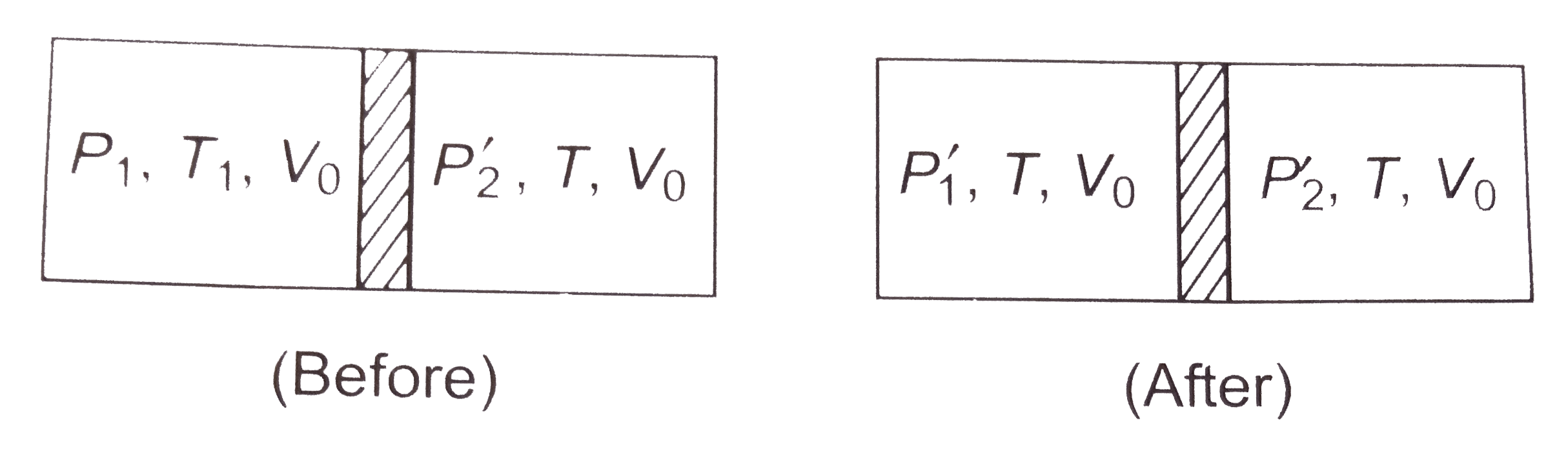

(a) Since wall is fixed, no change in volume of gas, hence, work done is zero
(b) Let common temperature is `T`, pressures in two chambers are `P'_1` and `P'_2`
Since number of moles remains same
`n_1+n_2=n'_1+n'_2`
`(P_1V_0)/(RT_1)+(P_2V_0)/(RT_2)=(P'_1)/(RT)+(P'_1)/(RT)`
`(P_1)/(T_1)+(P_2)/(T_2)=(P'_1+P'_2)/(T)` .(i)
Since total internal energy remains same
`U_1+U_2=U'_1+U'_2`
`1.5n_1RT+1.5n_2RT=1.5n'_1RT+1.5n'_2RT`
`P_1V_0+P_2V_0=P'_1V_0+P'_2V_0`
`P_1+P_2=P'_1+P'_2` .(ii)
By (i) and (ii)
`(P_1)/(T_1)+(P_2)/(T_2)=(P_1+P_2)/(T)`
Common temperature
`T=(P_1+P_2)/((P_1)/(T_1)+(P_2)/(T_2))=(T_1T_2(P_1+T_2))/(P_1T_2+P_2T_1)`
(c) The number of moles in each chamber remains same
Chamber `1` `n'_1=n_1`
`(P'_1)/(RT)=(P_1V_0)/(RT_1)impliesP'_1T=(P_1T_2(P_1+P_2))/(P_1T_2+P_2T_1)`
Chamber `2`: `n'_2=n_2`
`(P'_2V_0)/(RT)=(P_2V_0)/(RT_2)impliesP'_2=(P_2)/(T_2)T=(P_2T_1(P_1+P_2))/(P_1T_2+P_2T_1)`
(d) Heat flown from right to left chamber
`=U_2-U'_2=1.5n_2RT-1.5n'_2RT`
`=1.5n_2R(T_2-T)`
`=1.5(P_2V_0)/(T_2)(T_2-T)`
`=1.5P_2V_0(1-(T)/(T_2))`
`=1.5P_2(V)/(2)[1-(T_1(P_1+P_2))/(P_1T_2+P_2T_1)]`
`=(3P_2V)/(4)[(P_1T_2-P_1T_1)/(P_1T_2+P_2T_1)]`
`=(3P_1P_2(T_2-T_1)V)/((P_1T_2+P_2T_1))`
Promotional Banner

Topper's Solved these Questions

  • LAWS OF THERMODYNAMICS

    CP SINGH|Exercise EXERCISE|131 Videos
  • KINETIC THEORY OF GASES

    CP SINGH|Exercise Exercises|79 Videos
  • MOTION IN A PLANE

    CP SINGH|Exercise Exercises|69 Videos

Similar Questions

Explore conceptually related problems

shows a cylindrial tube of volume V with adiabatic walls containing an ideal gas. The internal energy of this ideal gas is given by 1.5nRT. The tube is divided into two equal parts by a fixed diathermic wall. Initially, the pressure and the tempreture are p_(1), T_(1) on the left and p_(2), T_(2) on the right. the system is left for sufficient time so that the tempreture becomes equal on the two sides. (a) how much work has been done by the gas on the left part ? (b) find the final pressures on the two sides. (c ) find the final equilibrium tempreture. (d) how much heat has flown from the gas on the right to the gas on the left ?

A cylindrical tube with adiabatic walls having volume 2V_(0) contains an ideal monoatomic gas as shown in figure. The tube is divided into two equal parts by a fixed super conducting wall. Initially, the pressure and the temperature are P_(0), T_(0) on the left and 2P_(0), 2T_(0) on the rigid. When system is left for sufficient amount of time the temperature on both sides becomes equal

An insulting container of volume 2V_(0) is divided in two equal parts by a diathermic (conducting) fixed piston. The left part contains one mole of monoatomic ideal gas whereas right part contains two moles of the same gas. Initial pressue on each side is P_(0) . The system is left for sufficient time so that a steady state is reached. Find (a) the work done by the gas in the left part during the process, (b) initial temperature in the two sides, (c) the final common temperature reached by the gases, (d) the heat given to the gas in the right part and (e) the increase in the internal energy of the gas in the left part.

An adiabatic vessel of total volume V is divided into two equal parts by a conducting separtor. The is fixed in this position. The part on the left contains one mole of an ideal gas (U=1.5 nRT) and the part on the right contains two moles of the same gas. initially, the pressure on each side is p. the system is left for sufficiant time so that a steady state is reached. find (a) the work done by the gas in the left part during the process, (b) the temperature on the two sides in the beginning, (c ) the final common temperature reached by the gases, (d) the heat given to the gas in the right part and (e) the increase in the internal energy of the gas in the left part.

A thermally insulated container is divided into two parts by a screen. In one part the pressure and temperature are P and T for an ideal gas filled. In the second part it is vacuum. If now a small hole is created in the screen, then the temperature of the gas will

Two vessels A and B with rigid walls containing ideal gases. The pressure, temperature and the volume are P_(1), T_(1), V in the vessel A and P_(2), T_(2), V in the vessel B . The vessels are now connected through a small tube. In equilibrium, pressure P and temerature T becomes same in two vessels. Find the value of P//T .

A cylindrical vessel made of thermally insulating material is divided into two equal parts by an insulating and. Movable piston. Both parts contain ideal monoatomic gas . The gas in the left part is supplied heat such that the volume of right part becomes one-eight of its initial volume . Work done by the gas in the right part is

A container with insulating walls is divided into two equal parts by a partition fitted with a valve. One part is filled with an ideal gas at a pressure P and temperature T, whereas the other part is completely evacuated . If the valve is suddenly opened, the pressure and temperature of the gas will be

CP SINGH-LAWS OF THERMODYNAMICS-EXERCISE
  1. Figure shows a cylindrial tube of volume V with adiabatic walls contai...

    Text Solution

    |

  2. The first law of thermodynamics incorporates are concept (i) conserv...

    Text Solution

    |

  3. The work done in the process AB is

    Text Solution

    |

  4. (i) DeltaW(AB)=5P0V0 (ii) DeltaW(BC)=0 (iii) DeltaW(CA)=-2P0V0 (...

    Text Solution

    |

  5. Consider the process on a system shown in figure. During the process, ...

    Text Solution

    |

  6. Consider two processes on a system as shown in figure. The volumes in...

    Text Solution

    |

  7. A system can be taken from the initial state p(1),V(1) to the final st...

    Text Solution

    |

  8. In the figure given two processes A and B are shown by which a thermod...

    Text Solution

    |

  9. Refer to figure in previous question, DeltaU(1) and DeltaU(2) be the c...

    Text Solution

    |

  10. Refer to figure DeltaU(1) and DeltaU(2) be the changes in internal ene...

    Text Solution

    |

  11. In a given process on an ideal gas, dW=0 and dQlt0. Then for the gas

    Text Solution

    |

  12. Consider the following two statements. (A) If heat is added to a syst...

    Text Solution

    |

  13. In a process on a system, the initial pressure and volume are equal to...

    Text Solution

    |

  14. The pressure p and volume V of an ideal gas both increase in a process...

    Text Solution

    |

  15. The state of a thermodynamic system is represented by

    Text Solution

    |

  16. Which of the following is not a thermodynamical function

    Text Solution

    |

  17. If Q, E and W denote respectively the heat added, change in internal e...

    Text Solution

    |

  18. For free expansion of the gas, which of the following is true?

    Text Solution

    |

  19. A system is given 300 calories of heat and it does 600 joules of work....

    Text Solution

    |

  20. In thermodynamic process, pressure of a fixed mass of a gas is changes...

    Text Solution

    |

  21. A perfect gas goes from a state A to another state B by absorbing 8 × ...

    Text Solution

    |

