Home
Class 11
PHYSICS
Two non-mixing liquids of densities rho ...

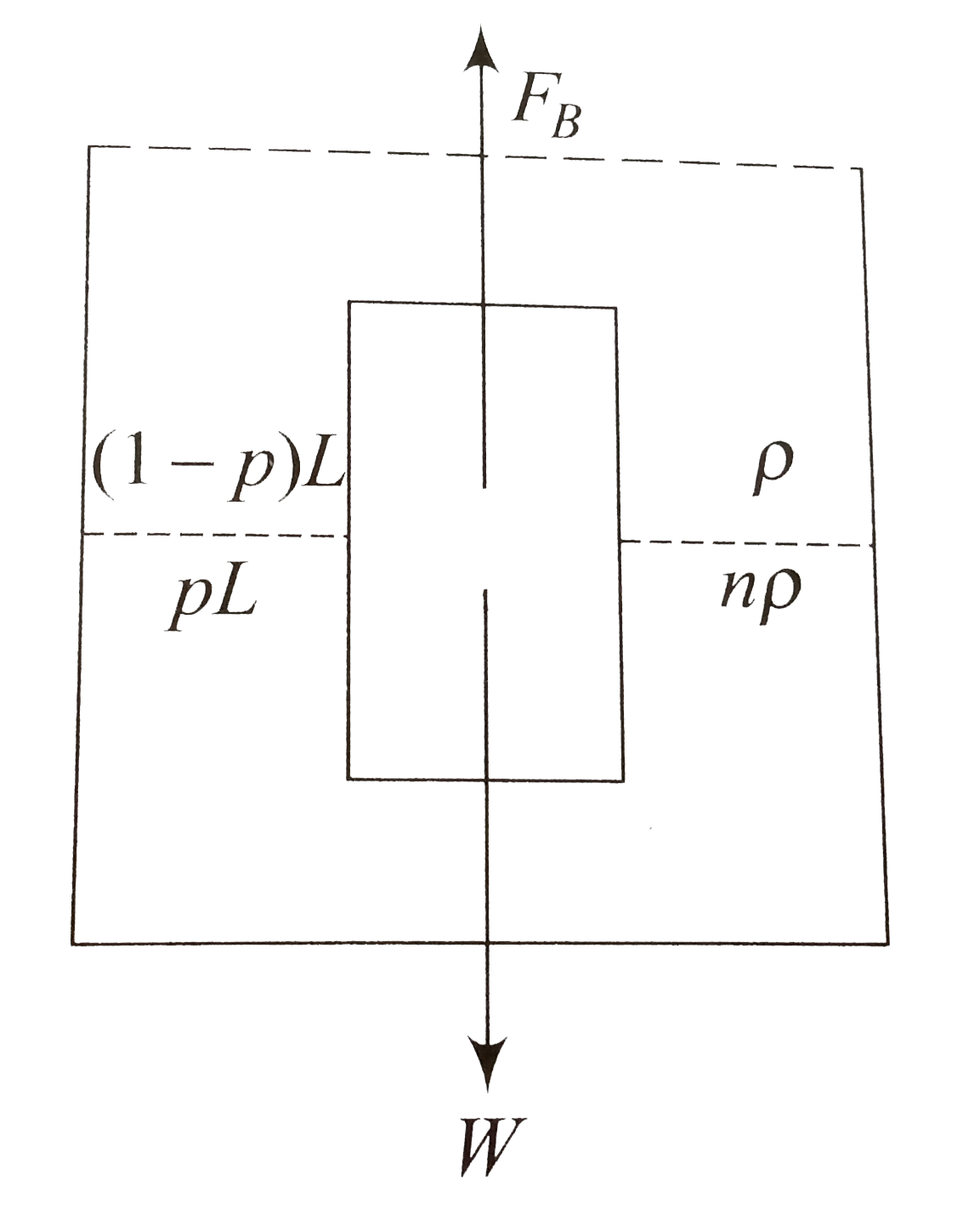
Two non-mixing liquids of densities `rho` and `(n gt1)` are put in a container. The height of each liquid is `h`. A solid cylinder of length `L` and density `d` is put in this container. The cylinder floats with its axis vertical and length `pL(p lt 1)` in the denser liquid. The density `d` is equal to :

A

`{1 + (n + 1)p} rho`

B

`{2 + (n + 1)p} rho`

C

`{2 + (n - 1)p} rho`

D

`{1 + (n - 1)p} rho`

Text Solution

Verified by Experts

`W = F_(B)`
`dALg = (1 - P) LA pg + pLA npg`
`d = P (1 - p) + pnP`
`rho [1 + (n - 1) p]`
Promotional Banner

Topper's Solved these Questions

  • NEET PREVIOUS YEAR

    CP SINGH|Exercise Solved Questions|64 Videos
  • MOTION IN A STRAIGHT LINE

    CP SINGH|Exercise EXERCISES|128 Videos
  • NEWTONS LAWS OF MOTION

    CP SINGH|Exercise EXERCISES|84 Videos

Similar Questions

Explore conceptually related problems

Liquid of density rho in a container exerts pressure P given by (height of liquid h and area A)

If equal masses of two liquids of densities d_(1) and d_(2) are mixed together, the density of the mixture is

A container of a large uniform cross-sectional area A resting on a horizontal surface holds two immiscible, non viscous and incompressible liquids of densities d and 2d , each of height H//2 as shown in figure. The lower density liquid is open to atmosphere. A homogeneous solid cylinder of length L(L lt (H)/(2)) , cross-sectional area A//5 is immersed such that it floats with its axis vertical of the liquid-liquid interface with length L//4 denser liquid. Determine (a) density D of the solid and (b) the total pressure at the bottom of the container. (Atmospheric pressure = P_0 ). .

Fluids at rest exert a normal force to the walls of the container or to the sruface of the Body immersed in the fluid. The pressure exerted by this force at a point inside the liqid is the sum of atmospheric pressure and a factor which depends on the density of the liquid, the acceleration due to gravity and the height of the liquid, above that point. The upthrust acting on a body immersed in a stationary liquid is the net force acting on the body in the upward direction. A number of phenomenon of liquids in motion can be explain by Bernoulli's theorem which relates the pressure, flow speed and height for flow of an ideal incompressible fluid. A container of large uniform corss sectional area. A resting on a horizontal surface holds two immiscible, non viscous and incompressile liquids of densities d and 2d , each of height H//2 as shown in the figure. The lower density liquid is open to the atmosphere having pressure P_(0) . Situation I: A homogeneous solid cylinder of length L(LltH//2) . cross sectional area A//5 is immersed such that it floats with its axis vertical at liquid -liquid interface with lenght L//4 in the denser liquid. The density of the solid is

A container of large uniform cross-sectional area A resting on a horizontal surface, holes two immiscible, non-viscon and incompressible liquids of densities d and 2d each of height H//2 as shown in the figure. The lower density liquid is open to the atmosphere having pressure P_(0) . A homogeneous solid cylinder of length L(LltH//2) and cross-sectional area A//5 is immeresed such that it floats with its axis vertical at the liquid-liquid interface with length L//4 in the denser liquid, The cylinder is then removed and the original arrangement is restroed. a tiny hole of area s(sltltA) is punched on the vertical side of the container at a height h(hltH//2) . As a result of this, liquid starts flowing out of the hole with a range x on the horizontal surface. The density D of the material of the floation cylinder is

A container of large uniform cross-sectional area A resting on a horizontal surface, holes two immiscible, non-viscon and incompressible liquids of densities d and 2d each of height H//2 as shown in the figure. The lower density liquid is open to the atmosphere having pressure P_(0) . A homogeneous solid cylinder of length L(LltH//2) and cross-sectional area A//5 is immeresed such that it floats with its axis vertical at the liquid-liquid interface with length L//4 in the denser liquid, The cylinder is then removed and the original arrangement is restroed. a tiny hole of area s(sltltA) is punched on the vertical side of the container at a height h(hltH//2) . As a result of this, liquid starts flowing out of the hole with a range x on the horizontal surface. The total pressure with cylinder, at the bottom of the container is

A container of large uniform cross-sectional area A resting on a horizontal surface, holes two immiscible, non-viscon and incompressible liquids of densities d and 2d each of height H//2 as shown in the figure. The lower density liquid is open to the atmosphere having pressure P_(0) . A homogeneous solid cylinder of length L(LltH//2) and cross-sectional area A//5 is immeresed such that it floats with its axis vertical at the liquid-liquid interface with length L//4 in the denser liquid, The cylinder is then removed and the original arrangement is restroed. a tiny hole of area s(sltltA) is punched on the vertical side of the container at a height h(hltH//2) . As a result of this, liquid starts flowing out of the hole with a range x on the horizontal surface. The initial speed of efflux without cylinder is

A container of large uniform cross-sectional area A resting on a horizontal surface, holes two immiscible, non-viscon and incompressible liquids of densities d and 2d each of height H//2 as shown in the figure. The lower density liquid is open to the atmosphere having pressure P_(0) . A homogeneous solid cylinder of length L(LltH//2) and cross-sectional area A//5 is immeresed such that it floats with its axis vertical at the liquid-liquid interface with length L//4 in the denser liquid, The cylinder is then removed and the original arrangement is restroed. a tiny hole of area s(sltltA) is punched on the vertical side of the container at a height h(hltH//2) . As a result of this, liquid starts flowing out of the hole with a range x on the horizontal surface. The initial value of x is

CP SINGH-NEET PREVIOUS YEAR-Solved Questions
  1. At what height from the surface of earth the gravitation potential and...

    Text Solution

    |

  2. The ratio of escape velocity at earth (v(e)) to the escape velocity at...

    Text Solution

    |

  3. Two non-mixing liquids of densities rho and (n gt1) are put in a cont...

    Text Solution

    |

  4. A uniform rope of legnth L and mass m1 hangs vertically from a rigid s...

    Text Solution

    |

  5. An air column, closed at one end and open at the other resonates with ...

    Text Solution

    |

  6. A siren emitting a sound of frequency 800 Hz moves away from an observ...

    Text Solution

    |

  7. Coefficient of linear expansion of brass and steel rods are alpha(1) a...

    Text Solution

    |

  8. The molecules of a given mass of a gas have rms velocity of 200 m//s a...

    Text Solution

    |

  9. A piece of ice falls from a height h so that it melts completely. Only...

    Text Solution

    |

  10. A gas is compressed isothermally to half its initial volume. The same ...

    Text Solution

    |

  11. A refrigerator works between 4^(@)C and 30^(@)C. It is required to rem...

    Text Solution

    |

  12. A black body is at a temperature of 5760 K. The energy of radiation em...

    Text Solution

    |

  13. A physical energy of the dimension of length that can be formula cut o...

    Text Solution

    |

  14. Preeti reached the metro station and found that the escalator was not ...

    Text Solution

    |

  15. The x and y coordinates of the particle at any time are x=5t-2t^(2) an...

    Text Solution

    |

  16. Two block A and B of masses 3m and m respectively are connected by a m...

    Text Solution

    |

  17. A spring of force constant k is cut into lengths of ratio 1 : 2 : 3. T...

    Text Solution

    |

  18. Consider a drop of rain water having mass 1 g falling from a height of...

    Text Solution

    |

  19. One end of string of length l is connected to a particle on mass m and...

    Text Solution

    |

  20. Two astronauts are floating in gravitational free space after having l...

    Text Solution

    |