Home
Class 12
PHYSICS
A totally reflecting, small plane mirror...


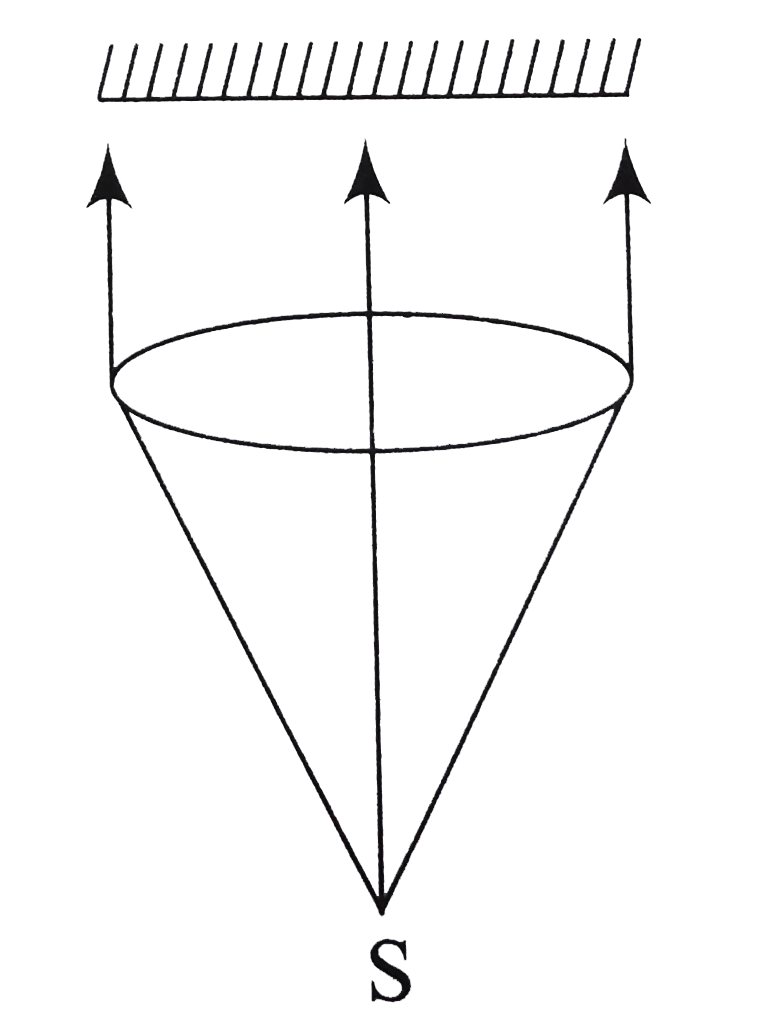
A totally reflecting, small plane mirror placed horizontally faces a parallel beam of light as shown in the Fig. The mass of the mirror is 20 g. Assume that there is no absorption in in the lens and that `30%` of the light emitted by the source goes through the lens. Find the power (in`xx10^(8)`W) of the source needed to support the weight of the mirror. Take `g=10ms^(-2)`

Text Solution

Verified by Experts
(a) Let P: power of lens. `30%` of light passes through lens and light is completely reflected.
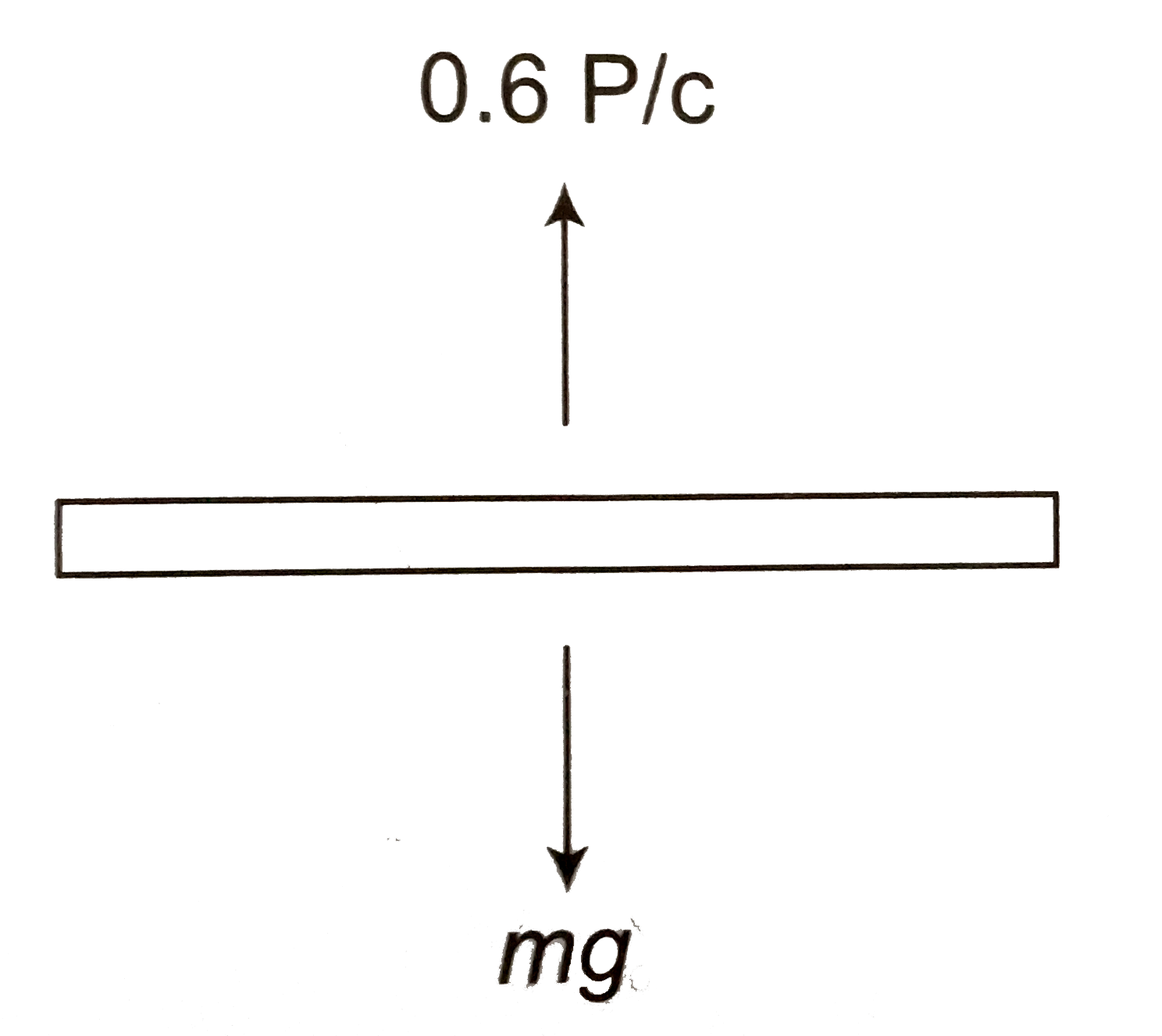
Force exerted by lilght `=(2(0.3P))/(c) =(0.6P)/(c)`
Weight of mirror = mg

In equilibrium
`(0.6P)/(c) =mg`
`P=(mgc)/(0.6) =(20xx10^(-3)xx10xx3xx10^(8))/(0.6) =10^(8) W`
(b)
Intensity of light at surface
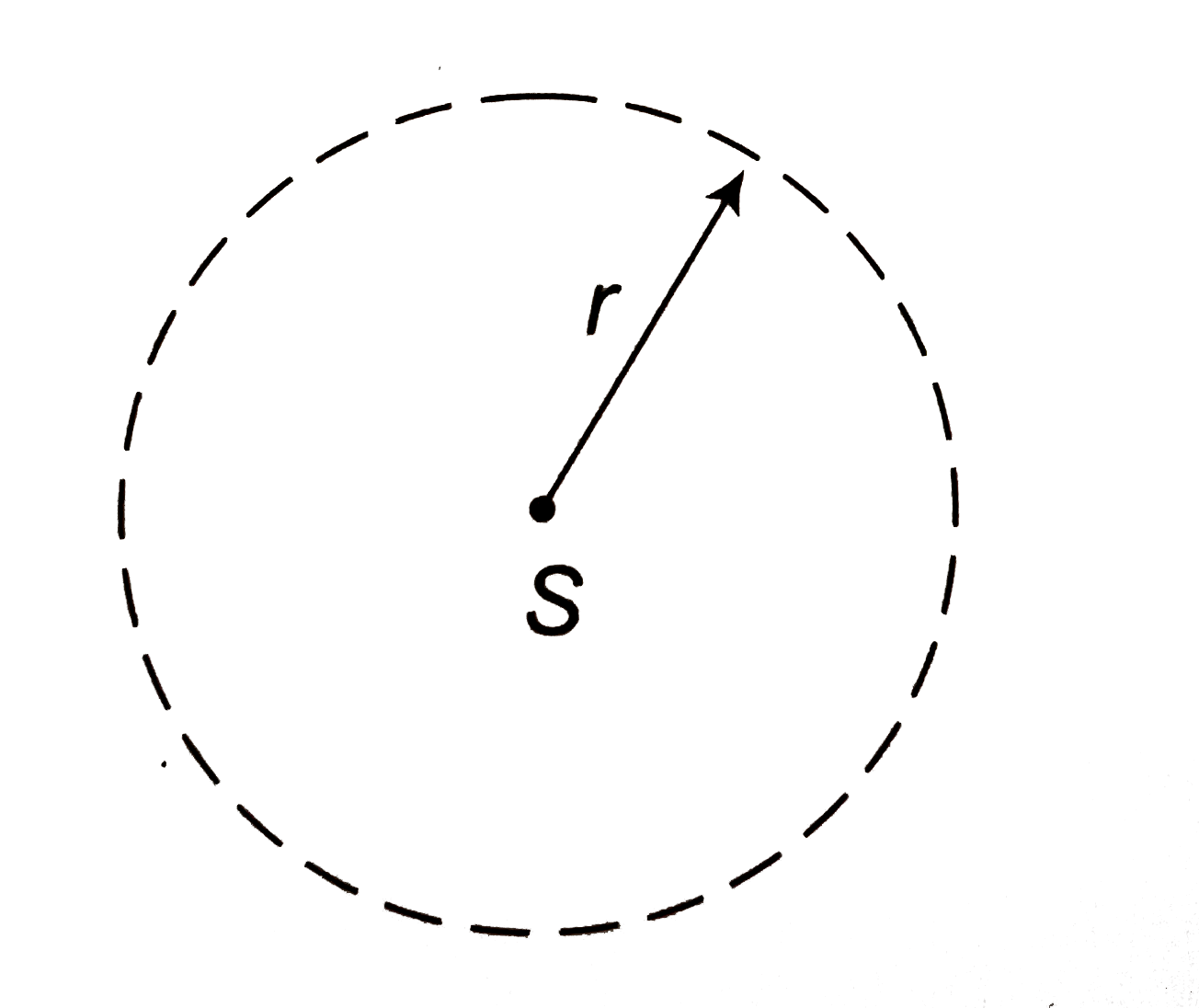
`I =(0.6P)/(4 pi r^(2))`
Pressure exerted by light
`p=(I)/(c) =(0.6 P)/(4 pi r^(2)c) =(110xx0.6)/(4pi(0.2)^(2)xx3xx10^(8))`
`=4.4xx10^(-6) N//m^(2)`
(c)
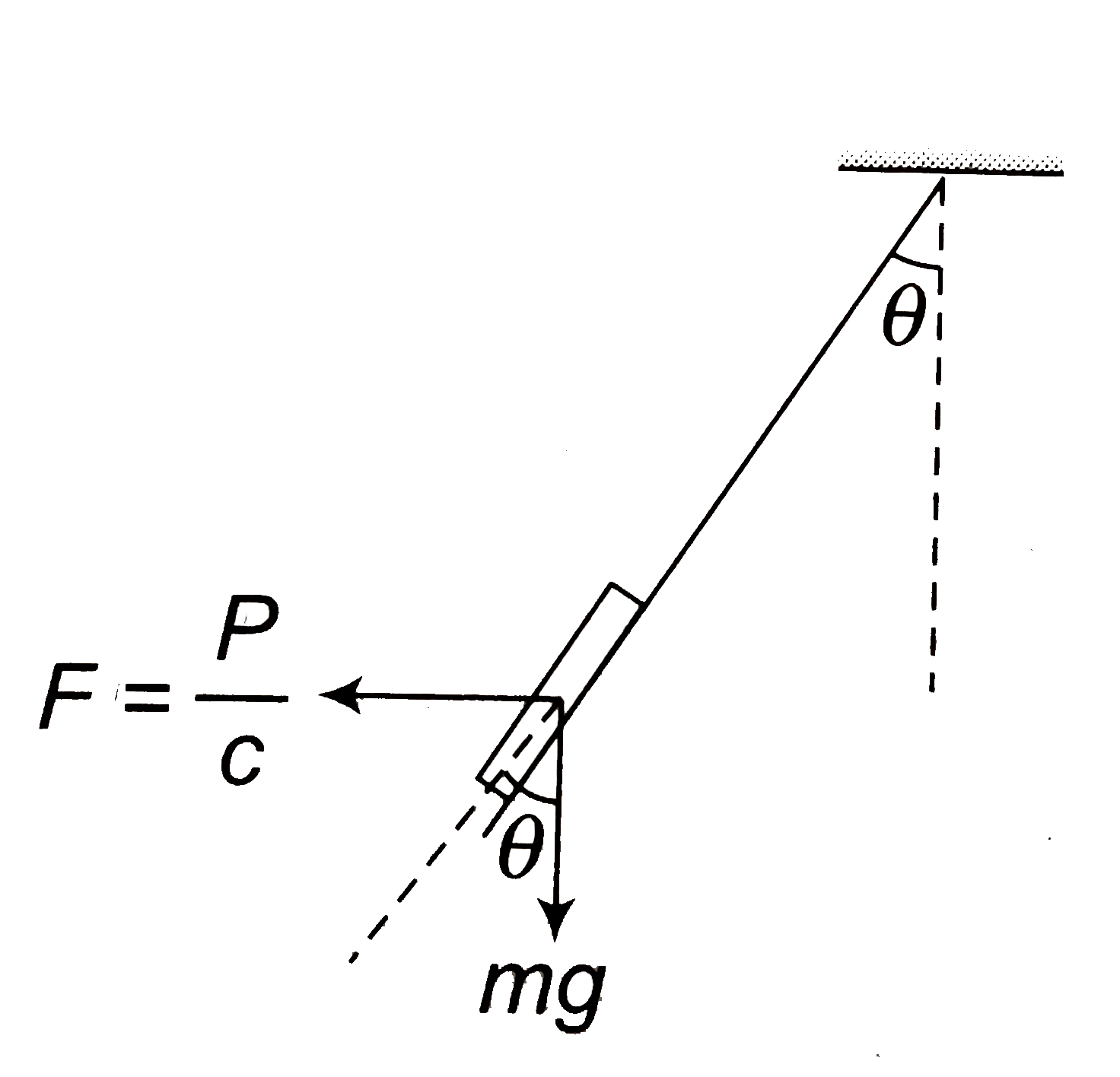
(i) Force exerted by light `F =P//c`
`tan theta =(P//c)/(mg) =(P)/(mgs)`
`theta =tan^(-1) ((P)/(mgc))`
(ii) Time period of simple pendulum
`T=2 pi sqrt((L)/(a))`
a: effective acceleration.
`a=(sqrt((mg)^(2) + (P//c)^(2)))/(m)`
`sqrt(g^(2) +((P)/(mc))^(2))`
`T =(2pi sqrt(L))/([g^(2) +((P)/(mc))^(2)]^(1//4))`
Promotional Banner

Topper's Solved these Questions

  • PHOTOELECTRIC EFFECT

    CP SINGH|Exercise EXERCISES|73 Videos
  • OPTICAL INSTRUMENTS

    CP SINGH|Exercise EXERCISES|63 Videos
  • REFLECTION OF LIGHT

    CP SINGH|Exercise EXERCISES|67 Videos

Similar Questions

Explore conceptually related problems

A totally reflecting, small plane mirror placed horizontally faces a parallel beam of lighy as shown in figure. The mass of the mirror is 20g. Assume that there is no absorption in the lens and that 30% of the light emitted by the source goes through the lens. Find the power of the source needed to support the weight of the mirror. Take g= 10 m s^-2.

A totally reflecting small plane mirror placed horizontally faces a parallel beam of light as shown in the figure. The mass of the mirror is 200 g. Assume that there is no absorption in the lens and that 20% of the light emitted by the source goes through the lens. The power of the source needs to support the weight of the mirror is P xx 10^(8) watt, where P is [take g = 10 ms^(-2) ]

A converging lens and a diverging mirror are placed at a separation of 20 cm. The focal length of the lens is 30 cm and that of the mirror is 50 cm. Where should a point source be placed between the lens and the miror, so that the light, after getting reflected by the mirror and then getting transmitted by the lens, comes out parallel to the principal axis?

A plane mirror of length 30 cm is placed horizontally along with a vertical screen. A monochromatic point source of light is placed 20 cm to the left off the left edge of the mirror, at a height of 2 mm above the plane of the mirror. If the wavelength of light used is 6400Å , then find the number of complete bright fringes formed.

The separation between the screen and a plane mirror is 2 r . An isotropic point source of light is placed exactly midway between the mirror and the screen. Assume that mirror reflects 100% of incident light. Then the ratio of illuminances on the screen with and without the mirror is

Two identical mirrors are placed in a hollow cylindrical tube as show in the figure. A light ray incident on one of the mirrors undergoes multiple reflections. In the length of each mirror is 3 m, and the velocity of light is 3xx10^(8)ms^(-1) , then find the time raken by the light ray incident on the mirror to come out of the bollow cylinder.

A point source of light is placed at 2f from a converging lens of focal length f. A flat mirror is placed on the other side of the lens at a distanc d such that rays reflected from the mirror are parallel after passing through the lens again. If f = 30 cm, then d is equal to

A source of light is located at double focal length from a convergent lens. The focal length of the lens is f=30cm. At what distance from the lens should a flat mirror be placed, so that the rays reflected from the mirror are parallel after passing through the lens for the second time?

CP SINGH-PHOTOELECTRIC EFFECT-EXERCISES
  1. A totally reflecting, small plane mirror placed horizontally faces a p...

    Text Solution

    |

  2. Which of the following is correct regarding photons? (i) A photon al...

    Text Solution

    |

  3. The equation E=pc is valid

    Text Solution

    |

  4. Let p and E denote the linear momentum and energy of a photon. If the ...

    Text Solution

    |

  5. The energy of a photon in eV of wavelength lambda nm will be

    Text Solution

    |

  6. If 5% of the energy supplied to a bulb is irradiated as visible light,...

    Text Solution

    |

  7. A hydrogen atom moving at a speed v absorbs a photon of wavelength 122...

    Text Solution

    |

  8. Let (nr) and (nb) be respectively the number of photons emitted by a r...

    Text Solution

    |

  9. A beam of white light is incident normally on a plane surface absorbin...

    Text Solution

    |

  10. Which of the following is correct regarding photo-electric effect? (...

    Text Solution

    |

  11. Which of the following is correct regarding Einstein photo-electric ef...

    Text Solution

    |

  12. As the intensity of incident light increases

    Text Solution

    |

  13. The number of photo - electrons emitted per second from a metal surfac...

    Text Solution

    |

  14. Photons of frequency v fall on a metal surface for which the thershold...

    Text Solution

    |

  15. Which of the following statements about photoelectric effict is/are fa...

    Text Solution

    |

  16. When stopping potential is applied in an experiment on photoelectric e...

    Text Solution

    |

  17. In photoelectric effect

    Text Solution

    |

  18. A metallic surface ejects electrons when exposed to green light of int...

    Text Solution

    |

  19. Lights of two different frequencies whose photons have energies 1 and ...

    Text Solution

    |

  20. Two identical photocathodes receive light of frequency f(1) andf(2) if...

    Text Solution

    |

  21. Radiation of wavelength lambda in indent on a photocell . The fastest ...

    Text Solution

    |