Home
Class 12
PHYSICS
An n-p-n transistor is connected in comm...

An `n-p-n` transistor is connected in common emiter configuration in which collector supply is `8V` and the boltage drop across the load resestance of `800Omega` connected in the collector circuit is `0.8V`. If current gain factor is `(25//26)`, determine the collector -emitter voltage and base current. if the internal resistance of the transistor is `200Omega`. calculate the voltage gain and power gain.

Text Solution

Verified by Experts
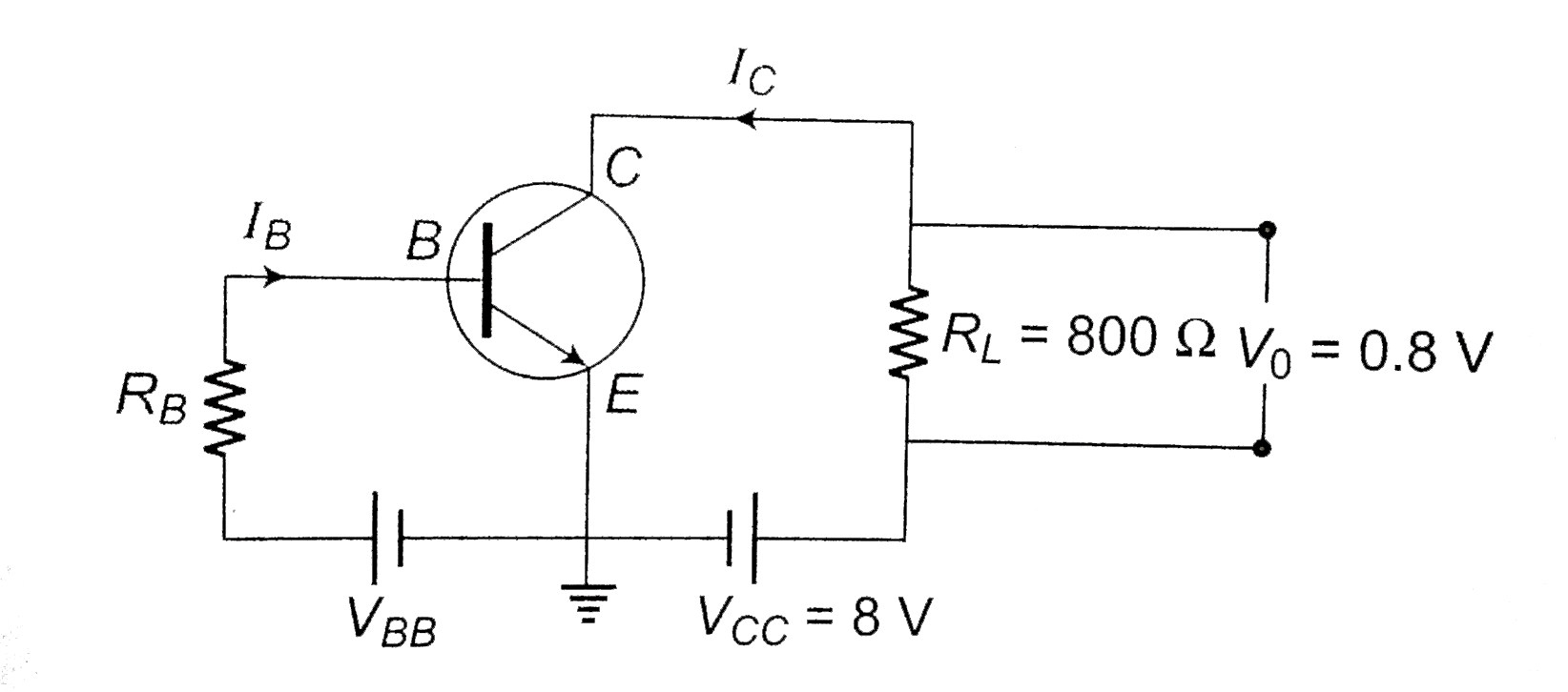
`v_(0)=DeltaI_(C )R_(L)`
`0.8=DeltaI_(C )xx800impliesDeltaI_(C )=10^(-3)A`
`V_(CC)=8-0.8=7.2V`
`alpha=(25)/(26),beta=(alpha)/(1-alpha)=(25//26)/(1-25//26)=25`
`DeltaI_(B)=(DeltaI_(C ))/(beta)=(10^(-3))/(25)=4xx10^(-5)A=40muA`
`A_(v)=beta(R_(L))/(r_(i))=25xx(800)/(200)=100`
`A_(p)=beta^(2)(R_(L))/(r_(i))=betaA_(v)=25xx100=2500`
Promotional Banner

Topper's Solved these Questions

  • SEMICONDUCTORS

    CP SINGH|Exercise Exercises|140 Videos
  • REFRACTION OF LIGHT BY PLANE SURFACES

    CP SINGH|Exercise Exercises|110 Videos
  • THERMAL AND ELECTRIC EFFECT oF CURRENT

    CP SINGH|Exercise Exercises|101 Videos

Similar Questions

Explore conceptually related problems

An n - p- n transistor is connected in common - emitter configuraration in which collector supply is 8 V and the voltage drop across the load resistance of 800 Omega connected in the collector circuit is 0.8 V . If current amplification factor is 25 , determine collector - emitter voltage and base current . If the internal resistance of the transistor is 200 Omega , calculate the voltage gain and the power gain.

A n-p-n transistor is connected in common emitter configuration in which collector supply is 9V and the voltage drop across the load resistance of 700Omega connected to the collector circuit is 0.7V. If the current amplification factor alpha is 25//26 , determine collector emitter voltage and base current. If the input resistance of the transistor is 100Omega , calculate the voltage gain and the power gain.

An N-P-N transistor is connécted in common emitter contiguration in which collector supply is 9V and the voltage drop across the load resistance of 1000Omega connected in the collector circuit is 1V. If current amplification factor is (25/26), If the internal following options is incorrect.

A transistor is connected in common emitter configuration. The collector supply is 8V and the voltage drop across a resistor of 800Omega in the collector circuit is 0.5 V. If the current gain factor (alpha) is 0.96, find the base current.

A transistor is connected in a common emitter configuration. The collector supply is 8 V and the voltage drop across a resistor of 800 Omega in the collector circuit is 0.5 V. If the current gain factor (alpha) is 0.96 , Find the base current.

An N-P-N transistor is connected in common-emitter configuration in which collector supply is 8V and the voltage drop across the load resistance of 800Omega connected in the collector circuit is 0.8V. If current amplification factor is 25/26 (If the internal resistance of the transistor is 200Omega ), the collector-emitter voltage, voltage gain and power gain are respectively.

A transistor is connected in common base configuration, the collector supply is 8V and the voltage drop across a resistor of 800 Omega in the collector circuit is 0.5V. If the current gain alpha is 0.96, then the base current is

A transistor is connected in common emmitter (CE) configuration. The collector supply is 8V and the voltage deop across a resistor of 800 Omega in the collector circuit is 0.8 V . If the current gain factor (alpha) is 0.96 , then the change in base current is

A transistor is connected in common-emitter (CE) configuration.The collector-supply is 10 V and the voltage drop across 500 Omega in the collector circuit is 4 V. If the current-gain factor (alpha) is 0.96, the base-current is

CP SINGH-SEMICONDUCTORS-Exercises
  1. An n-p-n transistor is connected in common emiter configuration in whi...

    Text Solution

    |

  2. Which of the followin is correct regarding band theroy of solids?

    Text Solution

    |

  3. In isulators

    Text Solution

    |

  4. In an insulator, the forbidden energy gap between the valence band and...

    Text Solution

    |

  5. In an insulator, the forbidden energy gap between the valence band and...

    Text Solution

    |

  6. A hole in a semiconductor is

    Text Solution

    |

  7. Electric conduction in a semiconductor takes place due to

    Text Solution

    |

  8. In a semiconductor, (i)there are no free elctrons at 0K (ii) there...

    Text Solution

    |

  9. A pure semiconductor has

    Text Solution

    |

  10. when the electrical conductivity of a semiconductor is due to the brea...

    Text Solution

    |

  11. In an intrinsic semiconductor

    Text Solution

    |

  12. Let n(p) and n(e), be the numbers of holes and condution electrons in ...

    Text Solution

    |

  13. If tempreture is increased, the number of electron-hole pairs increase...

    Text Solution

    |

  14. A strip of copper and another of germanium are cooled from room tempre...

    Text Solution

    |

  15. An electric field us applied to a semiconductor.Let the number of char...

    Text Solution

    |

  16. Solids having highest energy level partially filled with electrons are

    Text Solution

    |

  17. In semiconductors at a room tempreture

    Text Solution

    |

  18. The state of the energy gained by valence electrons when the temperatu...

    Text Solution

    |

  19. Energy band in solids are a consequence of

    Text Solution

    |

  20. Which of the following is semi-conductor?

    Text Solution

    |

  21. Carbon , silicon and germanium have four valence elcectrons each . The...

    Text Solution

    |

