Home
Class 12
PHYSICS
An electron (mass m(e ))falls through a ...

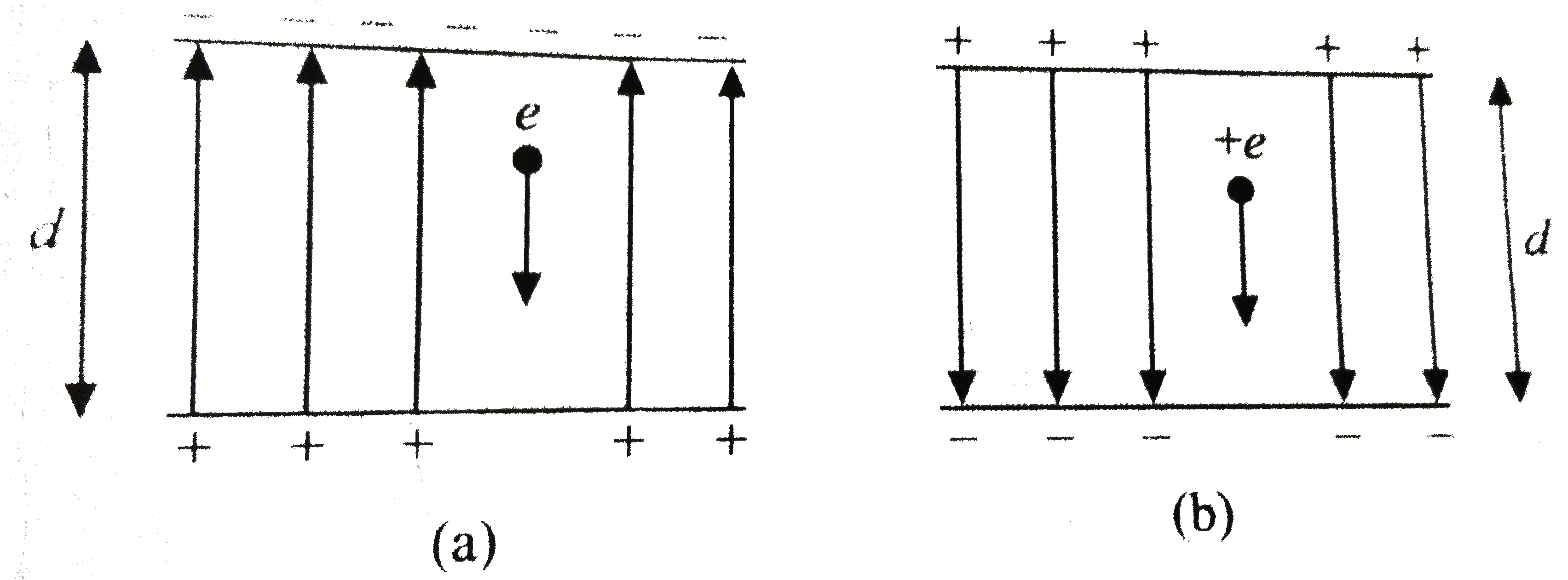
An electron (mass `m_(e )`)falls through a distance d in a uniform electric field of magnitude E.
,
The direction of the field is reversed keeping its magnitudes unchanged, and a proton(mass `m_(p)`) falls through the same distance. If the times taken by the electrons and the protons to fall the distance d is `t_("electron")` and `t_("proton")` respectively, then the ratio `t_("electron")//t_("proton")`.

A

`10` times greater

B

equal

C

`5` times greater

D

smaller

Text Solution

Verified by Experts

The correct Answer is:

D

Acceleration `=(eE)/m`
`h=1/2 (eE)/mt^(2) implies t prop sqrt(m)`
As `m_(e) lt m_(p)`, therefore `t_(e) lt t_(p)`
Promotional Banner

Topper's Solved these Questions

  • MAGNETIC FORCE, MOMENT AND TORQUE

    CP SINGH|Exercise Exercises|141 Videos
  • NUCLEAR PHYSICS AND RADIO ACTIVITY

    CP SINGH|Exercise EXERCISES|118 Videos

Similar Questions

Explore conceptually related problems

An electron falls through a small distance in a uniform electric field of magnitude 2xx10^(4)NC^(-1) . The direction of the field reversed keeping the magnitude unchanged and a proton falls through the same distance. The time of fall will be

An electron falls through a distance of 1.5 cm in a uniform electric field of magnitude 2.4xx10^(4) NC^(-1) [Fig.1.12 (a)] . The direction of the field is reversed keeping its magnitude unchagned and a proton falls through the same distance [Fig. 1.12 (b) ]. Complute the time of fall in each case. Contrast the situation (a) with that of free fall under gravity.

An electron falls from rest through a vertical distance h in a uniform and vertically upwards directed electric field E. The direction of electric field is now reversed , keeping its magnitude the same. A proton is allowed to fall from rest in it through the same vertical distance h. The time of fall of the electron, in comparison to the time of fall proton is

An electron initially at rest falls a distance of 1.5 cm in a uniform electric field of magnitude 2 xx10^(4) N//C . The time taken by the electron to fall this distance is

A proton falls dwon through a distance of 2 cm in a uniform electric field of magnitude 3.34xx10^(3) NC^(-1) . Determine (i) the acceleration of the electron (ii) the time taken by the proton to fall through the distance of 2 cm, and (iii) the direction of the electric field.

An electron and a proton travel through equal distances in the same uniform electric field E. Compare their time of travel. (Neglect gravity)

CP SINGH-NEET PREVIOUS YEAR-PAPER
  1. Two polaroids P1 and P2 are placed with their axis perpendicular to ea...

    Text Solution

    |

  2. A toy car with charge q moves on a frictionless horizontal plane surfa...

    Text Solution

    |

  3. An electron (mass m(e ))falls through a distance d in a uniform electr...

    Text Solution

    |

  4. The electrostatic force between the metal plate of an isolated paralle...

    Text Solution

    |

  5. A carbon resistor of (47 +- 4.7) k Omega is to be marked with rings of...

    Text Solution

    |

  6. A set of 'n' equal resistor, of value of 'R' each are connected in ser...

    Text Solution

    |

  7. A battery consists of a variable number n of identical cells having in...

    Text Solution

    |

  8. Current sensitivity of a moving coil galvanometer is 5 div/mA and its ...

    Text Solution

    |

  9. A metallic rod of mass per unit length 0.5 kg m^(-1) is lying horizon...

    Text Solution

    |

  10. A thin diamagnetic rod is placed vertically between the poles of an el...

    Text Solution

    |

  11. The magnetic potential energy stored in a certain inductor is 25mJ, wh...

    Text Solution

    |

  12. An inductor 20 mH, a capacitor 100 muF and a resistor 50 Omega are con...

    Text Solution

    |

  13. An EM wave is propagating in a medium whith a velocity vecv=vhati. The...

    Text Solution

    |

  14. When the light of frequency 2 v(0) (where v(0) is threshold frequency)...

    Text Solution

    |

  15. An electron of mass m with an initial velocity vec(v) = v(0) hat(i) ...

    Text Solution

    |

  16. The ratio of kinetic energy to the total energy of an electron in a Bo...

    Text Solution

    |

  17. For a radioactive material, half-life is 10 minutes. If initially ther...

    Text Solution

    |

  18. In a p-n junction diode, change in temperature due to heating

    Text Solution

    |

  19. In the circuit shown in the figure, the input voltage V(i) is 20V,V(BE...

    Text Solution

    |

  20. In the combination of the following gates the output Y can be written ...

    Text Solution

    |
