Home
Class 11
PHYSICS
A particle starts SHM from mean position...

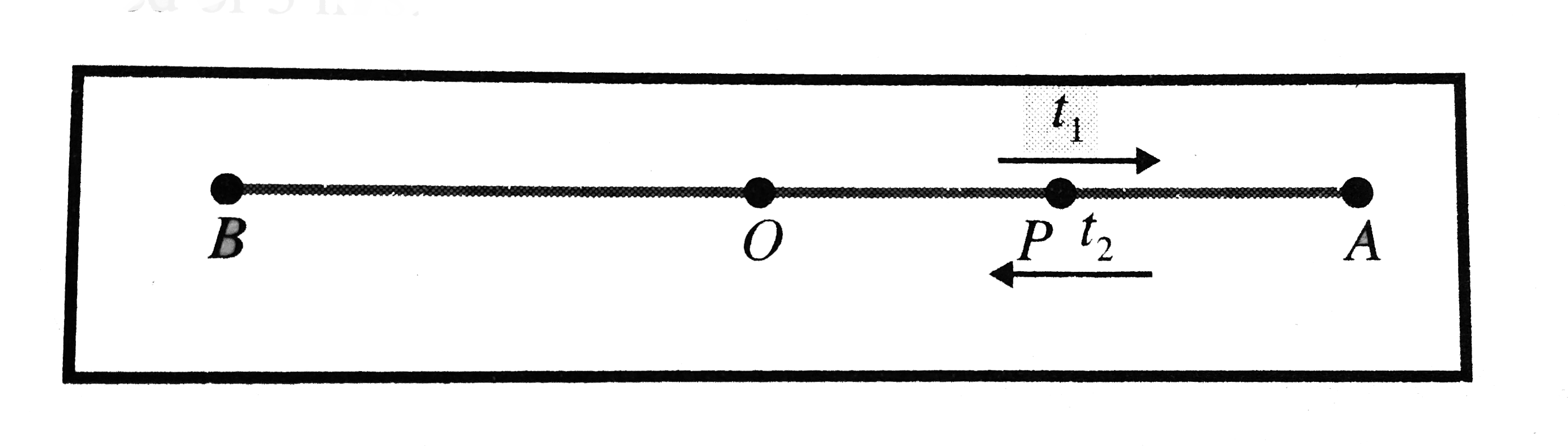
A particle starts SHM from mean position O executing SHM A and B are the two point at which its velocity is zero . It passes through a certain point P at time `t_(1) = 0.5 and t_(2) = 1.5 s` with a speed of `3 m//s`.

i. The maximum speed .......
ii. ratio `AP//PB` .....

A

`3m//s`

B

`3sqrt(2)m//s`

C

`3sqrt(3)m//s`

D

`6m//s`

Text Solution

Verified by Experts

The correct Answer is:

B

`T = 2sec, v = omega sqrt(A^(2) -x^(2)), v = 3m//sec` at `x = (A)/(sqrt(2)), v_(max) = A omega`
Promotional Banner

Topper's Solved these Questions

  • OSCILLATIONS

    NARAYNA|Exercise NCERT BASED QUESTIONS|1 Videos
  • OSCILLATIONS

    NARAYNA|Exercise MULTIPLE ANSWER QUESTIONS|23 Videos
  • OSCILLATIONS

    NARAYNA|Exercise LEVEL -II (C.W)|36 Videos
  • NEWTONS LAWS OF MOTION

    NARAYNA|Exercise PASSAGE TYPE QUESTION|6 Videos
  • PHYSICAL WORLD

    NARAYNA|Exercise C.U.Q|10 Videos

Similar Questions

Explore conceptually related problems

A partical starts SHM frommean position O executing SHM A and B are the two point at which its velocity is zero . It passes through a cartain point O at time t_(1) = 0.5 and t_(2) = 1.5 s with a speed of 3 m//s . i. The maximum speed ....... ii. ratio AP//PB .....

A particle is executing SHM on a straight line. A and B are two points at which its velocity is zero. It passes through a certain point P(APltBP) at successive intervals of 0.5s and 1.5 s with a speed of 3m/s.

(i) The acceleration (a) of a particle moving along a straight line is related to time (t) as per the differential equation (d^(2)a)/(dt^(2))=-ba. b is a positive constant. Is the particle performing SHM? If yes, what is the time period? (ii) A particle is executing SHM on a straight line. A and B are two points at which its velocity is zero. It passes through a certain point P (AP gt PB) with a speed of 3 m//s at times recorded as t = 0, 0.5 s, 2.0 s, 2.5 s, 4.0 s, 4.5 s......Determine the maximum speed of the particle and also the ratio AP//PB .

A particle is executing SHM . It passes through mean position at the instant t = 0 . At what instants the speed of it is 50% of its maximum speed?

A particle starts its SHM from mean position at t = 0 . If its time period is T and amplitude A then the distance travelled by the particle in the time from t = 0 to t = (5T)/(A) is

A and B are two points on the path of a particle executing SHM in a straight line, at which its velocity is zero. Starting from a certain point X (AXltBX) the particle crosses this pint again at successive intervals of 2 seconds and 4 seconds with a speed of 5m//s Q. The ratio (AX)/(BX) is

X_(1) and X_(2) are two points on the path of a particle executing SHM in a straight line, at which its velocity is zero. Starting from a certain point X(X_(1)XltX_(2)X) then particle crosses this point again at successive intervals of 2s and 4s with a speed of 5m//s . The time period of SHM is

A particle executing S.H.M. starts from the mean position. Its phase, when it reaches the extreme position, is

A particle starts SHM from the mean position. Its amplitude is A and time period is T. At the time when its speed is half of the maximum speed, its displacement y is

NARAYNA-OSCILLATIONS-LEVEL -III
  1. Two particles are in SHM in a straight line about same equilibrium pos...

    Text Solution

    |

  2. Two particles undergo SHM along the same line with the same time perio...

    Text Solution

    |

  3. A particle starts SHM from mean position O executing SHM A and B are t...

    Text Solution

    |

  4. A particle starts SHM from mean position O executing SHM A and B are t...

    Text Solution

    |

  5. Vertical displacement of a plank with a body of mass 'm' on it is vary...

    Text Solution

    |

  6. A particle performing simple harmonic motion having time period 3 s is...

    Text Solution

    |

  7. A partical slides back and forth between two inclined friction lesspla...

    Text Solution

    |

  8. A simple pendulum executing SHM in a straight line has zero velocity a...

    Text Solution

    |

  9. The x-t graph of a particle undergoing simple harmonic motion is shown...

    Text Solution

    |

  10. The displacement x of a particle in motion is given in terms of time b...

    Text Solution

    |

  11. Three SHO's of equal amplitude A and equal time period combine in the ...

    Text Solution

    |

  12. The potential energy of a particle oscillating on x-axis is given as U...

    Text Solution

    |

  13. A particle of mass 4g is in a gravitational potential V =(800x^(2) +15...

    Text Solution

    |

  14. A particle free to move along the (x - axis) hsd potential energy give...

    Text Solution

    |

  15. The variation of potential energy (U) of a simple harmonic oscillator ...

    Text Solution

    |

  16. A mass of 0.98 kg suspended using a spring of constant K = 300 Nm^(-1)...

    Text Solution

    |

  17. A small block is connected to one end of a massless spring of un - str...

    Text Solution

    |

  18. The mass (M) shown in the figure oscillates in simple harmonic motion ...

    Text Solution

    |

  19. A block (B) is attached to two unstriched sprig S(1) and S(2) with spr...

    Text Solution

    |

  20. A spring is loaded with two blocks m(1) and m(2) where m(1) is rigidly...

    Text Solution

    |
