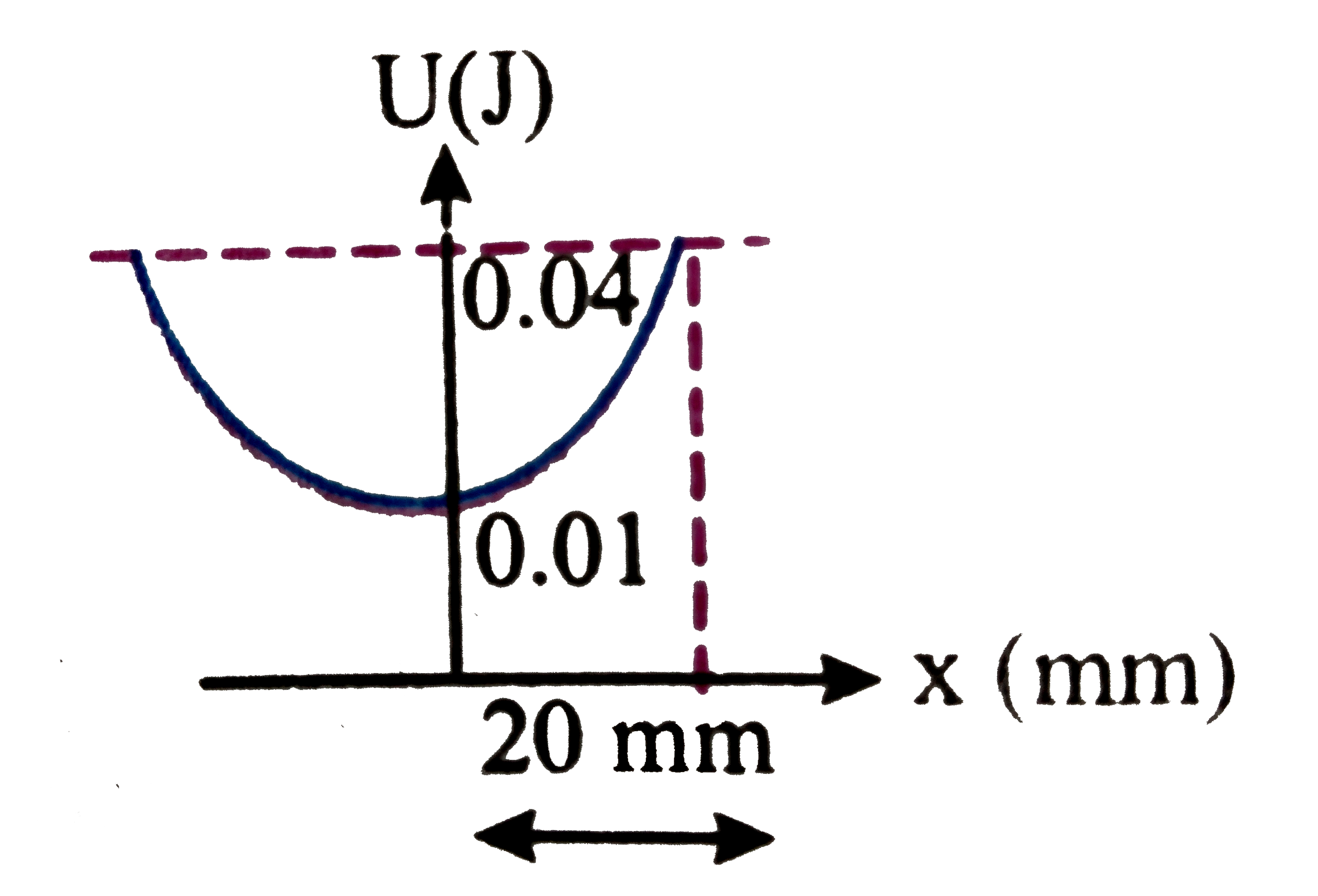
A
B
C
D
Text Solution
Verified by Experts
The correct Answer is:



Topper's Solved these Questions
Similar Questions
Explore conceptually related problems
NARAYNA-OSCILLATIONS-LEVEL -III
- A particle of mass 4g is in a gravitational potential V =(800x^(2) +15...
Text Solution
|
- A particle free to move along the (x - axis) hsd potential energy give...
Text Solution
|
- The variation of potential energy (U) of a simple harmonic oscillator ...
Text Solution
|
- A mass of 0.98 kg suspended using a spring of constant K = 300 Nm^(-1)...
Text Solution
|
- A small block is connected to one end of a massless spring of un - str...
Text Solution
|
- The mass (M) shown in the figure oscillates in simple harmonic motion ...
Text Solution
|
- A block (B) is attached to two unstriched sprig S(1) and S(2) with spr...
Text Solution
|
- A spring is loaded with two blocks m(1) and m(2) where m(1) is rigidly...
Text Solution
|
- A body of mass m is released from a height h to a scale pan hung from ...
Text Solution
|
- A block P of mass m is placed on horizontal frictionless plane. A seco...
Text Solution
|
- With the assumption of no slipping, determine the mass m of the block ...
Text Solution
|
- There is a spring with netural length L(0). Two masses m(1) and m(2) a...
Text Solution
|
- A pendulum of mass m and length L is connected to a spring as shown in...
Text Solution
|
- A small block is connected to a massless rod, which in turns attached ...
Text Solution
|
- In the device shown in Fig, the block m is displaced down slightly and...
Text Solution
|
- A tray of mass 12 kg is supported by two identical springs as shown in...
Text Solution
|
- A particle of mass 'm' is attached to three identical springs A,B and ...
Text Solution
|
- One end of a spring of force constant k is fixed to a vertical wall an...
Text Solution
|
- A simple pendulum of length 4.9m is immersed in a liquid of density rh...
Text Solution
|
- A simple pendulum is hanging from a peginserted in a vertical wall. It...
Text Solution
|